I know I should be researching or finishing or conceiving or cleaning or thanking or discussing or working on proposals. But like everyone else in the northern Northern Hemisphere, I can barely remain indoors these fine days. Because — and I hate to be the bearer of bad news here  — the days will be getting shorter in six weeks. The time to make a break for it is NOW. Out, into the city gardens and the public beaches and the urban forests.
You know you're aching to get going/growing when you and your artist friends are more enthused about a trip to Home Depot for potting soil than an art show opening. You know it when your desktop is suddenly stacked with images of art that lives outdoors, in the midst of natural and tended landscapes. We want to make, we want to be inspired but mostly we want it to all happen out there

Artists' gardens I have known may be overgrown shambles or even slightly freaky spaces but they are never manicured hedges and putting greens. They are spaces of adventure and surprise and they take me back to my artist father's East Van oasis, where my brother and I would get lost in the winding path that held treasures like his concrete head planters with greenery erupting out of the heads like Sideshow Bob hair. Artist gardens often have the feel of public art spaces in miniature, spaces of experimentation with form and materials, maquettes for possible large-scale works.
The discovery of these tiny simple sculptures in a garden would create surprise through unexpected form and the power of multiples, while referencing their particular space.
Picture
Having just finished a course in public art I’ve been thinking a lot about what makes garden art successful. Stuffing the space with curios feels like a clutter problem on summer migration. (The large-scale version of that is the charity eagle/bear/orca sculpure...thingies. Even monumental bronzes of horse-mounted Lords on expansive rolling lawns can be overlooked because they don't resonate.)

It's the site specificity and the element of surprise that makes any outdoor space sing, whether that's in the use of materials and scale, like the giant pinecones (above) that Ontario metal artist Floyd Elzinga fabricates from shovels, or the juxtaposition of the object and the natural surroundings, like the firepit below. (I'm filing this mass-produced, buy-online item, credited only to "an artist" in Tennessee, under Accidental Art.)

It's something to contemplate while I look at all the unidentifiable weedy things already going to seed in my little space. 

Picture
This globe fire pit will not be ignored  — not because of scale or materials but concept. That and the scary inferno.

Picture
This hose topiary references its particular space through use of materials and is just weird enough that it works for me. (Artist's name lost in the Pinterest jungle.)


I'm pretty sure I'm not the only one who is aching to make a break from the indoors and take it all outside. Now that the weather is improving (well, theoretically at this writing) thoughts go to how to set up an outdoor setup for sketching, fabricating, painting or plotting our next moves or just playing with materials.

In my neck of the woods, where the studio is often someplace at home due to insanely prohibitive rental fees, personal outdoor space is more likely a balcony and one that's none too private either. 
It's a challenge to carve out a little outdoor sacred space in our vertical built environment. And even if we're allowed to create some delineation, on the Wet Coast there's no point hanging billowy curtains or installing anything that would sag and sog at the first spring shower. We're looking for something attractive yet weather-proof. 
These are the kinds of things I think about when I scan all those online image collections on Tumblr, Houzz and Pinterest. There's no shortage of ideas for ideal outdoor sanctuaries, but I like the ingenious solutions, the ones that make use of all the excess lying around, like the flip-flop bead curtain composed of plugs of the foam soles in Nairobi:
This blogger composed a collage of flip-flops found on a Nairobi beach during a single morning walk, as well as the pic of the storefront with the fun foam curtain.
Picture
It's the perfect case of necessity being the mother of invention, and an inspiration to make use of what's in over-abundance locally, relying on little or no tools in the making.
And since we're in the artwork-making world, we'd rather invest in supplies than decor anyway.

It reminds me of this little project I made a few years back, after I was searching for a way to deal with the ubiquitous plastic bags that are not accepted in my building's recycling bins. I shred the bags into roughly two-inch strips with a rotary cutter (scissors work fine too), tied them together into strands, then tied one end of each strand to each eye of a simple ceiling-mounted curtain rod. Voila!: a blossom-y sun-filtering retractable screen that to this day has withstood the elements, and grows as bags accumulate.


We are to understand that being distracted is bad, and being focused is good.  Being focused will get the job done while being in the moment is not productive — productivity being the cornerstone of our prevailing Protestant work ethic.

I'm aware that it is absurd to continue measuring our national wellness by Gross Domestic Product stats and I deeply respect those ER and childcare workers who must rely on their mental agility to withstand chaotic conditions but if I'm not at least working toward producing something I start wondering why I'm even here.

I've been forced to think about the virtues of making over the last several weeks as life trumped my fastidious little production schedule. The best I could do was grab a few moments to watch from the sidelines, or catch a glimpse of work by other producers, like Eastern-Canadian metal sculptor Cal Lane whose Gutter Snipes show at Grunt Gallery wound up last week. Lane, known for wielding an oxy-acetylene torch and scrambling around 2,000-gallon oil tanks, is my kinda hands-on gal.
Picture
Photo from grunt.ca
She shows serious devotion to her work of imposing filigree patterns into found, often rusted industrial materials. It's the kind of demanding work ethic that recharges my productivity urge, but under the circumstances I had to park that and be content surfing over reviews of her work, her other shows and other collaborators, and soon, other expressions of lace as a pattern.

I'm sure that much has been written about the importance of going on a mental/physical/emotional hiatus, but I usually file that reading for later and get back to the job at hand. That's probably a sign that I may be overdosing on a devotional practice.

Since I couldn't get down to any real work I did a lot of image-surfing between things. This image of the artist's Burnt Lawn installation (right) reminds me that my serious focus can narrow the visual field.

Focusing on not focusing so much is a bit of a trial for me but I'm trying to resist the production compulsion and ride the Googleverse free-form a little more, enjoying the discussion on a related show, Lace in Translation, at Philadelphia University or viewing an interview with Lane at Grunt Gallery (at right).
Picture
Lane's 'Burnt Lawn' at The Design Center at Philadelphia University, 2010
And then I did what was only possible due to the distractedness of the last few weeks: I sat back and did nothing but watch a 12-minute video made for a 2009 exhibition of re-imagined manufactured lace that plays in the space between art and production.  Time well wasted.
Picture
Kerry Polite photo, from The Design Center


Lace Fence, galvanized PVC-coated wire, by Demakersvan, 2009. 16 panels: 152'W x 6.5'H


Picture
This week's clippings, destined for my over-stuffed sketchbook.
I’m addicted to Google Images and I’m not happy about it.

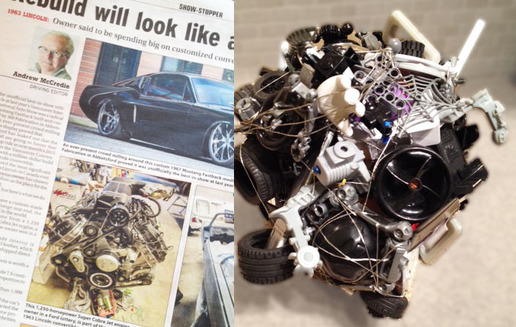
For the last several decades, most of my ideas have come from markings on wood pulp, specifically newspapers. And even though it’s now becoming almost unconscionable to sacrifice trees for the purpose of disseminating information, we’re missing out on something in the loss of the traditional newspaper format.

We’re missing an element of randomness and surprise that comes from scanning the sheets of a good newspaper full of a wide range of engaging opinion and well-researched, original subject matter. When we're used to flipping through the pages numerically, we come across whole areas of information that we're not looking for.

For most of my adult life this has involved a routine of morning coffee, three or four daily newspapers, the sharing of sections, and a lot of bitching over what’s missing from stories or the paper. It ends with tearing out a few items to share with others or add to my over-stuffed sketchbook, then bringing the stack of papers downstairs to drop on a neighbour’s doormat.

It all sounds so quaint now, and we’re fighting the losing battle to get our content without plunking screens down at the kitchen table. In fact, anecdotal evidence tells me that the rise of new media over tactile media has all but eclipsed the whole breakfast-table routine.

Newspapers were my entry point into an early understanding of public art, the global art market and art history. I would never have any awareness of the issues under those categories if I had solely relied on new media and its format of reading by topic. That method will instantly get me to what I’m looking for, but I won’t get what I’m not looking for.

I’m already mourning the stimulating visual experience of opening up the paper to a clutter of photos and fonts, opinions and statistics. I’m still clutching on to the clipping habit, still passing around pieces of paper, but I’m also getting sucked into art aggregators like Colossal and Collacubed
Picture
The Day After, 2008. Newsprint, canvas, acrylic medium.
Above and right: Two of my artworks that weave together the visual, tactile and literal elements of newspapers.

Picture
Deadlines, 2008. Newsprint, canvas, acrylic medium.
 

But the research randomness I crave is seductively being serviced by Google Images. Now, thanks to its new aggregating software, any image that I search includes a series of visually related options. No more walking to the newspaper boxes. No more sharing. No waiting. 

We used to wait for it
Now we're screaming ‘Sing the chorus again!’


(Click the arrow below to hear the song that says it all)
 
 
Picture
My not-quite-resolved plastic quilty test.
I’ve been left high and dry, marooned by a foul waste stream — a particular category of non-recycled stuff that ends up in Vancouver’s landfill.

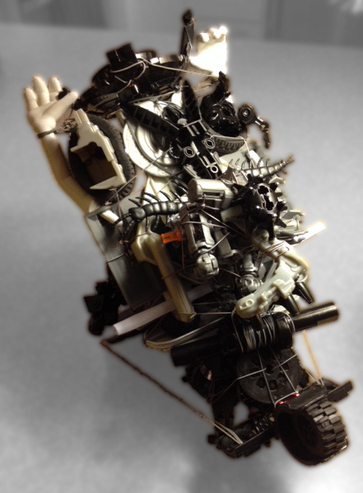
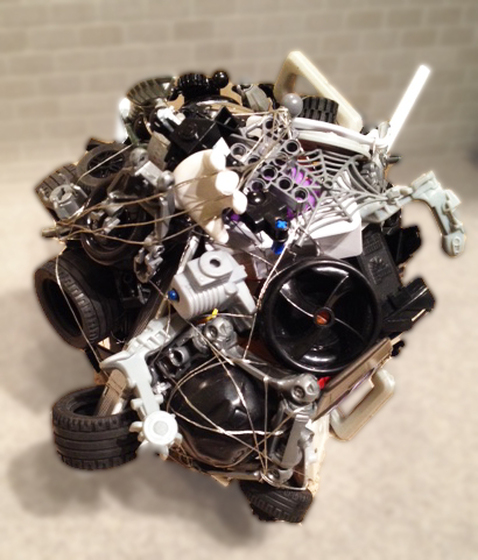
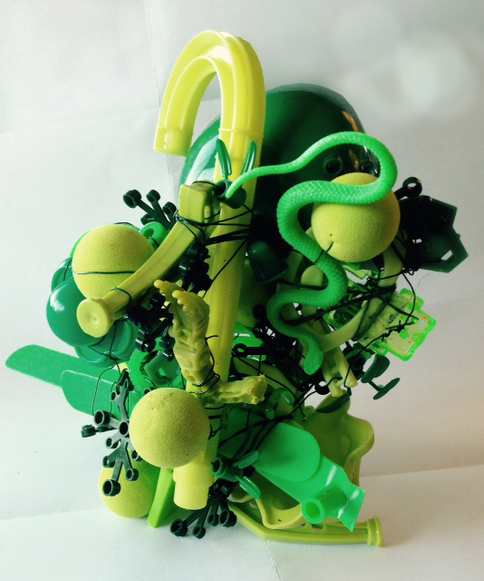
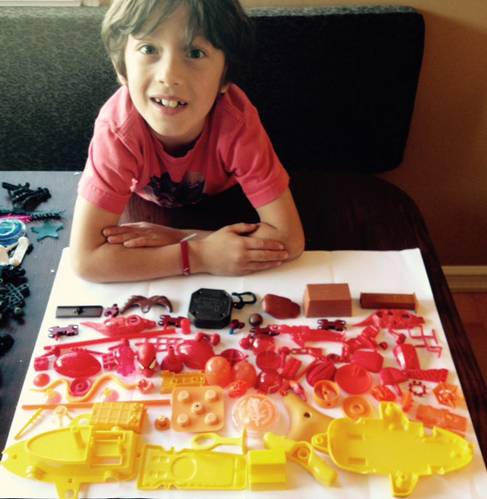
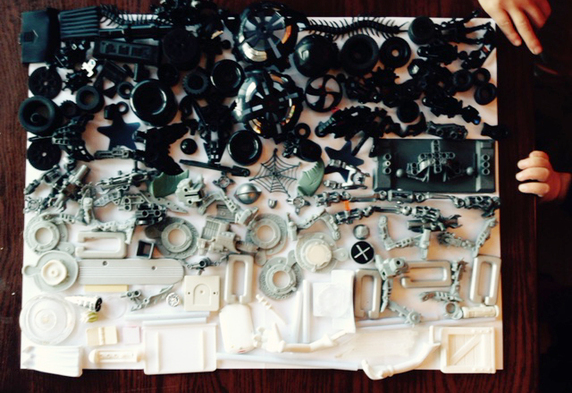
This category consists of many boxes of rigid-plastic toy bits that my nephews leave in their wake of play. I nabbed the lot a couple of years back because I loved their indeterminate shapes, their hot colours, their embedded culture. The big plan was to turn these remnants of their childhood into a scrap-quilty, uh, thing.  I never really did have a sharp objective for the objects.

But that was before I embarked on my Great Leap Forward Toward More Space campaign in January. Now the toy detritus is the last of my hoardy habit left to face down.

I’ve done the math and have realized that the number of hours required to explore and execute the various art projects that involve all these bits encroaching on my living space probably exceeds my estimated lifespan. But I have another reason for not wanting to part with the toy parts: no one accepts them for recycling in these parts, as dude at the Recycling Hotline (604-732-9253) informed me. All non-numbered rigid plastic junk is just chucked into the landfill where they will stay intact pretty much forever. 


Picture
Photo of artist/designer Adrian Draigo from www.draigo.com.
There is another option, he said; I could drive the stuff to a monthly drop-off location in another community set up by Pacific Mobile Depots, pay $7 per big bag to take it all away for use in some plastic-lumber business down the road, or I can pay $30 to arrange a pick-up. It’s a service that is probably used by a tiny minority of households —a tiny drop of effort in the plastic tsunami.

Meanwhile, the quandary is major: Until our governing bodies stop acting like whipping boys to the global petroleum industry and start regulating against the sale of non-recyclable plastic products, we’re all left to either try to make use of the stuff that’s piling up around us or stuff it into the earth.

Many designers have put the glut of a particular waste stream to good use, creating ingenious upcycled products. London-based artist Adrian Draigo, for example, creates lighting using bottle caps — another plastic reject from most recycling programs — and LED lights. The low-energy, ambient 'Glo' light can be hung anywhere, literally highlighting the issue of this ubiquitous waste product. 

It’s a new spin on the old ‘necessity is the mother of invention’ axiom, except the need that drives this innovation is not in the resulting use-object but in reducing garbage. The key to this — and every —upcycling project is creating an object that people want, otherwise it’s just waste transformed.

My urge to use the throwaways falls more within the need to visually express short-sighted (at best) and greed-driven (more likely) global production-consumption actions. The motivation to make my scrappy sculpture starts from medium and works toward idea rather than the other way around. This compulsion to dream up an idea in order to make use of the bits feels overly opportunistic, and it's why I remain in option-paralysis over whether to keep it to maybe one day use it or let it all go. That's what happens when you're confronted by this plastic problem.
Picture
photo from www.core77.com
UK artist Stuart Haygarth made good use of what showed up in his environment with his iconic “Tide” chandelier. The suspended sphere is fabricated from the plastic that washed up on a particular stretch of the Kent coastline.

The work makes it impossible not to think of the giant garbage patches swirling around the planet.

For more on that staggering reality, hit this Ted Talk:


My mother might remember this: as a kid, I once declared that I could handle a stint in jail, because I would spend the time dressing up the place by making decorations out of any old bits and pieces. 
Not a huge leap, as making something out of nothing was already my preferred activity within my own four walls, for hours at a time.

I scored stuff around the house and started fabricating, often without too much of a game plan. I recall a lot of painted papier-mache figurines made of plastic dishwashing liquid bottles, sock puppets from what may or may not have been orphan socks. This is around the first time I heard 'crepe' refer to fabric, and not just to 'paper', as in, "That was my good black crepe!"
Picture
Arntzen's models are a work of art themselves. (Photo courtesy of the artist)
I was — and still am — an opportunistic maker. I am inspired by whatever materials I come across, fabricating a lot of experiments, literally playing with ideas. In my world, that's not unusual. The other day a friend reflexively picked plastic bits from the alley while we walked. Another friend I met for coffee smiled in triumph as she held up a small battered bit of found metal, an inevitable component of a future encaustic painting.

Makers might dream of spacious studios or top-quality materials and tools to develop their concepts through doing, but a lack of all that won't keep the making from happening. In fact, restricted space and resources can lead to innovation, necessity being the mother of invention and all that.

I was reminded of this during the Eastside Culture Crawl back in November, while visiting Arnt Arntzen's steampunky workshop in Strathcona, a must-see stop for any passionate maker. Just a few weeks earlier, Arnt and artist-spouse Valerie Arntzen had just returned from six months in a small pied-a-terre in Amsterdam's city centre, so surely he wouldn't have a lot of new examples of his signature reclaimed-wood and metal furniture to show.

Yet there it was: a collection of what this famously humble industrial designer calls models for future furniture, created out of whatever he found around the city and a Leatherman pocket-sized multi-tool. They may have been modest macquettes to him, but to me they are exquisite, concrete proof that you can't keep a good maker down. Six months away from his workshop may have been hard for this hard-worker but the restriction also pushed him in another new direction, and the writing was on the walls: paintings that combine his passion for industrial design with pattern and abstraction.


Random sample of innovation with scant art materials and no tools but a lot of heart:


This would be the sequel to the New Year’s resolution post a couple of weeks back, in which I vowed to part ways with years of art projects from past classes and phases, and future artworks that just are not going to happen.

I used to help people shed their clutter for a living, so how hard could it be to take my own advice? Clear the decks and clear the mind, yada yada.

But it really does feel like a bit of my soul is being destroyed when I finally get down to chucking out a drawing or a collage, or face the strong probability that I will never master weaving or silk-screening. I know something has to give or I will be Rusty in Orchestraville, that annoying kid from the ancient record of the same name we had growing up. (Rusty kept switching instruments so he never mastered any one, and got kicked out of band. Or something like that.)

The Buddhists would say that it’s important to let go of material objects and the ego embedded in them, but I also see there’s something to learn from those past studies and explorations, so I’ve come to a workable compromise.

Thanks to one of my favourite art school instructors who required we keep a well-stuffed sketchbook for our Creative Processes class, I’ve kept up the habit. It takes me about a year to fill a spiral-bound hard-cover sketchbook with my notes, clippings, found things, sketches, pattern studies and painting tests for bigger artworks. The collection of bulging books are more important to me than any particular painting or sculpture because I refer back to those ideas and bits of inspiration as I move forward.

Cutting a section out of a painting and gluing it onto a sketchbook page feels like cutting my ego down to size. I get to keep the idea without the fetishistic need to hold on to every little thing just because I made it. 

Who knew letting go could feel so good?

Picture
BEFORE: Transforming plain cardstock paper into a multi-coloured burst pattern was a useful exercise but the finished project was just hanging around, taking up space.

Picture
AFTER: Cropping the piece and gluing it into the sketchbook gives it new dimension: a process to refer to in the future.

My sketchbooks are a happy mash-up of miscellaneous studies and processes, half-baked ideas and doodles. Weirdly chronological, they might have something to tell me down the road.
 
 
I got the gift of a visual feast for Christmas: a date to see some performance-art mastery by Cirque du Soleil. And it was no less a sensory experience than the first show I saw when Alegria debuted in Vancouver in '03.

Amaluna also has an operatic storyline but I looked past that to better focus on the abstract. Narratives can be distracting, in the same way that lyrics in music distract me when I'm in the middle of a creative process. Instead, I let the spectacle of sound, light, and unimaginable feats of the human form wash over me. 

I was close enough to the stage to feel the velocity of Olympics-level gymnasts in fiery costumes swinging through uneven bars while others scrambled below and pushed them into the air, in a kind of choreographed chaos in the dark void, set to a hard-rock soundscape and mesmerizing light show.

This is my kind of Olympics. All of the technical ability but none of the brutal, singular competition and nationalism. No instant-replayed technical errors, no ranking, no tears, but instead a slightly psychedelic viewer experience of human physical and creative potential.
Picture
Acrobatic coach Stacy Clark told thestar.com that she challenges the highly trained gymnasts to find ways "to strip away some of the intense discipline they had as a gymnast and turn it into a much more expressive experience."

I could see it on the faces of the mostly female cast from as far as China, Japan and Russia that they were fully engaged. Some of those talents were not found in elite training schools but  in the world's most egalitarian performance space: YouTube. 

Picture
Compared to Cirque, Olympics gymnastics — and the whole Games — feel too hard-core, too political, even fascist. 

But I have to admit I'm a little puffed up with nationalistic pride myself as this wildly successful French-Canadian company displays new possibilities for showing off what bodies can do in creative collaboration.


A taste of Amaluna:
 
 
Picture
Mukai has been quietly working and reworking her paintings and drawings for 30 years.
Painting feels a lot like grasping for words to me. There’s general comprehension there, thanks to some study, but I don’t have enough command of my own visual language to express myself with eloquence. It’s like there are gaps in vocabulary.

This is why I often leave well-curated gallery shows humbled (on a good day) or discouraged (most days). Still, there's the possibility of an epiphanic moment, like the one I had last month at an opening at Trench Gallery, just east of Gastown.

The Alchemy of Practice was a collection of the mostly unseen drawings and paintings by an artist I was not familiar with: Amy Mukai (whose only google presence is in relation to this show). Friends and I moved around the gallery perimeter, peering at the intricate and subtle spatial puzzles and geometric patterns done in acrylic gouache, ink, or oil on paper until we bumped into the show’s curator, Craig Sibley, who told us he recognized the exquisiteness of the never-before-shown works when he was visiting her husband. Mukai created them between going to art school in the ‘70s, raising a family, getting a biology degree and doing pollination research at SFU. The artwork is something she did for herself, quite removed from the show-and-tell scene.

It was another example of the Malcolm Gladwell rule: it takes 10,000 hours of practice to master a skill. Mukai’s devotion to her subject matter built her a fully realized body of work that revealed a fluency in her visual language.

And here’s where the epiphany hit: It doesn’t matter if you have a list of show credits; it’s the practice that counts.

Mukai was there at her opening, but I was a little shy to say hi, and she seemed a little shy herself. Then there’s the problem of what to say after “Great show” without putting her on the spot. But I would have liked to say that this show has inspired me to brave the obscurity, to ignore the art trends, to keep practising communicating between heart and head and hand.

Picture


Mukai's very personal works have a fully realized language of their own.


A friend of mine was a little obsessed with cleaning her carpeting in the condo she brought brand new several years ago.  She seemed to be at constant war with her wall-to-wall. I always assumed it was her strong design aesthetic that drove her to splurge on a top-of-the-line vacuum-cleaner but I couldn't figure out the vacuuming fetish. This month she finally broke the bank and had it all ripped out and replaced with wood floors. The installer sucked up 12 shopvac cannisters of dust from her two-bedroom unit. Clearly the carpet was installed before the unit was cleared of debris. Not really surprising if you live in a building that flew up in a condo boom, which is sort of how it happens in Vancouver.

A family member in the construction business says that when you're part of a crew that is told you have to finish up and be out of one condo project by a Friday and show up at another on Monday or lose your pay, you do more than just sweep it all under the rug; you chuck all the bits of building stuff into the walls and drywall over the problem. If it were not for the whistle-blower involved in the Athletes Village mega development the uninsulated pipes hidden behind drywall would be leaking through several buildings by now.

Which brings me to "juxtaposition," a key term in post-modernism that speaks to issues of globalism and consumerism in relation to art.
Picture
Bloom tables: Salvaged Western Red Cedar tree stumps filled with creamy organic resin
Against this backdrop of some seriously shoddy workmanship — even within those hastily-completed interiors  — is a considerable number of talented, skillful designers who spend their days creating furniture pieces of supreme workmanship and beauty, as evident in last weekend's Eastside Culture Crawl. The Bloom tables (right) by Mth Woodworks and Peter Pierobon's Plumb Pendant cedar lamps (below) lie in juxtaposition to the slap-dash boom-town antics.

Picture
Against the clutter of cranes marking the current boom, these visual poems are more than lovely use items; they provoke us to consider the role and value of art in society.
They are fully realized form and function against a speculative-market-driven built environment.