carlyn yandle
  • about
  • the creative process
  • crafted objects
  • public art
  • painting
  • exhibitions
  • contact

public art exposed: a peek behind the scenes at new show

8/29/2014

Comments

 
It's one thing to dream up an idea for the back end of the elevated Canada Line track and quite another to see that dream come together in a mammoth aluminum sculpture.
PictureMetal fabrication at the Select Steel shop, Delta. Carlyn Yandle photo
So when I got my first glimpse of the progress of Cluster at the metal fabricators this week, the piercing clang and whine of the shop suddenly seemed to give way to the theme from 2001: A Space Odyssey. 

Whoa.

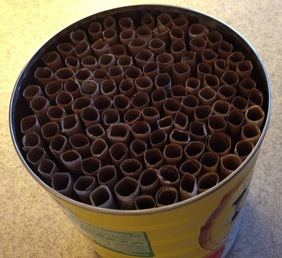
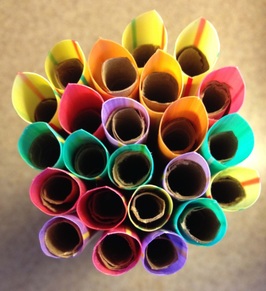
It was exactly as I had imagined it, except for the immensity. That something so voluminous could come out of a bundle of bubble tea straws was sort of short-circuiting my brain.

Well?, their faces seemed to ask.

"It's... very... big," I said, immediately thankful their earplugs spared them from hearing the bleeding obvious. 

PictureCluster concept sketch (image by Carlyn Yandle)
Of course, no one sees these moments of shock, nor all the anxiety, revelation, frustration, obsession typical of the emotional swings that go into the creation of public artwork. When Cluster is hoisted into position next month, its narrative will be in the eye of the beholder, its entirety read in an instant.

But a new Richmond Art Gallery exhibit (opening next Friday evening, Sept. 5) is pulling back the curtain on the process behind five public artworks that dot the city, in its City As Site show, curated by RAG director Rachel Lafo. Here is where visitors will see evidence of the beginning of the ideas that were pitched, developed, reworked, and finally translated into forms for public placement. Combined with that focus is a survey of all artwork in the local public sphere that is defining Richmond as not just another clutter of condos but a specific space in a particular time.

PictureMetal fabricator Jordan Thys at work. (Carlyn Yandle photo)
For me, laying bare some of my half-baked early concepts and awkward sketches that led to the development of Cluster (as well as the Crossover crosswalk design) is slightly uncomfortable but this is a warts-and-all display. Not shown is the high level of trust that must exist for any collaborative project to succeed: trust in one's own ideas, the physical properties of the materials, the skill and temperment of  fabricators, the foresight of structural engineers, and the patience of the commissioning bodies. Public art projects come with the headache-y package of  issues of insurance, permits, budgets, timelines and many unforseeables. In short, it's much more than a good idea.

Embedded in those physical projects is the intangible quality of faith. Cluster isn't done yet, but I have faith that it will soon be a thing in the manufactured landscape that will spark conversation, which will connect people and by extension contribute toward a unique, vibrant community and cultural hub.

Fingers crossed anyway.


Picture
Comments

Memorable designs discovered on road trip

8/14/2014

Comments

 
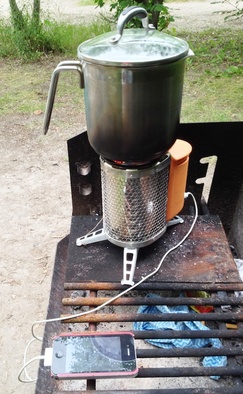
PictureCarlyn Yandle photo
We were a bit of a spectacle, using survivalist technology outside our tent wedged between the humming, air-conditioned RVs,  but we were aching to use our car-camping trip to finally test the BioLite.

And it was good. (See 26-second YouTube review, below.)

The Sputnik-esque stove converts the energy of any post-disaster carbon-based material  — paper, leaves, cardboard, grass, wood shards — into a USB-port power source while boiling water in minutes. Yes, you can have your coffee and call home too, thanks to an  ingenious copper conductor-fan system that kicks in when heated and then turbo-charges the tiny fire into a flame as good as if you're cooking with gas.

The brilliance of this design was not lost on residents of Lower Manhattan who were plunged into cold, damp darkness for days after Hurricane Sandy struck in October 2012. 

The young Brooklyn inventors rushed  to the rescue with stoves for stranded people who needed a hot drink, social interaction, a way to call family. Emergency services didn't take too kindly to open fires during the chaos and so the BioLites were banned.

We first spotted the gizmo a month after the area was ravaged, in a New York Times article and made it our Christmas present. Good design endures; now Mountain Equipment Co-op carries it.
PictureCarlyn Yandle photo
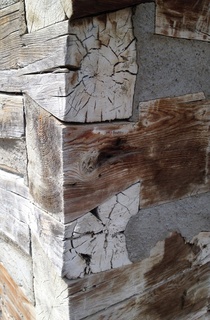
And bad design disappears, or makes the bad design lists. That's why you don't see lawn darts anymore. But old, ingenious design isn't always readily apparent until you really feel it, like the moment we walked into a century-old log cabin and suddenly forgot about the blistering South Saskatchewan heat. Thick walls of almost petrified dovetailed wood and mortar were doing the same trick as energy-squandering air conditioners back at the campsite, except without the drone that was keeping us awake at night.

The rough-hewn angled dovetail joinery, used in various forms in traditional building around the world, succeeds in all aspects of good design. This settler cabin used local, renewable materials, and simple tools and easily-learned methods. The undeniable beauty of those checked cross-sections of silvered lumber, enhanced by age and the elements, is made possible through the collective creative process.
PictureCarlyn Yandle photo
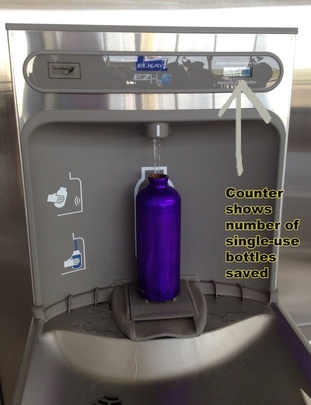
Good design answers a need. And during a heatwave, that need is drinking water. We spent much of our trip looking for a place to fill up our water bottles but it seems that in the rural areas at least, most people still buy the 48-pack of single-use water bottles at the ubiquitous Co-op stores. There oughta be a law to provide ample drinking water in public areas, but I digress.

This beauty (right) in the Saskatoon airport departure lounge does the trick. A motion sensor triggers the water to flow while a counter shows how many plastic bottles were not used in the process. 


PictureCarlyn Yandle photo
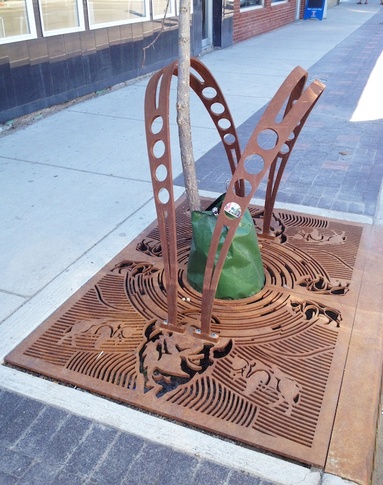
At least the young trees were getting hydrated; in Moose Jaw, a bagged water system seemed to be winning the war against the elements. The surrounding corten steel framework serves as a rain-friendly grill featuring historically significant images of bison/buffalo, trunk protection as the tree grows, and bike lock-up. What's not to love?
PictureCarlyn Yandle photo
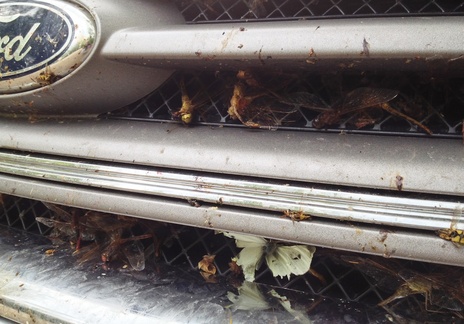
The one deadly design that haunts me still is the private automobile, a lethal projectile from the point of view of the native large grasshoppers, butterflies and dragonflies (and at least one starling and one small rodent). We tried to avoid looking at the critter mash on the grill at the end of each day but we have their blood on our hands. Their little corpses are reminders that the car is not designed with nature in mind. Next time, bike camping, where RVs fear to tread.
Comments

everyday video footage — with a conceptual twist

7/18/2014

Comments

 
Now that we're all carrying around the equivalent of movie cameras and photo-editing studios in our pockets and purses we are each potential blockbuster or documentary filmmakers, iMovie-ing and uploading all of life's activities that have become performative acts.
YouTube boasts 100 hours of video uploaded every minute but like digital photography devalued the actual, tactile photo album, the bombardment of everyday video footage has reduced the essential beauty of the captured moving image. What was once the miracle of the moving image is now a lot of space-hogging files we fail to manage well.

Shooting video is as easy as a screen swipe, but finding the art in what's being shot has created genres of filmmaking that surely has the Spielbergs, Lucases and Coppolas included in the one billion viewers glued to YouTube every month.

I'm addicted to capturing the cute moments of every kid in my life, but with everyone else filming countless hours of other moments of those same kids, I'm fully aware that my shots of kids at dinner, kids playing catch, kids dressing up, kids watching the World Cup, kids rolling out pizza dough, kids acting in skits, and kids with other kids may carry little value or interest in 20 years. More likely, we'll all be using some new interface model by then and all our .MOV  and M4v files will be too obsolete to translate. Or iCloud and Google Cloud and all the other cloud-like storage systems will crash in a great grid-locking e-storm and I'll have nothing left to show for all my years of hunchy running around the perimeters of play.
Picture
8 Days, 2013, installation at Vancouver Art Gallery Offsite. Photo: Rachel Topham, Vancouver Art Gallery
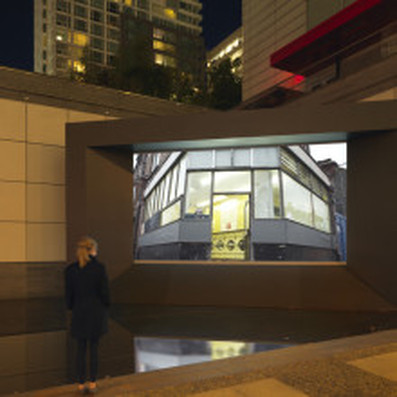
What will remain is a new way of seeing, understanding and playing with moving images of the everyday. It's why the plastic-bag-in-the-wind scene from American Beauty still sticks in the head. It's why Mark Lewis' real-time videos of landmarks and laundromats  resonated with the public when they were screened over the winter at the Vancouver Art Gallery's Offsite (top).

For me, it's a new kind of sketching (see above) that is not made for public viewing but for my own reference. For what remains to be seen. (YouTube vid, above)

Below, some other inspiring videos of the everyday seen with a fresh and critical eye:
Comments

deadhead alive with ideas of our watery past, uncertain future

6/27/2014

Comments

 
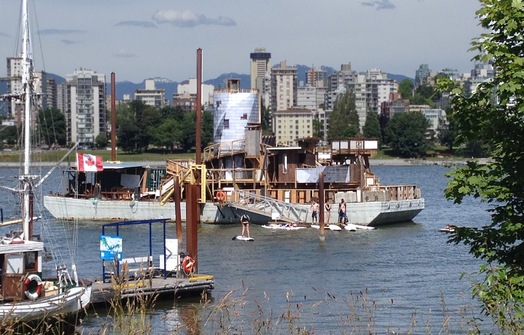
PictureLike moths to a light, paddleboarders hover around Deadhead. (Carlyn Yandle photo)
On one rambling two-hour bike tour of False Creek Sunday, a friend and I cruised by the Dragonboat festival, the jazz festival and the food truck festival. Granville Island was foody festive. Kits Beach was body-festive. When everything is awesome we found some  visual relief in the form of Deadhead, a chaotic sort of pirate ship/treehouse combo straight out of Waterworld.

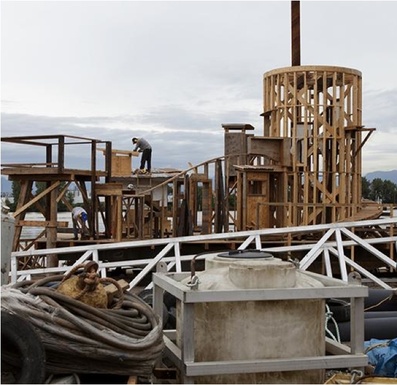
Except this floating sculpture is not a big-budget flop. In fact, this curious floating object that is currently moored at the Heritage Marina in front of the Vancouver Maritime Museum makes use of wood salvaged by Cedric Bomford, with his retired engineer father Jim Bomford and artist brother Nathan Bomford.

PictureDeadwood under construction. Photo: Maritime Museum
Deadhead is anti-slick, a welcome switch from the Disney and Celebrity Cruise floating cities that are part of the local summer scene. 
The mash-up of spiral stairs, lookouts and ramps make this a magnet for curious kids, and a good introduction into what public art can look like.

An open house (or open barge) is slated for next Saturday (July 5), 2-5 p.m. with sig­nal flag work­shops running at  2, 2:30, 3, and 3:30 pm
Sat­ur­day July 5, in Her­itage Har­bour and at the Van­cou­ver Mar­itime Museum, just off the south side of the Burrard Bridge — a good excuse to use the new bike lane).

More photos showing Deadwood in process here.

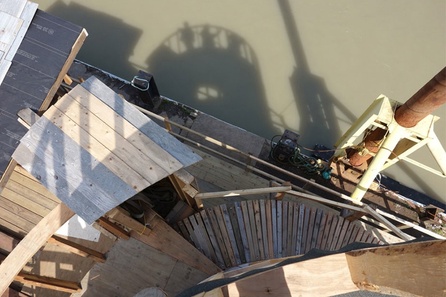
PictureView from the crowsnest. (Photo from http://deadhead.othersights.ca/)
Just when I was sure every last skilled carpenter has been sucked up north to Kitimat, or further, to Fort McMoney, it's with some relief to see local builders constructing something for the purpose of art.

I love a sculpture that is both playful and foreboding. It speaks of the imagination of kids and the hands of skilled makers with means, but it also evokes our shared history of makeshift dwellings in the watery part of the world, and a climate-changed future we'd rather not imagine.

Comments

How not to crash at the big art shows

5/9/2014

Comments

 
The mammoth art museum experience is like an all-inclusive resort for the mind: there's so much coming at you the brain binges 'til it can't party anymore. 

Unless you're an art history major, what's hanging on those soaring walls and placed on those marble floors at the big art palaces like the Louvre, the Rijksmuseum and The Met is filled with cranial-clanging mystery, intrigue, obscurity, beauty and repulsion that can crash the whole neural system in something approaching Stendhal Syndrome. There's only so much visual field one garden-variety brain can take in. You need to pace yourself, preferably over several days. 
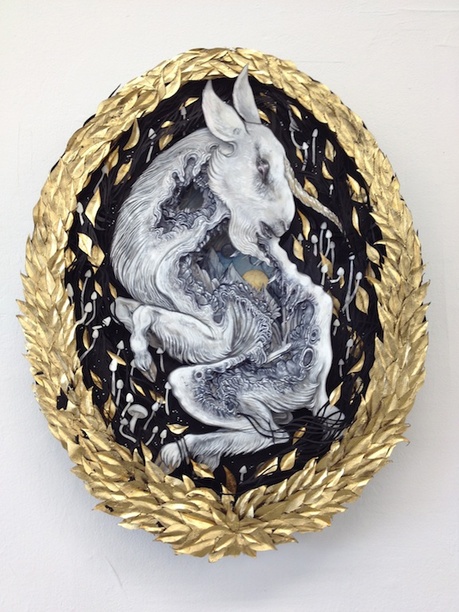
PictureAlison Woodward's emblematic, multi-layered drawings suggest carcasses.
Same goes for big education-institution shows so this is the how I tackle the annual Emily Carr University Grad Show, now open daily until May 18 on Vancouver's Granville Island.

With hundreds of final works in media arts, sculpture, industrial design, ceramics, illustration and visual arts packed into two buildings I take the cavernous rooms of randomness in small bursts over a few days, usually with one friend at a time — a sort of playdate. But the only thing organized about this date is the area of creative work we're going to linger in. It's the difference between sports on a school field and free play in the forest. 

The real play is in the conversation that is sparked just by being in the milieu of this cacophonous visual field. It might start off as first impressions of an individual piece but often ends up in a whole different kind of thinking, and that's where the exhilaration lies. It's all just as important in the creative process as working in the studio.

The beauty of online column-writing is infinite space, so, in the spirit of the gargantuan art museum and its daunting theme-free collections, as well as the need to let the brain out to play, I present here a few of my own pics of emerging visual artists at this year's Emily Carr grad show whose works contest the two-dimensional tradition.

Picture
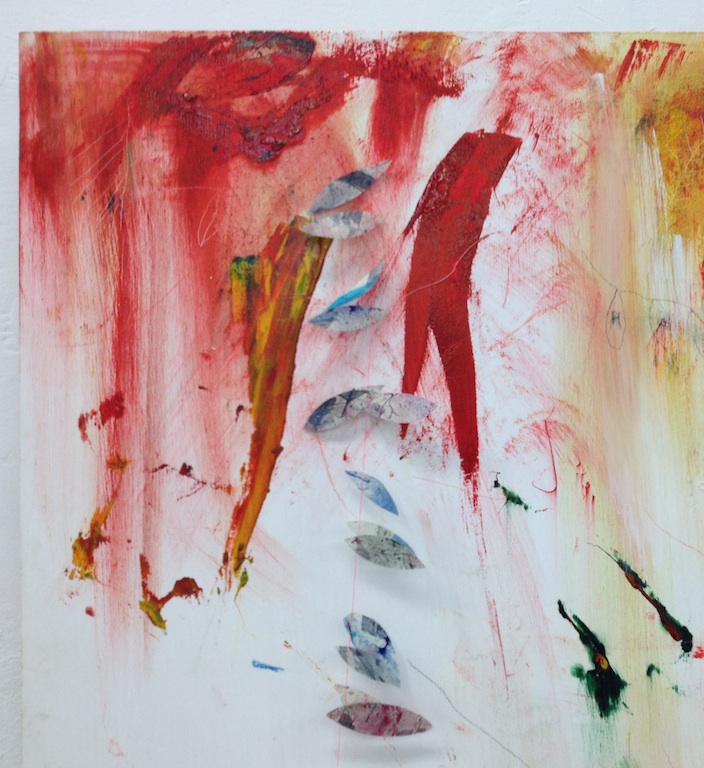
A detail from Jessica Probyn's large gestural painting reveals a threaded leaf-shaped garland.
Picture
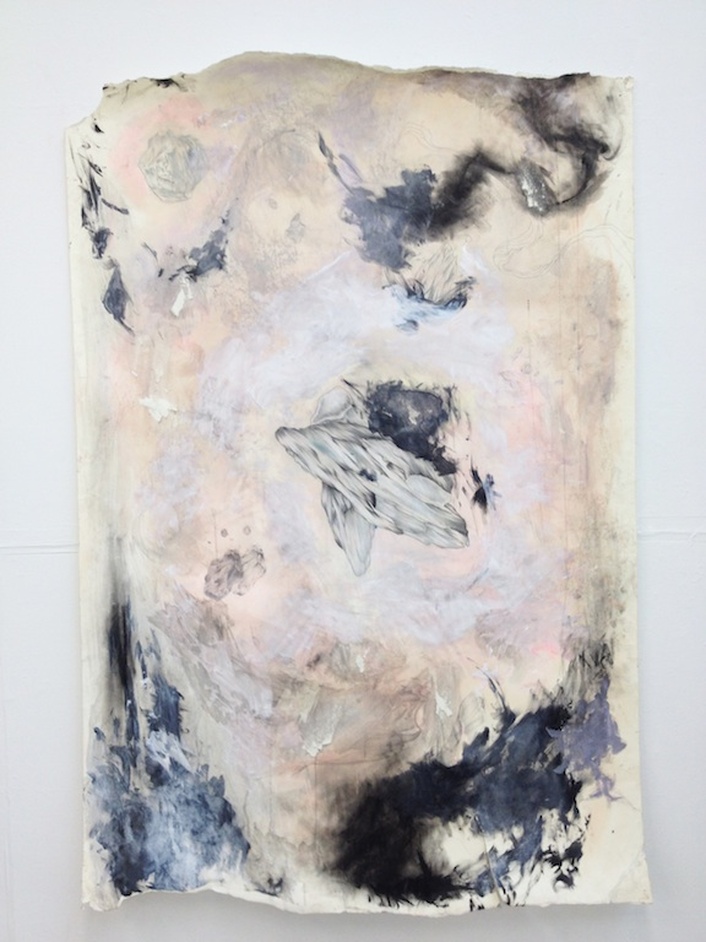
The ethereal effect of Colette Stubbings' large 'Channeling Dreams' is enhanced by a ground of creased, ripped and crumpled paper.
Picture
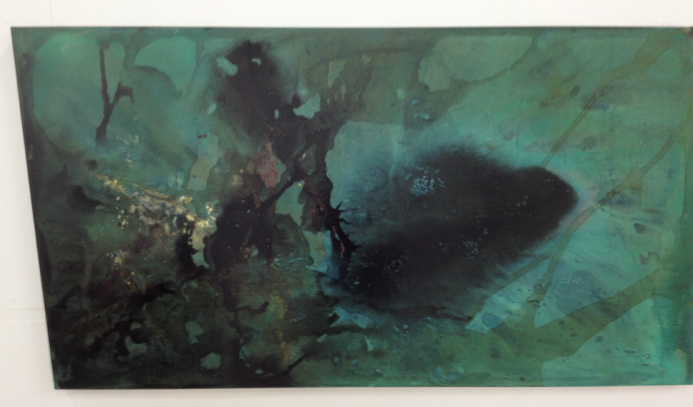
Rose Fior's 'Ominous I' is an off-square panel that includes areas of gouging, thin washed and dimensional globs of paint.
Picture
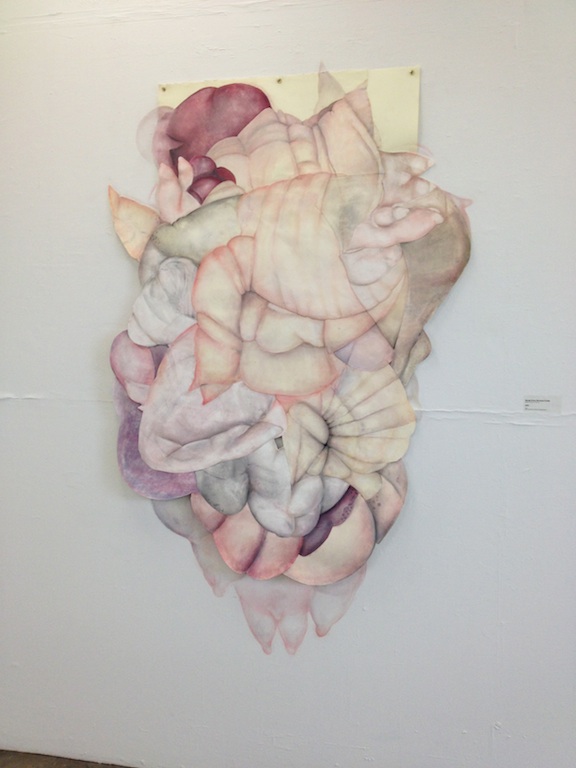
The visceral subject of Sarah Erica Berman Goble's work moves from two grounds of paper to the wall itself.
Picture
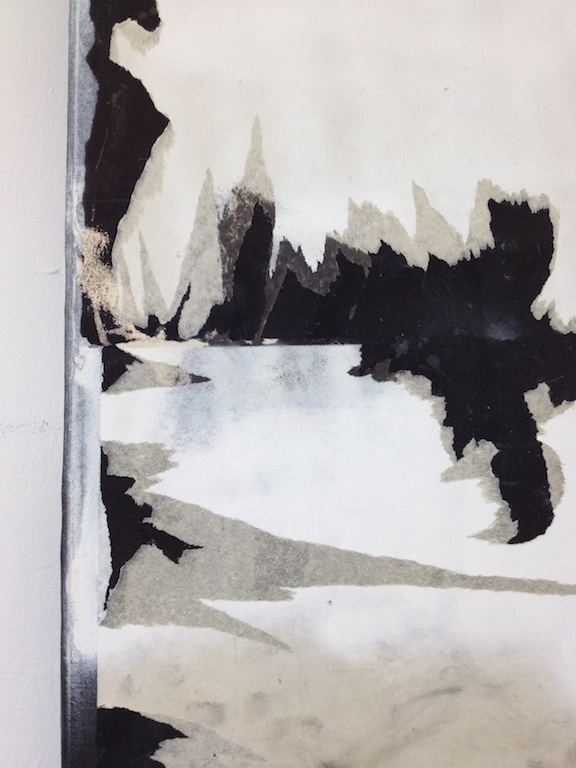
A detail of Scott Lewis' inked, ripped paper on canvas evokes both disputed public spaces and stark landscapes.
Picture
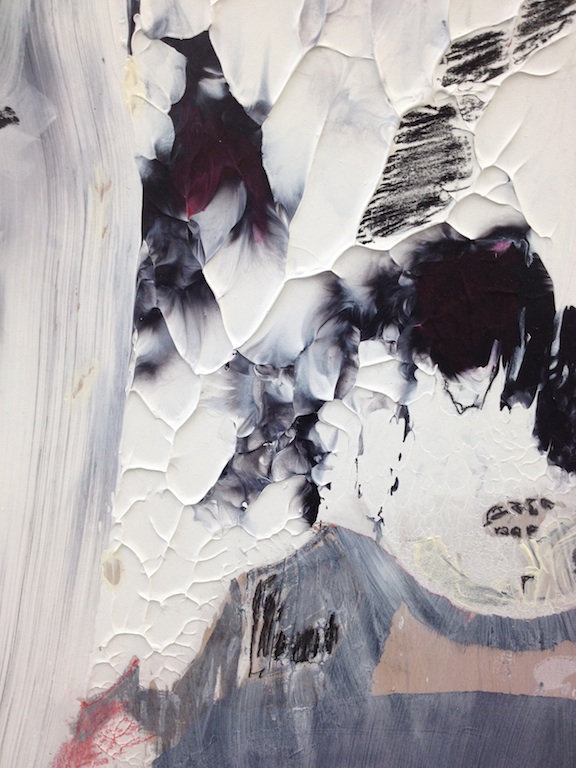
Maya Gulin explores the pattern effects of acrylic in this detail of her deftly layered mixed media painting.
Comments

The unfathomable drives next generation of artists

4/17/2014

Comments

 
PictureDetail from Emily Carr Masters student Duobaitis' ink on board work, '(re) formatting', 2014.
How we're feeling about our place in an uncertain world is evident on art school walls.

This is where the next generation of emerging artists grapples with the shape-shifting natural and built environment, consciously or subconsciously.

The increasingly puzzling, distracted, technically fraught visual field reflects students' reactions and responses to the relentless and devastating images of catastrophe and the bombardment of data-graphics, encompassing everything from micro-surgical robots to data-graphics on global human migration patterns.

It's all enough to make a person retreat to a quiet corner to knit or knot. Or draw. Or collage. Or build. 

Dallas Duobaitis' recent work in his first year Masters program deals with some of those topics — maybe. That's the beauty of abstracted images;  they engage the ideas and thoughts of the viewer who is also negotiating this particular, uncertain time and space. This artwork resonates because it is of our time. 

PictureDetail from Motut-Firth's installation (Carlyn Yandle photo)
Monique Motut-Firth (disclosure: friend) also grapples with those themes in her first-year Masters installation, part of the It's Not You, It's Me show at the Concourse Gallery.  Her found print images of largely domestic objects (including pictures of women) are meticulously constructed into robot-esque clusters that hover on the gallery wall, in conversation with Duobaitis' work that includes a motion-sensor-activated oculus/dream-catcher contraption (see below).

This emerging genre of work is not created in a Vancouver vacuum but is in conversation with creatives all over the world, in reaction to innovations that provide answers to problems but also more questions, as seen  in this documentary from Japan on the future of robots in our daily lives and this one on the horrifying/banal reality of surveillance in the UK.


PictureDuobaitis and his latest installation at Emily Carr University.
 ***
The Emily Carr University gallery walls have since been transformed for the annual Foundation Show, often the very first showing of work from the university's first year students as young as 18 and from all over the world.  The Foundation Show continues to April 26.

Picture
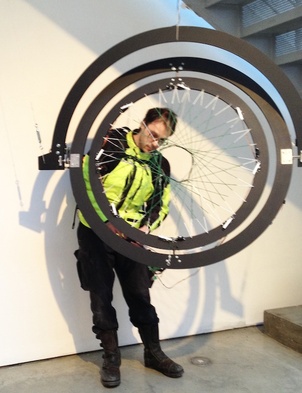
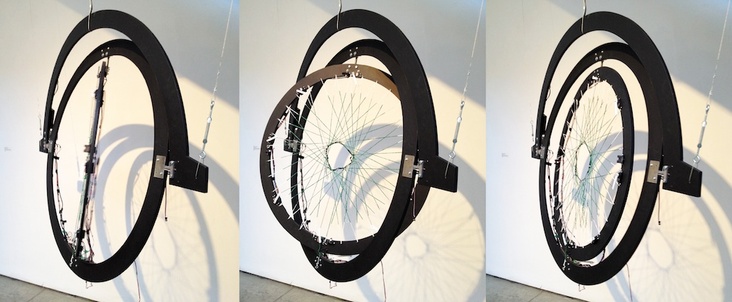
Motion sensors activate Duobaitis' chilling/thrilling installation of metal and threads. (Carlyn Yandle photos)
Comments

craftsmanship at the core of paper art show

4/4/2014

Comments

 
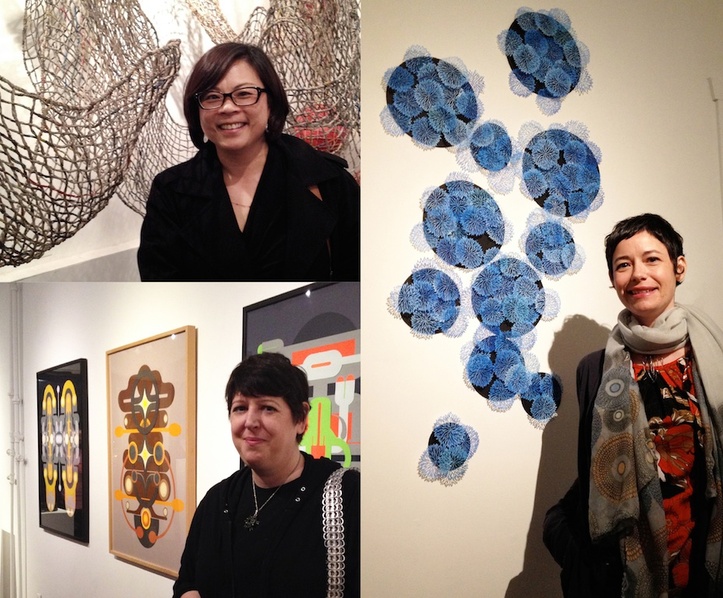
PictureClockwise from top: Connie Sabo, Rachael Ashe and Sarah Gee Miller with their respective works. (Carlyn Yandle photos)


Sarah Gee Miller says she's pretty handy. That's the understatement of the evening. Her paper 'paintings' are not only visually stunning and conceptually rich but they resonate with the dedication of a serious craftsman.

Funny how the word 'crafts' only gets the serious respect it deserves when the 'man' is attached to it. Suddenly the mind moves from, say, knitting or embroidering to, say, boat-building or blacksmithing. Here at the Voices from Another Room show at the Hot Art Wet City gallery, the craftsmanship is here in the medium of paper.

It's that juxtaposition between the humble, ephemeral material and the heavy-duty skill and commitment of craftsmanship that makes this show of five artists' work so compelling. The results of that individual devotional patience, determination, repetition is on view. And I can attest that there's also frustration, physical exertion, second-guessing and the flops. You don't get to this calibre of work without enduring a few hard battles.

The conceptual elements of the pieces in this group show may reference particular art genres (or not) but the methods are perhaps unconsciously rooted in this region that is built on a New World culture of self-sufficiency, innovation and handwork, in a medium fitting for this corner of the world that was built in large part on the pulp and paper industry. Location, whether in art or real estate, is everything.

The beauty of the group show that has that one connecting thread — or in this case, wood fibre — is in how far that thread can be stretched, from Miller's totemic paintings to Sabo's heavy net-like installations of twisted newspaper, to Ashe's filigree screens, to Alison Woodward's three-dimensional twisted fairytale vignettes and Joseph Wu's origami sculptures. But beyond the medium there's the other connecting thread of craftsmanship, which Wu articulates as both a scientific and artistic exploration.

This is a show of skill that is developed through the often meditative repetitive act of carving or twisting or folding, but the art is in the repetition of those expanding skills. It is how Sabo's net works have led her to ideas about laminating newspaper blocks, or how Miller's paper paintings grew out of her own drawing machine.

"The open relation between problem solving and problem finding... builds and expands skills," according to author Richard Sennett in The Craftsman. "But this can't be a one-off event. Skill opens up in this way only because the rhythm of solving and opening up occurs again and again."

Voices from Another Room: 5 Artists Explore Paper continues to April 25, Wed-Sat noon to 5 p.m. at 2206 Main (at 6th Ave.), Vancouver.


Comments

QR button blanket: Epic fail or a larger reading?

3/21/2014

Comments

 
Picture
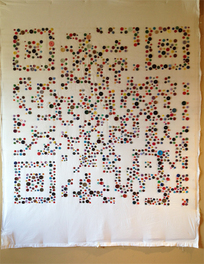
After three months of sewing one donated button after another into a giant QR code, the big moment arrived this week: time to stand back and scan that baby with a reader app, translating this quilt-thing to read, "The devil is in the details."

Except it didn't read. Don't panic!, I thought, then spent the entire next day working with a photo image of the QR Button Blanket, Photoshopping in more buttons and darker buttons and bigger buttons, trying to add the minimum amount of density for the software program to register the pattern and work its magic to produce the punchline. No luck; even a sliver of white in one button cluster puts a wrench in the wholecloth works. I filed this one under the category of Epic Fail, not worth finishing it as intended, framing it in black bias binding. I do not want to create something that is 'still' good; I want the thing to be good, full stop.

Picture
Failure demands confronting the why. Why conceive such a laborious, risky project in the first place?  Why endure the painstaking process when half-way through it was becoming abundantly clear that this was not going to 'read'?

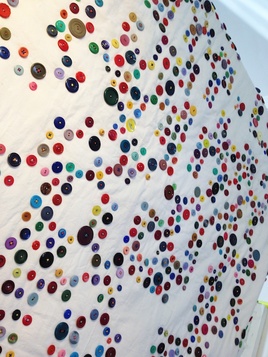
But there is another power here, and that's tied to the process beyond the product. The achievement may lie in the endurance (in an increasingly A.D.D. world) that is not necessarily attached to the product after all. It may be in seeing it through, without the promise of a sure result. The power may lie in the humble, everyday materials and the community of women who contributed all those bits of plastic saved from the waste stream. (There should really be a global ban on production of billions of plastic buttons. Plant-based plastic, bone, wood, and leather- or fabric-wrapped tin buttons eventually return to the earth.)

But what's really starting to click in for me is the cultural reference of this button-grid design. A decade ago, it might have been viewed as an oddly arranged colour field or an abstracted grid but we're so acclimatized to codes that the pattern begs to be 'read.' The fact that this is irresolvable might be annoying. And that's interesting. 

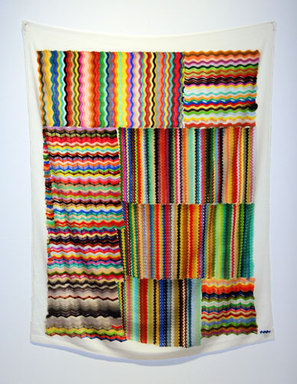
PictureWavy Gravy, marker on synthetic velvet, 58" x 43"
The possible multiple references could be more engaging than the one answer provided by a QR reader app. There's something to be learned in the discomfort of the open-endedness.

Moments like these, I seek out the artists who have embraced what New York artist Polly Apfelbaum calls the 'tough beauty' of visually exciting works that incorporate everyday materials in surprising ways. Apfelbaum, who calls herself a bad crafter, articulates the process of hard work in this video. 

"I work all the time," she says, without a schedule and in a highly experimental way. "You make the work and then you hope for the best." 

 "It's very important to get your fuck-you back."

I'm going with that.

Comments

Golden Tree a better tribute than 'real' tree

3/14/2014

Comments

 
Picture
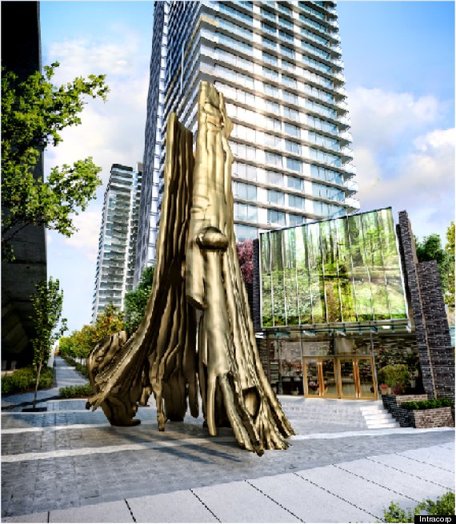
This week marks the unveiling of Golden Tree, Douglas Coupland's latest public artwork, to be installed next year at the southern gateway to Vancouver, at Cambie and Marine Drive.

The gold-patina, steel-reinforced resin and fiberglass mirror image of the famous hollow tree in Stanley Park will stand in front of a billboard-sized image of Stanley Park forest at the entrance to an Intracorp condo tower complex.

And already the tongues are wagging. 

This is when the art is working, when people are a little alarmed at the materials, the placement, the meaning. If art is a conversation with many often conflicting viewpoints, public artwork connects directly to the public. We not only have the opportunity to weigh in; we have the right.

So I'm weighing here on Golden Tree: Love, love, love.  A respected colleague suggested I was drinking the Coupland Kool-Aid. So I had to think about that. Am I too close to the artist to form a critique? What exactly has me digging the blingy dead tree-thing?

For the record, unlike Coupland, I was not in the 'for' camp for propping up the dead tree-thing in Stanley Park, or, at least in the way it was done (see video clip below on the story behind the prop-up project). I could not understand the panic around the parks board's news that the rotted, leaning partial carcass would have to go back to nourishing the forest floor. To quell the knee-jerk public outcry, the shell-fragment has been stabilized with concrete and steel. So now we have fake tree-thing, with all the artistic integrity of a movie prop or Disney street-furniture, and I'm sure the tourists love it. 

There had to be a better way to remember that scrap of a giant relic of the last stand of old growth forest that has been replaced by a dense forest of glass, concrete and steel. And now we have it, incongruously situated in the newest area of condo-tower densification, the gold evoking (to me, at least) festishization of an object, or our view of the ancient temperate rainforest seen through gold-coloured glasses as we glide by on the Canada Line.

I like the idea that the title necessarily includes 'tree' because this sculpture's connection to tree-ness is tenuous, sort of like someone's stuffed dead pet cat, now with marble eyes and in regal pose for all eternity. The title could have been This is Not A Tree, evoking Belgian surrealist artist Magritte's The Treachery of Images work, specifically his Ceci n'est pas une pipe (This is Not A Pipe) that is in fact not a pipe but a painting of a pipe. 

From a working-artist viewpoint, Golden Tree, like Coupland's Infinite Tire, ingeniously walks that fine line between creating a work that will be approved by the private developer but that doesn't pander to that payer. Its form, placement and materials deny a single meaning, reflecting these shifting, tenuous times. It could have easily been included in The Uncertainty of Objects and Ideas at the Smithsonian for its powerful subtext. (Hear more about the power of uncertainty in sculpture in this podcast interview with Hirshhorn museum curator Anne Ellegood.)

Now that we have a powerful tribute to the last "standing" giant conifer in the downtown area, perhaps we can let the original go the way nature intended, helping ensure the future of the city's lungs in Stanley Park.


Comments

Granville Island needs an injection of innovation

3/7/2014

Comments

 
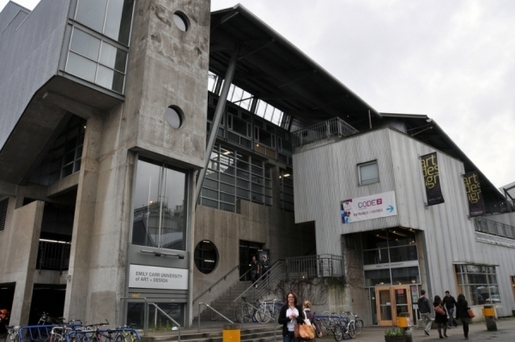
PicturePhoto of ECUAD's South Building by Stephen Hui/Georgia Straight
When finally — yet suddenly — I graduated from Emily Carr University of Art and Design, I was done, done, done, exhausted after four intense years of input. Now I needed space for four more years of output, to practice and to develop a practice.

But finding a suitable work space in this pricey city is no easy task. Self-(un)employed artists are no match for the slick technology firms and ad agencies that will pay top dollar to set up their cool premises in the port-town-era brick buildings. So we make do, sharing whatever space we can get while keeping an ear open for rumours of where we might be able to jump when the Permit Application billboard springs up in front of our crumbling building.

PictureIntriguing shows at the Charles H. Scott Gallery include the current Hyperflat.
Another art school in another city might play a part in providing studio rental opportunities for its new grads, encouraging a healthy cross-pollination of creative post-school work in industrial design, animation, sculpture, painting, media arts and curatorial services. But Emily Carr University is bursting at the seams and is focused on its campaign to move east to Great Northern Way. It's a grand vision, but what will become of the Granville Island community when the two-building campus vacates?  What of the dependable Opus Art Supplies, which depends heavily on the student customer base next door, as well as the other material suppliers on the Island? And the George H. Scott Gallery?

Vancouver Sun reporter Daphne Bramham took on the topic this week. In her story, one of the original designers of Granville Island, architect Norm Hotson, said replacing the school with another educational institution would help modernize the zone. Or it could be re-energized as "an incubator space” for "innovators", he said, or developed into a cultural hub that might include galleries, artist studios, residencies. And he pointed to Paris’s Cité Internationale des Arts as an example. 

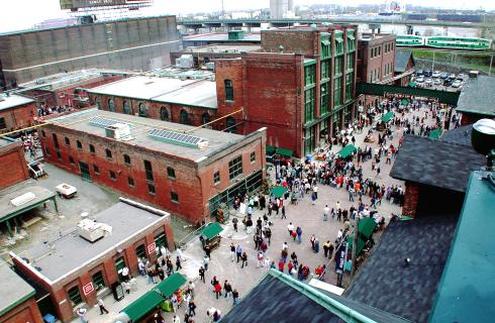
PictureToronto's Distillery District was revamped into a cultural hub. (Photo from Artscape website)
It's this kind of forward thinking that could stop the downtown core and Westside from slipping into a blandly privileged area with all the cultural texture of glassy high-end condos.

Granville Island needs a vibrant injection of new ideas and opportunities and Vancouver desperately needs a cultural hub, a multifunctional space with rental studios and residencies for everyone from painters to industrial designers, techies to musicians, performers to writers.

Yes, it's a balancing act. Nobody wants the Island to shut as tight as a tomb at night but the neighbours won't take kindly to the place being mobbed by booze-fueled night-crawlers. Artists and students work all hours, often after a day of slinging Italian coffees or serving Public Market customers. As students we purchase our supplies on the island, we depend on the visitors for our shows and showings. Our work ensures Granville Island is a tourist draw, not a tourist trap, that it is committed to Artisan over Ye Olde, authenticity over Disney.

It may sound like a pipe dream, but Granville Island was part of the inspiration that led the not-for-profit Artscape in Toronto to turn a collection of industrial buildings into a major cultural hub and tourist draw, in a remarkably short time. (See YouTube interview with Tim Jones, president and CEO of CityScape below.) 

Comments
<<Previous
Forward>>
    Cross-posted at
    carlynyandle.substack.com

    browse by topic:

    All
    Abject
    Abstract
    Abstract Embroidery
    Abstraction
    Abstract Painting
    Acrylic
    Activism
    Additive
    Aesthetics
    Agency
    AgentC Gallery
    Aging
    Alison Woodward
    Aluminum
    Anxiety
    Appropriation
    Arcade Fire
    Architecture
    Arleigh Wood
    Art
    Art Activism
    Art Blog
    Art Business
    Art Discourse
    Art History
    Artifact
    Artist
    Artist Residency
    Artist Statement
    Artist Talk
    Art Marketing
    Art Quilt
    Arts And Crafts
    Art School
    Art Show
    Art Spiegelman
    Assemblage
    Author
    Banksy
    Bauhaus
    Beauty
    Betsy Greer
    Big Data
    Billy Patko
    Binding
    Blogs
    Blog Tour
    Bob Krieger
    Body Of Work
    Books
    Boro
    Braided Rug
    Braiding
    Bruce MacKinnon
    Bruce Mau
    Building
    Bull Kelp
    Burlap
    Business
    Buttons
    Canadian Artist
    Carlyn Yandle
    Caroline Eriksson
    Cartoon
    Ceca Georgieva
    Challenge
    Charley Yandle
    Children
    Christmas
    Cindy Sherman
    Circular Thinking
    Cirque Du Soleil
    City As Site
    City Planning
    Cityspace Gallery
    Clay Yandle
    Climate Change
    Cluster
    Cob
    Cob Oven
    Collaboration
    Collage
    Colonialism
    Color
    Colour
    Commission
    Community
    Community Building
    Composition
    Conceptual Art
    Conceptual Craft
    Connection
    Connie Sabo
    Construction
    Coronavirus
    Cosplay
    Costume
    Counter Culture
    Counter-culture
    Cover
    Cover-19
    Covid
    Craft
    Craft Blogs
    Craft Camp
    Craftivism
    Crafts
    Craftsmanship
    Creative Process
    Critique
    Crochet
    Cross-stitch
    Cultural Hub
    Cultural Studies
    Culture
    Culture Jamming
    Culturejammingc9d75664fd
    Current Conditions
    Cycling
    Dafen Village
    Dallas-duobaitis
    Dance
    Data-graphic
    Data-graphic
    David Weir
    Dear Human
    Decorations
    Deep Craft
    Denim
    Denyse Thomasos
    Design
    Digital Art
    Discomforter
    Display
    Dissent
    Distraction
    Distracts
    DIY
    Doilies
    Doily
    Domestic
    Domestic Interventions
    Douglas-coupland
    Draw Down
    Drawing
    Dressed
    DSquared2
    Dude-chilling-park
    Dyeing
    Dystopia
    Eastend
    Eastside Culture Crawl
    ECUAD
    ECUAD MFA
    Editorial
    Edward Burtynsky
    Eggbeater Creative
    Embellishment
    Embroidery
    Emily Blincoe
    Emily Carr Cozy
    Emily Carr University
    Entanglements
    Environment
    Environmental Art
    Exhibit
    Exhibition
    Expanded Painting
    Experimentation
    Exploration
    Expression
    Fabric
    Fabricating
    Fabrication
    Facebook
    Failure
    Fashion
    Fashion Revolution
    Fast Fashion
    Feminisim
    Feminist
    Feminist Art
    Festival
    Fiber
    Fiber Artist
    Fiber Arts
    Fibre
    Fibre Arts
    Film
    First Saturday Open Studios
    Flo
    Flow
    Forage
    Foraging
    Form
    Form And Function
    Foundlings
    Found Materials
    Found Objects
    Fractal
    Free Store
    Fuckwit
    Fuzzy Logic
    Gallery
    Gallery-row
    Garden
    Gardening
    Garment
    Gathering
    Gentrification
    Geometric Art
    Gill Benzion
    Gingerbread
    Globalization
    Glue
    Goblin Core
    Grad 2020
    Graffiti
    Grannycore
    Granny Square
    Granville-island
    Green Space
    Grid
    Grief
    Guanajuato
    Guerrilla Art
    Guerrilla Girls
    Halloween
    Handmade
    Handmaking
    Hand Stitching
    Hand-stitching
    Handwork
    Hashtags
    Haywood Bandstand
    Healing
    Health
    Hearth
    Heirloom
    Hideki-kuwajima
    Homelessness
    Homemade
    Hot Art Wet City
    Housing
    Hybrid Thinking
    Ian Reid
    Ian Wallace
    Ideas
    Identity
    Images
    Imagination
    Immersive Art
    Improvisation
    Incomplete Manifesto For Growth
    Industrial Design
    Industry
    Innovation
    Inspiration
    Instagram
    Installation
    Installation Art
    Intervention
    Intrusive Thoughts
    Invention
    Irena Werning
    Ironing
    Janet Wang
    Jeans
    Jeff Wilson
    Joel Bakan
    Joseph Beuys
    Joseph-wu
    Journalism
    Joyful Making In Perilous Times
    Joyfulmakinginperiloustimes
    Judith Scott
    Kamala Harris
    Kids Art
    Kim Piper Werker
    Kimsooja
    Kintsugi
    Knitting
    Knots
    Knotting
    Kyoto
    Labor
    Labour
    LA Fires
    Landon Mackenzie
    Landscape
    Leanne Prain
    Lecture
    Lighthouse
    Linen
    Liz Magor
    Log Cabin
    Logo Sweater
    LOoW
    Lost Painting
    Lumiere Festival
    Lynda Barry
    Macrame
    Maker
    Making
    MakingIsConnecting
    Malcolm Gladwell
    Male Gaze
    Mapping
    Maquette
    Marie Kondo
    Marketing
    Mark Lewis
    Martha Rosler
    Martha Stewart
    Masks
    Material Exploration
    Mathematics
    Maya
    Media
    Meditation
    Meditative
    Mending
    Mend In Public Day
    Mental Health
    Metalworker
    MFA
    Mister Rogers
    Mixed Media
    Mobile Art Practice
    Monique Motut-Firth
    Monster
    Monte Clark
    Mosaic
    Motivation
    Mt. Pleasant Community Centre
    Mud Girls
    Mural
    Mushroom
    Mycelium
    Narrative
    Natalie Jeremijenko
    Nature
    Needlework
    Neon
    Net
    Network
    Networking
    Neuroplasticity
    New Forms Festival
    Newspapers
    Nick Cave
    Noah Goodis
    North Vancouver
    Obtrusive Thoughts
    Omer Arbel
    Online Talk
    Openings
    Organization
    Origami
    #overthinking
    Paint
    Painting
    Pandemic
    Paper
    Paper Sculpture
    Papier Mache
    Parkade Quilt
    Patchwork
    Patriarchy
    Pattern
    Pecha Kucha
    Pechakucha
    Perception
    Perfectionism
    Performance
    Performance Art
    Personalispolitical
    Photography
    Playing
    Political Art
    Political Satire
    Polly-apfelbaum
    Pompidou
    Poodle
    Port Coquitlam
    Portrait
    Practice
    Process
    Production
    Profession
    Project
    Protest
    Protest Art
    Psychedelic
    Public Art
    Pussy Hat
    Pussy-hat
    Qr Code
    Quilt
    Quilt Block
    Quilting
    Quilt Painting
    Rachael Ashe
    Rachel Lafo
    Ravages
    Raw Materials
    Rebar
    Recycle
    Recycling
    Reflection
    Reflektor
    Reimagine
    Renewal
    Repairing Is Caring
    RepairingIsCaring
    Research
    Residency
    Resistance
    Resurge
    Retreat
    Re-use
    Rhonda Weppler
    Richard-tetrault
    Richmond Art Gallery
    Right Brain
    Rondle-west
    Roses Against Violence
    Rote Activity
    Rug
    Ryan-mcelhinney
    Safe Supply
    Safety
    Sampler
    Sarah-gee-miller
    Sashiko
    Saskatchewan
    Scaffolds
    Scaffolds I
    Scale
    Scraps
    Sculpture
    Seasonal Decor
    Seattle Art Museum
    Seaweed
    Seismic Rug
    Semiotics
    Sewing
    SharingIsCaring
    Sharon Kallis
    Shawn Hunt
    Shigeru Ban
    Sketchup
    Slow Craft
    Smocking
    Social Art
    Socialart
    Social Distancing
    Social Distancing Hat
    Social Engagement
    Social-engagement
    Social History
    Social Justice
    Social Media
    Soft Sculpture
    South-granville
    Space Craft
    Spore
    Stitching
    Storage
    Street Art
    Studio
    Styrophobe
    Subversive Stitch
    Surrealism
    Surrey
    Tactical Frivolity
    Tactility
    Tagging
    Talking Art
    Tapestry
    Tattoo
    Teamlab
    Technology
    Terry Fox Theatre
    Text
    Textile
    Textile Art
    Textiles
    Thrifting
    Thrift Stores
    @tinypricksproject
    Tiny Pricks Project
    TJ Watt
    TO DO
    Tools
    Toronto Design Offsite
    Toybits
    Trash
    Trash Art
    Travel Art
    Trevor Mahovsky
    Trump
    Typography
    Tyvek
    Unbridled
    Unfixtures
    Upcycle
    Upcycling
    Urban Design
    Use Object
    Use Objects
    Utility
    Value Village
    Vancouver
    Vancouver Art Gallery
    Vancouver International Airport
    Video
    Video Tour
    Visual Field
    Visual-field
    Visual Language
    Wabi-sabi
    Wallace Stegner House
    Wall Hanging
    Waterwork
    Wearable Art
    Weaving
    William Morris
    Women's March
    Wood
    Wool
    Work Wraps
    Wrap I
    Wrap II
    Writing
    Xenobia Bailey
    Yarn Bombing
    YVR
    Zaha Hadid
    Zendoodle
    Zero Waste Art
    Zero-waste Art

    Archives

    September 2025
    May 2025
    April 2025
    March 2025
    January 2025
    December 2024
    November 2024
    October 2024
    September 2024
    August 2024
    July 2024
    June 2024
    October 2022
    August 2022
    June 2022
    November 2021
    April 2021
    September 2020
    April 2020
    December 2019
    November 2019
    September 2019
    August 2019
    July 2019
    June 2019
    April 2019
    November 2018
    July 2018
    May 2018
    November 2017
    September 2017
    June 2017
    April 2017
    March 2017
    February 2017
    December 2016
    November 2016
    September 2016
    July 2016
    March 2016
    February 2016
    January 2016
    December 2015
    November 2015
    October 2015
    September 2015
    June 2015
    May 2015
    April 2015
    March 2015
    February 2015
    January 2015
    December 2014
    November 2014
    October 2014
    September 2014
    August 2014
    July 2014
    June 2014
    May 2014
    April 2014
    March 2014
    February 2014
    January 2014
    December 2013
    November 2013
    October 2013
    September 2013
    August 2013
    July 2013
    June 2013
    May 2013
    April 2013
    March 2013
    February 2013
    January 2013
    December 2012
    November 2012
    October 2012
    September 2012
    August 2012
    July 2012
    June 2012
    May 2012
    April 2012
    March 2012
    February 2012
    January 2012
    December 2011
    November 2011
    October 2011
    September 2011
    August 2011
    June 2011
    May 2011
    April 2011
    March 2011

Powered by Create your own unique website with customizable templates.
Picture