carlyn yandle
  • about
  • the creative process
  • crafted objects
  • public art
  • painting
  • exhibitions
  • contact

Lessons from the grad show

5/20/2025

 
Art school is just the end of the beginning

The concourse was a crush on opening night at Emily Carr University’s Spring grad show. Seventies’ disco music fuelled giddy graduates clutching bouquets, hugging, posing for parents’ photos in front of their exhibits of graphite-drawn urban dystopias, bent wood-lam furniture and natural-dyed crocheted robes.
Picture
Emily Carr University’s graduation show opening, May 2025 (Carlyn Yandle)
It was quite the contrast to five years ago during my grad year when I had to fight the school’s installation technician to hang my final thesis work.

“What’s the point?” he said. “We’re shutting down, like, tomorrow.” The point, as every visual artist knows, is the photo-documentation for that fleeting moment of exhibition, especially fleeting in the hours before the pandemic lockdown. I pushed back on his push-back, he sighed dramatically and dragged the big ladder to the centre of the Sculpture Gallery.

I learned this need to be fierce and focused when it comes to displaying work from a moment of horror during my undergrad grad show a decade earlier.

I must have had a hunch that my installation might not go down as envisioned because I convinced my instructors to allocate me two final exhibit spaces since I had one foot in the painting department and the other in sculpture. The painting installation was easy: bang in two hooks, hang on wall. The sculpture piece was a little trickier. 

My dream was that those gallery-goers here for the sculpture, certainly a few internationally renowned curators and well-heeled collectors among them, would wander into my designated space in the third-floor room at the end of the long hall and stop in their tracks. What is this curious, lacy, bone-y floor installation?

Ah, I would say in a soft voice that I would still need to cultivate. I see you’ve noticed “Ravages.” A conversation would ensue. I would talk about my fascination with middens of bone and shell that hold clues to past and enduring Indigenous civilizations and cultures. I would speak to my own position as a settler descendant on this unceded coastal land, my anthropological curiosity awakened in high school that led to university studies in anthro/sociology. I would direct their eye to the use of found colonialist objects hand-crocheted in the round that evoke the fractal pattern of shoreline sandstone worn by time and event. I would link the distressed, chalky concretization of those abject objects to my immediate ever-changing environment of urban decay and hasty condo-tower construction, and my identity as a Mature Student trying not to feel like a decrepit bag of bones ha ha. You people get me!

Articulating the ideas in the making is an essential part of conceptual art studies and I spent weeks — months — thinking about how to talk about what I was making while scouring thrift stores for hand-made doilies and manipulating them in the sculpture lab to ossify with plasters then concrete thin-set. When that failed, I camped out in the mold-making shop mucking around with fibreglass and turning out copies of doilies in hardening acrylic too shiny so I coated them with gesso. Despite working under respirator my lungs complained and my skin erupted so when deadline hit for grad show submissions I went with what I had plus that large painting, a story for another time.

In the hours before opening night I assembled “Ravages,” propping some of the limp, cracking doilies onto each other house-of-cards style. The assembly was precarious but there was no breeze and I had a “Do not touch” sign beside the work so I went home to get fancified.

The main floor galleries were packed by 6pm, with people backing into dangling ceiling suspensions and failing to not step on floor installations. While my friends and family were preoccupied I slipped up to the empty third-floor room at the end of the hall. “Ravages” had collapsed into a pool of flat doilies like scraps from a factory floor. If it were not for the other students’ art I would have turned off the light and locked the door. Nothing to see here. I re-directed my people to the painting.

There is no photo-documentation of “Ravages;” some pictures are just too sad to take but here I am writing about it because there is a point in all this.
​
Art school, I want to tell all those kids holding bouquets and posing with friends beside their work last week, is not the culmination of your art-making ability but just your art right now. Unless you have a marketable skill like illustration, animation or industrial design, chances are you are going to have to do something else besides making art to earn a living and that’s okay; a fine arts degree is not a meal ticket.
Picture
Source: Federal Bank of New York via Employed Historian
But the art will continue to mature if you stick with it. It will evolve as you grow through all the unexpected events. It will bring you solace when nothing and no-one else can, and unlimited joy when it’s the purest way you know to express yourself. You may decide to drop it when life becomes too much but it’s never over; you’re just fallowing, building up rich experiences for your next chapter.
Picture
Concretized lace forms emerge after grad show failure (Carlyn Yandle)
As for the Covid-era ECU installer, his labour was not for naught; the school did indeed shut down right after he helped secure my three large-scale fibre artworks but I can boast that it’s the longest held-over show in the Sculpture Gallery, intact for the entire summer with no one inside to view it but the mice. I biked by the campus every once in a while where it was easily seen from the street through the two high walls of windows, a gallery-sized still life. I took photos of that.
​
All three artworks have since been seen by more than mice in other exhibitions, with the latest being Classics Reimagined, a US-based online show of 30 mostly American artists. During another unexpected life moment, it’s the only way this outspoken Canadian gets to mingle with our besieged maker friends.

When going back is good

11/23/2024

 
Past failures are invaluable teaching tools
​

This is my picking-up-the-pieces post, which is literally what I’m doing these days (and late nights).

With the outlook looking very dark indeed I turned to my colourful stash of fabrics that I keep at eye level in a wine crate on the wall. The ‘BACK’ and ‘NEXT’ sign plates — evoking the buttons on the bottom of every online form — are courtesy of an artist friend, so I texted him for his opinion on how to proceed in these times of need:
Picture
Turns out things are going back politically, now that the majority of Americans have voted in villains to run the show. I’m going back too, but only to revisit those failures for the lessons they hold for moving forward.
​

Exhibit A: Here I spent a good portion of one day heating a tapestry needle with a Bic lighter and poking it through a piece of stiff synthetic paper. Over and over. I loved the subtractive mark-making (also known as ‘burning holes’) and the increase in density that culminated in a large negative space. I was working as an artist-research assistant with astrophysicists and other big brains at the time so I think I was trying to get a grip on the concept of black holes or negative energy (not so much). Learning outcome: Breathing in melting synthetic paper fumes creates a whopper of a headache. Not an indoor sport.
Picture
Exhibit A
My father was a lifelong painter of mostly landscapes but I knew he was losing his mind when he looked at the last work-in-progress on his easel and declared, “Well I don’t know what’s going on here!” This is how I feel when I look at Exhibit B: A four-panel collage painting of lacy construction-crane patterns topped with bits of Tyvek building wrap and strips of acrylic skins. Learning outcome: I need to add a letter to my will requesting that all weird artwork be destroyed upon my demise.
Picture
Exhibit B
Moving on to Exhibit C: some jeans with all fabric removed and re-configured as a net or scaffolding. Maybe a more clever artist could write a profound statement about this that could land it in an Important Art Exhibit, perhaps something about togetherness or workers united, or maybe the hollowing out of union labour. It said nothing to me but the materials and technique were eventually incorporated into two distinct large-scale artworks. Learning outcome: Even dead-end projects contain something to build on.
Picture
Exhibit C
Exhibit D is a collection of coffee-bean sacks attached to a wall with sewing pins. I was exploring the sculptural possibilities of burlap, the shadow effects and warm tones, the varying weaves and the fonts of the silk-screened labels. But tacking bunched-up bags wasn’t enough.
Picture
Exhibit D
I doubled down, stitching one bag after another to a rusty concrete-forming tie, then pulling out most of the weft from the weave, macramé-ing them, then coating them with ready-use concrete mix. Meh. I knotted up the deconstructed sacks following designs of specific architecture, including a cathedral. I lashed the steel ties together and suspended the lot of them in an overly ambitious arrangement that called for a dozen more of these time-sucking labours from hell. I was stuck in that encrusted, fibrous rabbit hole for most of 2021. Learning outcome: Going bigger isn’t the answer when it’s not working and it’s okay to drop the project despite the large investment in time. Also, turns out my lungs don’t react well to the burlap-fibre dust bunnies floating around the studio.
Picture
Detail of concretized burlap macramé experiments
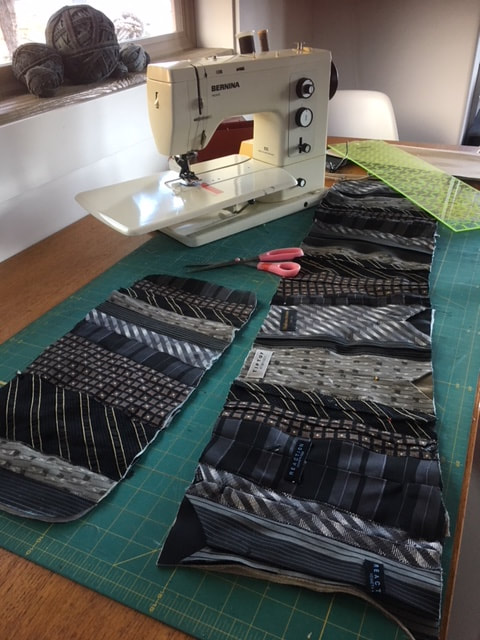
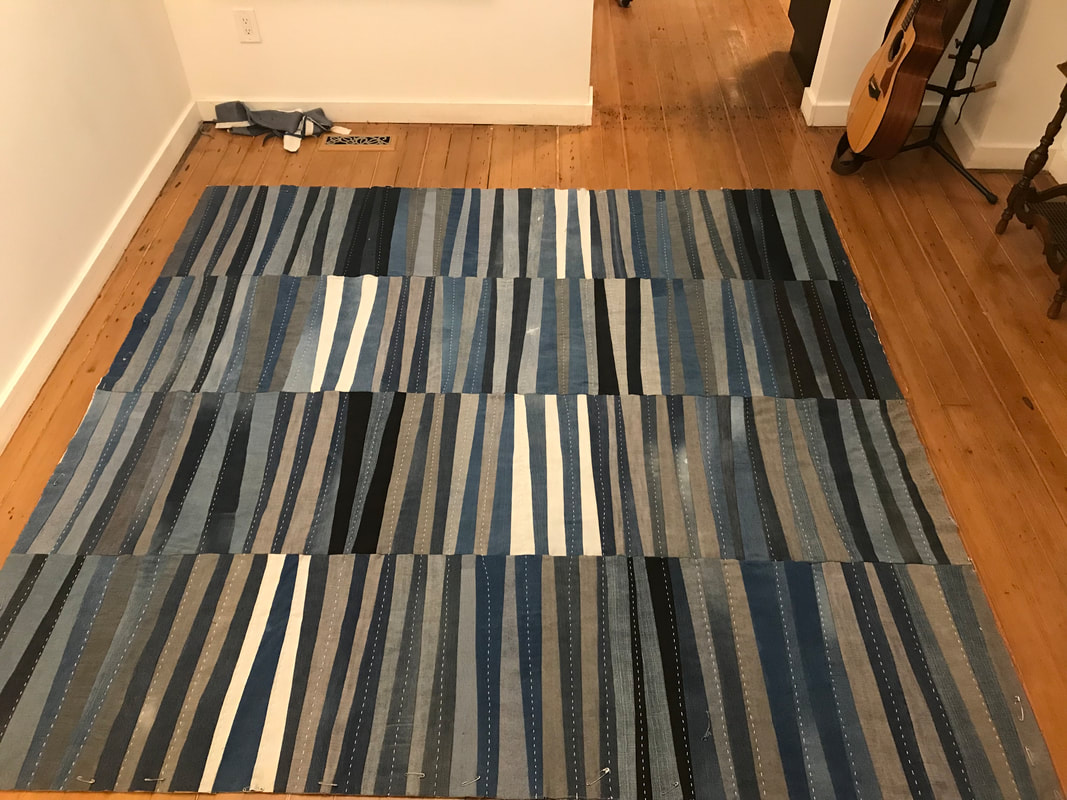
I finally received a sign to restart a couple of weeks ago when another artist gave me a collection of silky striped fabric swatches. They reminded me of some finicky, slippery satin quilt blocks I started a decade ago. I pulled out the fraying, wonky squares that had defeated me but decided to work with them. This will be a queen-sized memory quilt of my perfectly imperfect past. Learning outcome: Failures may need time for new energy, ideas and skill to arrive. This is that time.
Picture
Work in progress: Piecing together an abandoned project with new energy.

Materials matter, and Those of loved ones gone can live on

5/26/2018

Comments

 
Picture
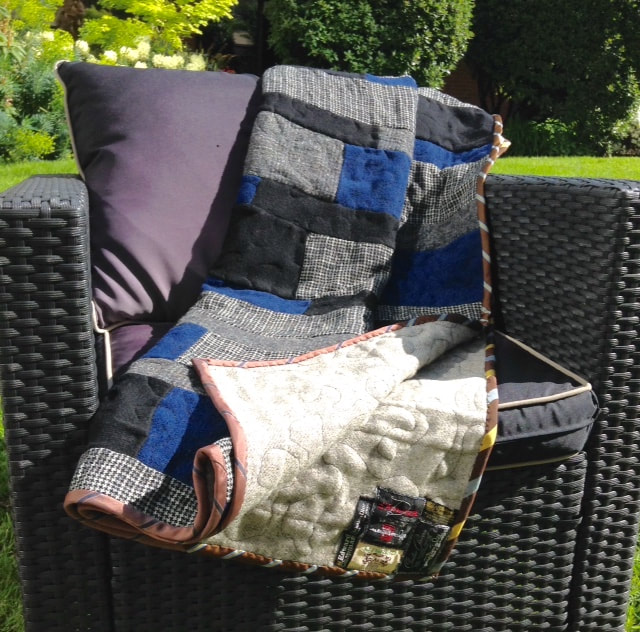
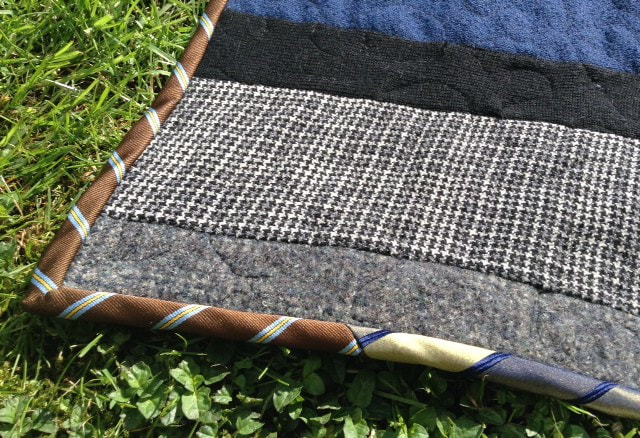
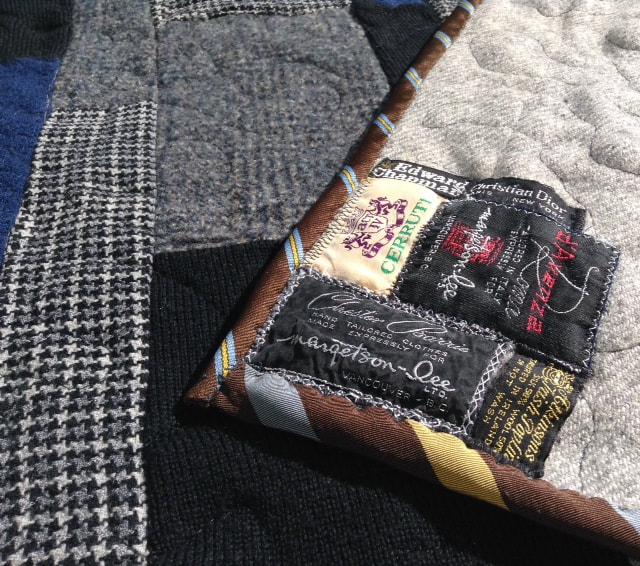
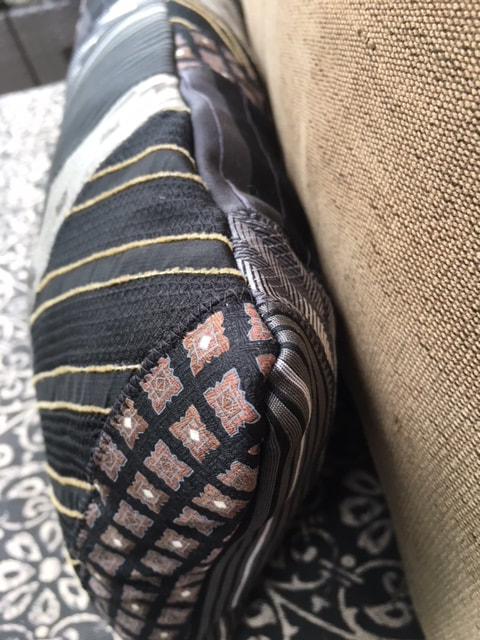
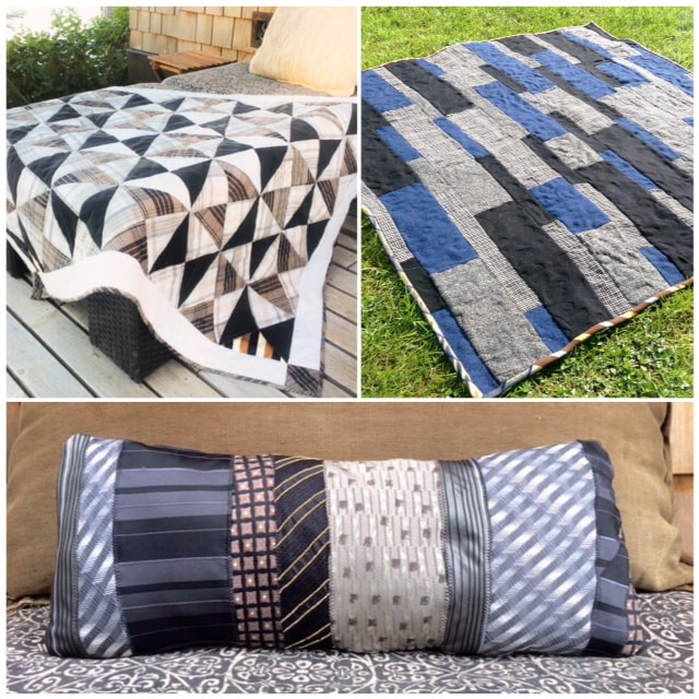
Clockwise from top left: Great-Grandfather Quilt; Dad's Throw; Tie Cushion. (Carlyn Yandle photos)
Materialistic. People say it like it's a bad thing.
But there's not necessarily anything selfish or hoardy or wasteful about feeling deeply connected to materials. If we all started being a little more materialistic we might not be now contending with the Great Pacific Garbage Patch or space junk. I want no part with parting so quickly from one-use-life materials when a meaningful second life is possible.

So when a couple of people dear to my heart were clearly torn about parting with some favourite clothes of their loved ones who recently passed away — one within this year, the other within 18 months — I felt it too.

These bits of cloth are interwoven with the memory of the wearer, his style, the special occasions and the everyday. Just looking at them hanging in the back closet brought the son, the wife, to tears. Some of that emotion is also about feeling at odds with what to do with it all. Yet holding onto useless things, especially in this town where we're so squeezed for space we have to go outside our living spaces just to change our mind, can even bring on some shame or panic that we can't let go, move on.

I felt the potency of the pieces too, and suggested selecting a few items to be repurposed into something that would bring comfort, and in remembrance.
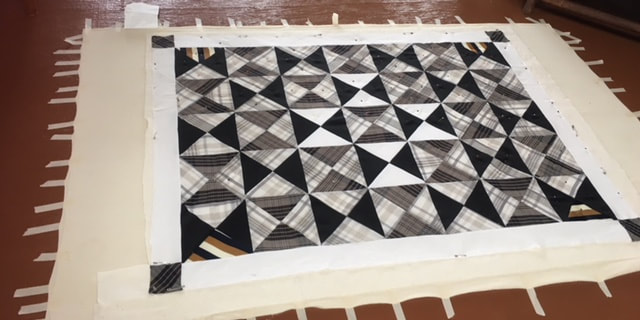
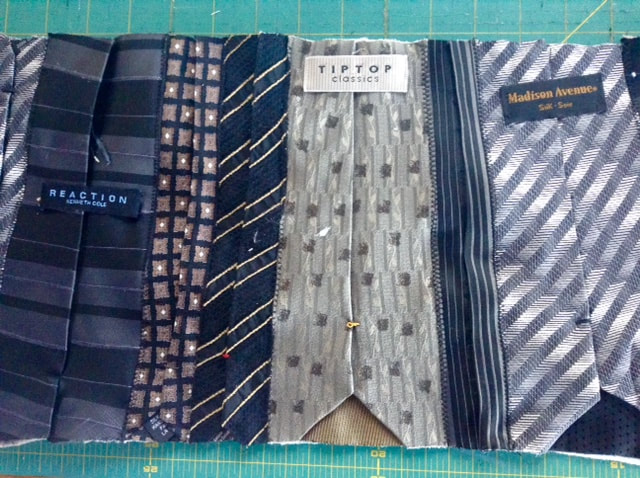
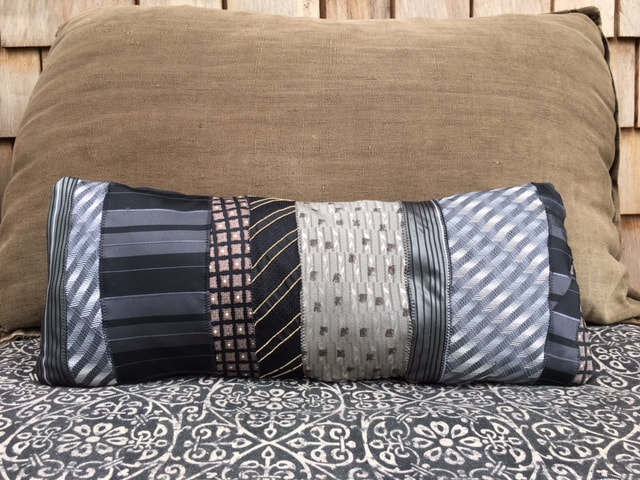
The first project this spring was the Great-Grandfather Quilt, for the first of the next generation who missed meeting his great-grandfather by 9 months. The second was Dad's Blanket, which lives on one of the two matching sofas where father and son watched the baseball in his last three years. The third is a lumbar-support cushion made from silk ties that's parked on his wife's favourite reading chair.

It takes a bit of faith to allow those blazers and sweaters, ties and dress shirts to leave their dark cupboards and be subjected to my fibre-art experiments but I'm grateful they did. It was a little unnerving, plunging wool blazers into a hot-water-wash and tumble-dry, or severing several silk neckties in one swipe of the rotary cutter, but that's the deal with making and innovating: sometimes you have to take a deep breath and boldly go, risking failure.
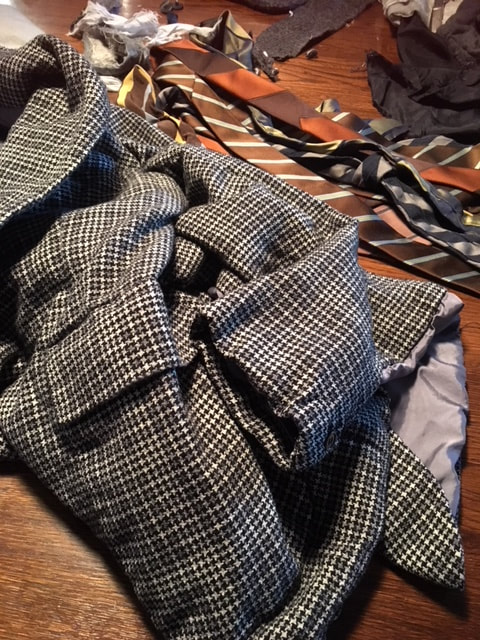
And there is definitely failure in all of this making. Design changes happen on the fly, dictated by odd dimensions of the pieces and unpredictable fabric behaviour. (It's a thing.) Trying to wrestle slippery bias-cut silk, unstable cashmere knit and coat-heavy woven wool into submission enough to lie flat together is a test of one's patience. The trick is to embrace imperfection and keep the big picture in mind. I think about the Gees Bend quilters I saw a few years ago at Granville Island and the gospel spiritual song two of them sang at the start of their talk, and I say a little prayer myself: God I hope this works.

The other challenge is creating works that resonate with the spirit of the original wearer, so it's not just a matter of chopping up the clothing into tiny unidentifiable pieces to be re-fabricated in a generic quilt. You don't want to be too literal either, appliquéing ties into a Ties Quilt or (creepier) using every last button and pocket or (horrors) just sewing all the clothes together into a blanket or something.

Binding the one blanket with necktie fabric and appliquéing the suit labels in one corner of an army blanket backing (for the man who served in the US Army) felt like the right balance.

I post each Remembrance Pieces project on Facebook to inspire other material girls and guys, and to pay my respects to the stuff of life and to those of this life no longer.
Comments

From disaster to 'Discomforter': 5 lessons learned

5/15/2015

Comments

 
Picture
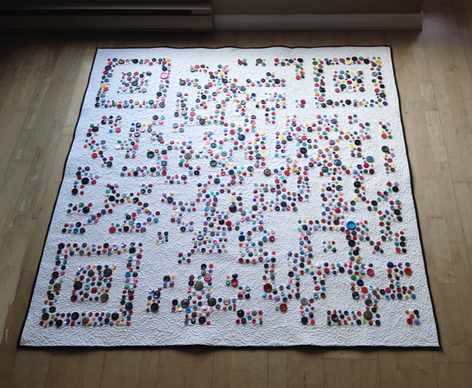
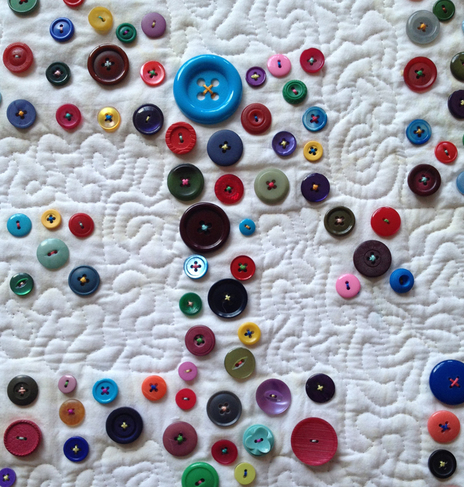
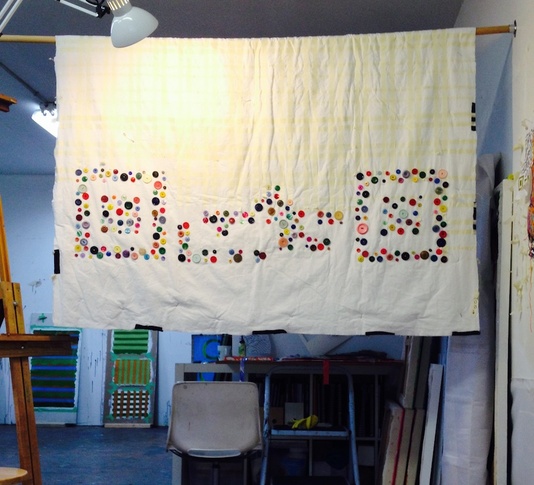
There is really no way to know whether a blanket covered in brightly coloured buttons will read until the very end of all the work so I wanted to build in the likelihood of failure. That's how I came to decide on "The devil is in the details" as the line of text that would appear on a QR code reader. If it didn't read successfully at least it would prove the rule.
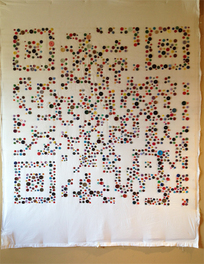
But it wasn't as simple as that. The details that bedevilled me began with my big idea to use masking tape to indicate the grid instead of tailor's chalk (too dusty), disappearing-ink marker (fades too quickly) or basting (tedious).

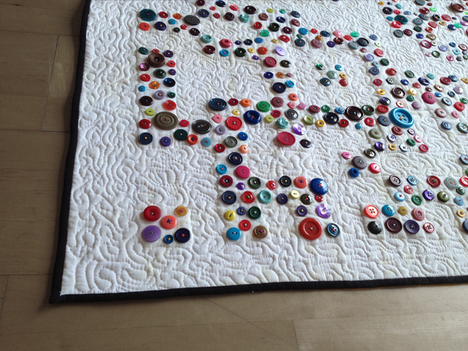
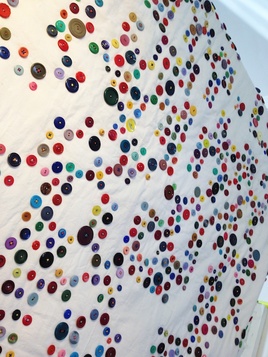
That tape plan might have worked if I had removed it in a timely manner, like within a few days or even weeks. But when you pull masking tape off of fine white cotton sheeting after 13 months you are left with a hard, yellowed embedded adhesive residue. You scrape it, scrub it, attack it with solvents and still it does not un-adhere. In desperation, you ball up the entire quilt and chuck it into the washing machine, despite the raw edges and exposed batting. When it comes out in a tight mass of threads and shrunken batting you curse your hare-brained impulsiveness. You let out a little scream when you realize that the colours from many of those buttons have inexplicably run, bleeding all over the white cotton.  (Lesson 2: Research your materials.) At this point you roll yourself up into a little ball and go fetal in a corner somewhere until you're ready to rejoin humanity.

I knew going into my second QR Quilt project that there was a very good chance that after sewing more than 1,000 buttons into three layers of fabric the pattern may not be recognized by the QR code reader. But I also knew that I had a fighting chance after the surprising success of the readable QR Quilt: After Douglas Coupland. My quilt version of his painting, I Wait and I Wait and I Wait for God to Appear proved that a quilt composed of scraps of coloured business shirts and scattered buttons could contain a message as easily as the typical black and white grid. After several weeks of piecing over 1,000 squares together into one queen-sized square I stood back, aimed my phone at the quilt, and prayed. The sentence appeared, like a message from god.
I wanted that euphoria again. I needed it. (Lesson 1: Avoid great expectations.)
Picture
You eventually decide that the title has suddenly gained poignancy (Lesson 3: Embrace unexpected results) so you pick away at the binding selvedge threads from the quilt-ball until you can hang the wet, lead-apron-heavy slab of fiber and plastic to dry for several days. You start to notice that the sheeting is puckering from the shrinking and is sagging from the weight of all that hard plastic in this queen-sized quilt of the damned. Turns out some of those buttons were of some early plastic vintage that were painted after they were fabricated. (Who knew?)

You attempt to find salvation from a bottle of stain-remover -- Out, damned spot! Out, I say!  -- but it looks worse. The next time you have the nerve to look at this fabricated failure you notice that -- praise the lord -- the bleaching agent has worked -- sort of. You stipple-quilt out the sags and bags and the rest of the discolouration disappears -- also sort of. You trim it square and bind it in black with a devil-may-care attitude. After it's finished you realize that the stippling was essential for creating enough rigidity to prevent the buttons from sagging when it hangs. You like the resulting topography. (Lesson 4: Innovate solutions.)

Then you air the whole sordid story on your blog, knowing that sharing the anguish is part of the process, though you regret you don't have any images that would give the full impact of the horror story. (Lesson 5: Photodocument the process, even failure.)

The title of this work is Discomforter (The Devil is in the Details). It's a cumbersome title befitting this project that took me to the edge of my sanity, or at least close enough to see that there is in fact an edge and I know I can't go there again.

Picture
Comments

One bit, two bits, green bits, black bits

3/13/2015

Comments

 
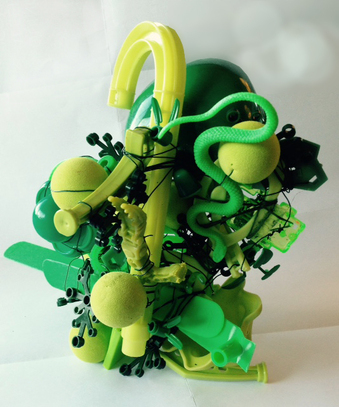
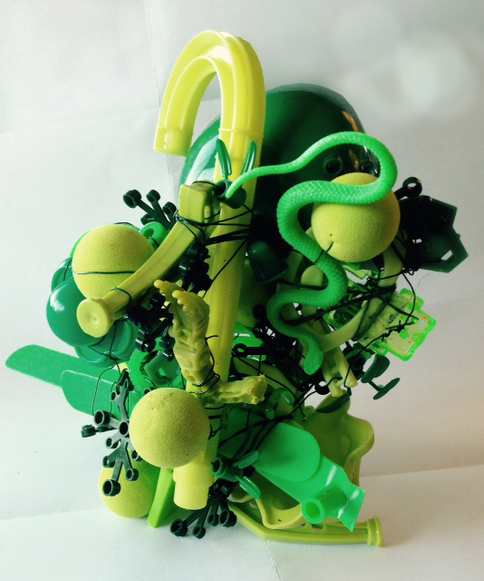
PictureToybits (green) - made from broken toys (Carlyn Yandle photo)
This may be the third or fourth column/post I've written that could come under the headline, 'Overthinking will be the death of me.' There is definitely a book in there somewhere about the power of overthinking to sabotage the creative process.

My latest overthinking sabotage occurred as I was experimenting with binding up broken toy bits (consciously not overthinking why).

I was taking care of my sister's kids while idly binding one green toy remnant to another. At some point, the curious object appeared to be done. And it was good.

It's an intriguing object but when photographed is also a visually absorbing abstract. It has richness in its ability to conflate the second and third dimensions. It is heavy with cultural reference yet lightly humorous.

I was onto something.

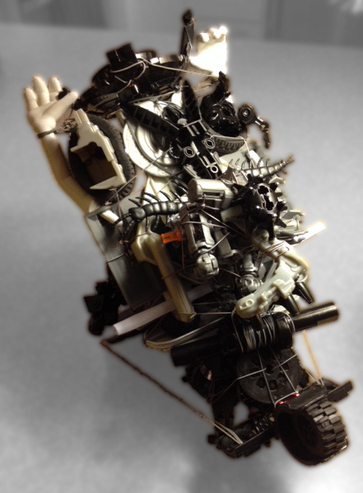
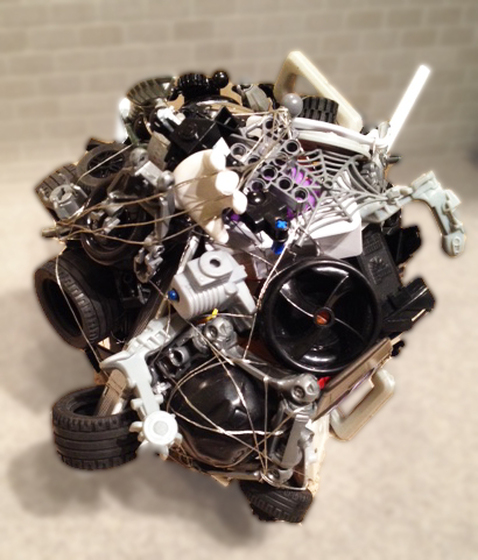
PictureToybits (black) - final version (Carlyn Yandle photo)
After a couple of hours I quit because it clearly would have no logical endpoint. But if there's one thing I've learned about the creative process it's to let the failures hang around and stink up the joint for a while. In my experience, the only way to get to the source of the stench is to keep it in the periphery. And a couple of days later it came to me: I was so hell-bent on the outcome I had completely negated the making, which, when referring back to the green toy-bits cluster, was the essence of the thing: play. 

I took it all apart, then started over, finding the fit between one bit to another bit, then adding one bit where it fit. (Maybe the book should be in Dr. Seuss language).

It had a beginning and an end, and the entire process was an adventure without a map. The result is a sculptural object with implied power that appears as part engine, part vehicle, part robot. It has composition, balance, architecture, intriguing sight lines and varying perspectives. It has something to tell me: Your instincts are good, keep going.

From the junk of life emerges new life.

You can see it in the above photo; it's a mess. Even as I was binding it I thought, This is not working, this is not working. Why is this not working? It has no balance, no composition. it is artless. And it was a chore from the get-go.
PictureToybits (black): first attempt (Carlyn Yandle photo)
So, like every creative I know,  the ol' mental processor starting whirring away in the background, rolling over this concept. Friends and I talk about this slightly obsessive stage when developing a new work. You're still functional in your daily routine but that whirring puts you in a slightly distracted state. It's sort of like falling in love; there's always something there to remind you of that growing passion. And when I fall in love with an idea, I fall hard. I'm consumed by the topic like the Paul Rudd character in The 40-Year-Old Virgin who can't stop talking about Amy or The Big Lebowski's John Goodman character who links any conversation to his days in 'Nam.

I've been seeing toy-bits inspiration everywhere, including in a car column in the morning newspaper. The picture of an engine reminded me of the toy-bits clusters and suddenly I was shoving aside breakfast dishes and breakfasting people and dumping my hoard of broken toys onto the table.

I will make that engine-y thing, I said. And therein lies the fatal flaw.

Comments

Exhibit of a great mistake was just the push I needed

2/27/2015

Comments

 
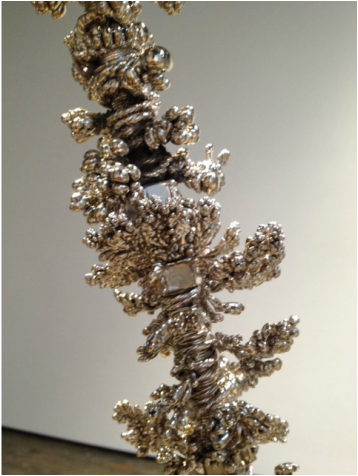
PictureVancouver-based creative force Omer Arbel and Monte Clark teamed up to embrace the power of happy accidents (Carlyn Yandle photo)
Last week Monte Clark gave four of us some insight into how an experiment by Omer Arbel went awry and ended up as a dazzling installation in his newish Monte Clark Gallery. 

The heavy, glittering swags appear as silver-dipped coral or precious Crown hardware retrieved after a palace inferno. The hardened bits of chaos are a dazzling example of why failure is vital in the push for new ideas and materials.

"Failure is a constant companion," says  Vancouver-based creative force Arbel, in Vancouver Magazine.

It was the perfect preface for my '3 artworks a day for five days' challenge that bounced over to me on Facebook. 

Risk is essential in my work but I don't have Arbel's creative empire to absorb expensive failures, so I turned to stuff lying around the house (a.k.a. Found Domestic Materials) in my thrice-daily experiments. The way I see it, the materials used below were already deemed waste, so if the tests didn't work out, so what? At least no new materials were harmed in the making.

Picture
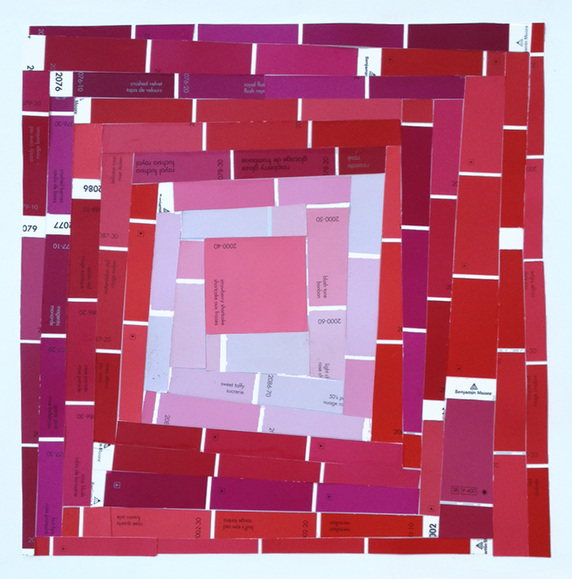
Paint chips as log cabin quilt block (Carlyn Yandle photo)

Day 2:

Picture
"Toybits": cluster of plastic toy fragments. (Carlyn Yandle photo)
Picture
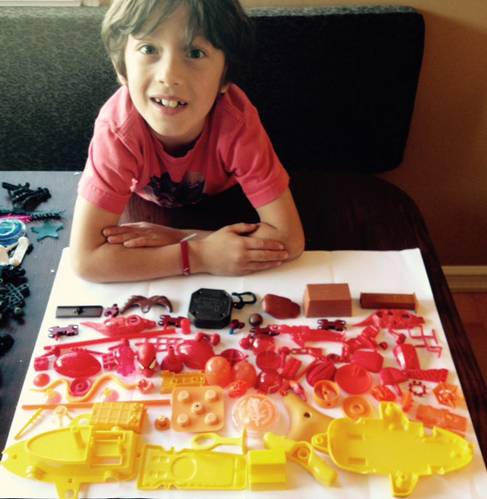
Reorganizing broken toys with kids II (Carlyn Yandle photo)

Day 3:

Day 1:

Picture
Re-organizing broken toy bits with kids (Carlyn Yandle photo)
Picture
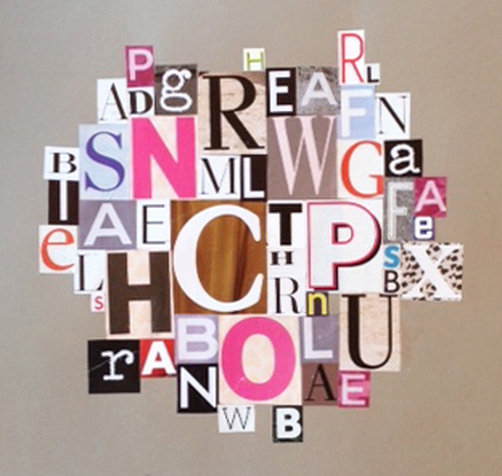
Playing with typography, New York Times Style Magazine (Carlyn Yandle photo)
Picture
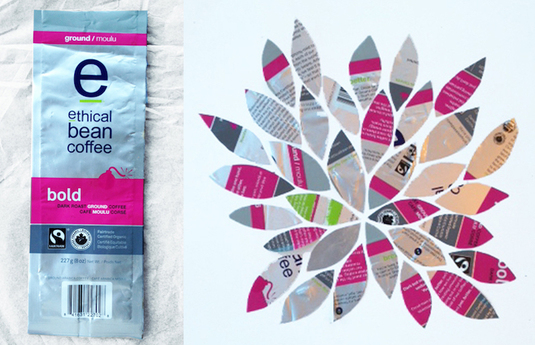
Reworking one coffee bag (Carlyn Yandle photo)
Picture
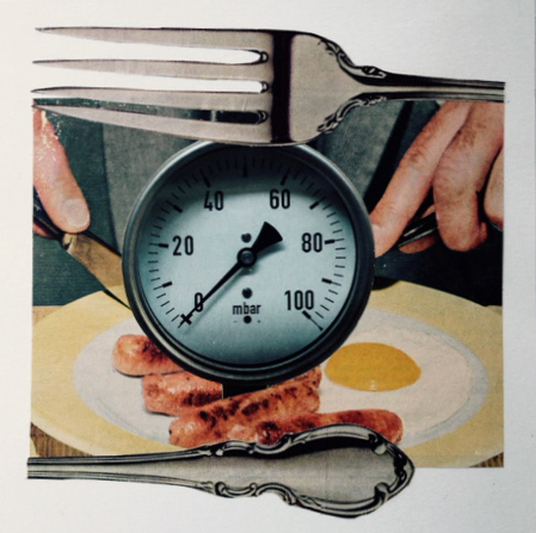
Collages of mid-century women's magazines (Carlyn Yandle photo)
Picture
Collages of mid-century women's magazines (Carlyn Yandle photo)

Day 4:

Picture
Collages of mid-century women's magazines (Carlyn Yandle photo)
Picture
Grid collage from New York Times Style magazine (Carlyn Yandle photo)
Picture
Grid collage from New York Times Style magazine (Carlyn Yandle photo)
Picture
Exhausted from doing grid collage using NYT magazine (Carlyn Yandle photo)

Day 5:

Picture
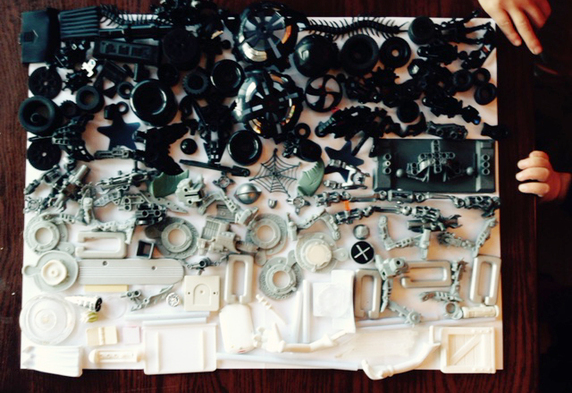
Broken toy amalgam inspired by morning newspaper (Carlyn Yandle photo)
Picture
Idea for a feature wall or screen, using inserts from wine bottle wood crates (Carlyn Yandle photo)
Picture
'Girl with Hole in her Head' possible title of random wire-as-drawing play (Carlyn Yandle photo)
Comments

3 artworks a day for 5 days -- and an extra challenge

2/20/2015

Comments

 
Vancouver artist Connie Sabo threw the current Facebook challenge (three artworks a day for five days) to me this week. I'm taking on the challenge for the chance to create three art experimentations per day, as opposed to sharing three artworks on each of those five days. Because there's nothing like a daily deadline of three new works to eliminate my usual obsessiveness and overworking, while pushing in new directions. I call it Fun with Failure.

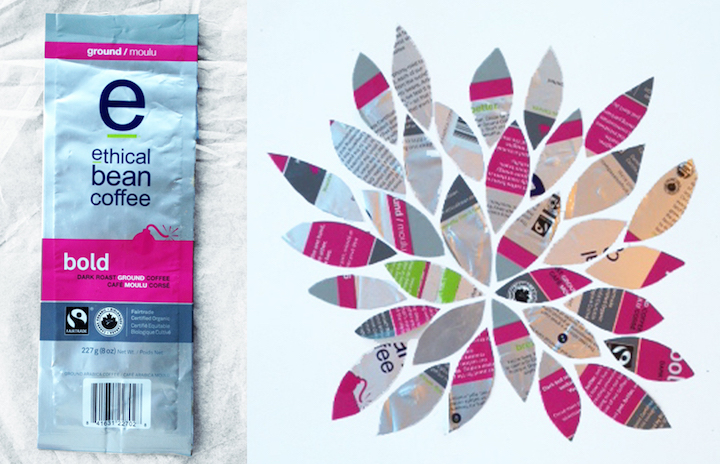
And just to ensure there will be no preciousness in the program I added another element to my personal challenge: none of the materials used may be new.  I'm using stuff that's already had a first use.

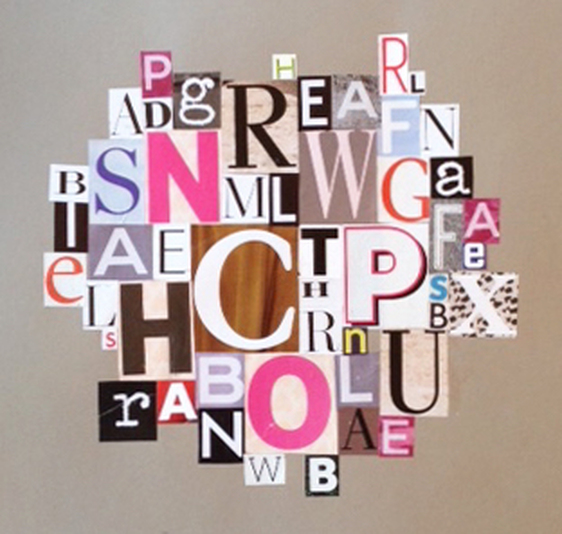
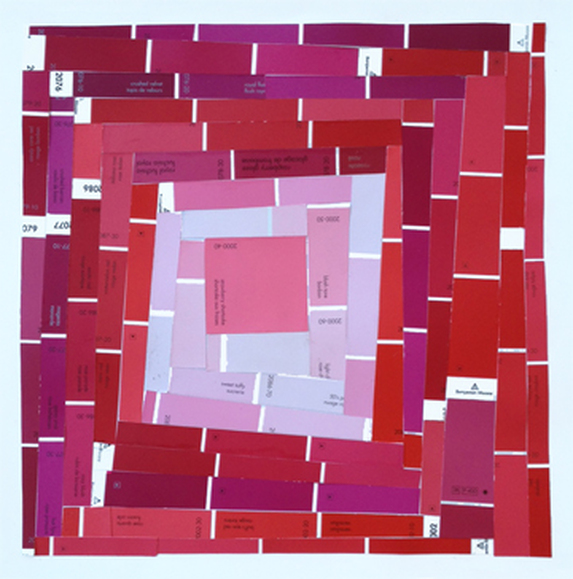
Here then is Day 1 of my Nothing New 3 Artworks in 5 days mission. The rest will be posted on Facebook for the next four days, culminating in a look at the outcomes of the challenge next Friday in this space.
Picture
Coffee bag collage, 1 coffee bag, gluestick, paper, 12" x 12" (Carlyn Yandle photo)
Picture
Typography cluster, discarded magazines, gluestick on paper, 12" x 12" (Carlyn Yandle photo)
Picture
Paint-chip block, paint chips, gluestick on paper, 12" x 12" (Carlyn Yandle photo)
Comments

Winter storms lead to brainstorms

1/2/2015

Comments

 
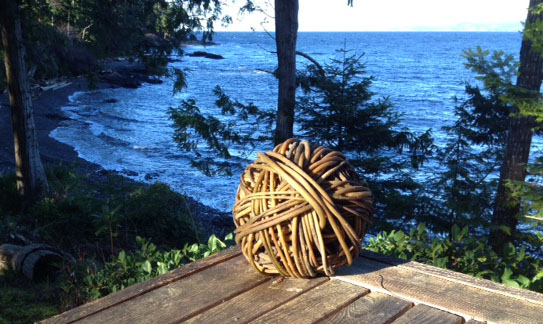
A Christmas Day king tide served up some thick snarls of bull kelp and I seized on an idea.
PictureKelp Skein, in progress. (Carlyn Yandle photo)
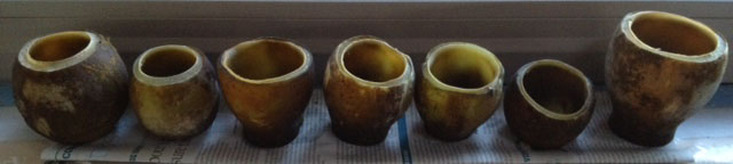
Actually, I had no particular idea in mind; only quite a bit of wonder at the quantity of the stuff. After dragging great hunks of it back to the deck, I started to play. I organized the stuff into visual categories, and soon I was winding the tendrils into a skein, and slicing the bulbs into vessels. Some experiments were left in the elements and others brought indoors to desiccate (and hopefully not moulder and go rank).
Will my 20-pound giant ball shrivel up and break apart? Will the vessels turn into leathery cups? Time will tell and failure will be a teacher. 

In the meantime, I turn to the research portion of this playing with materials which leads to playing with ideas.

Picture
Material test #2: Drying bulbs on a windowsill (Carlyn Yandle photo)
PictureKelp bags helped preserve harvests of shorebirds.
No surprise this high-tensile, miraculously durable, bouncy stuff has had many practical uses since ancient times.

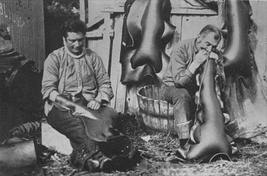
The first nations of New Zealand called it Rimurapa, and cut into the honey-comb-like walls of the blades to create bags — Poha — to preserve and cook their harvests of muttonbird, an oily shorebird. Or they cut slits in the bags, filled them with shellfish, starfish and abalone, then tossed them in the water to seed coastal areas. Or they attached two inflated pohas and used them as water-wings in strong currents. Or lined woven reed hulls to make super-buoyant Zodiac-type vessels. The first nations in these parts transported oolichan oil.

That's all before listing all the nutritional attributes, and there was plenty of play in that bull kelp too. The high concentration of alginate makes the material a natural rubber ball.

Picture
A high concentration of the chemical alginate creates elasticity — perfect for a ball.
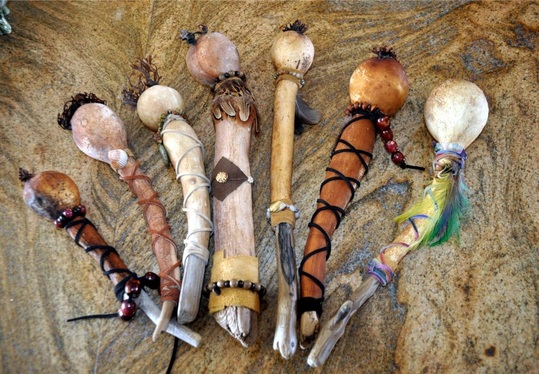
PictureCalifornia maker Geri Swanson's kelp rattles are part of her nature-crafty product line.
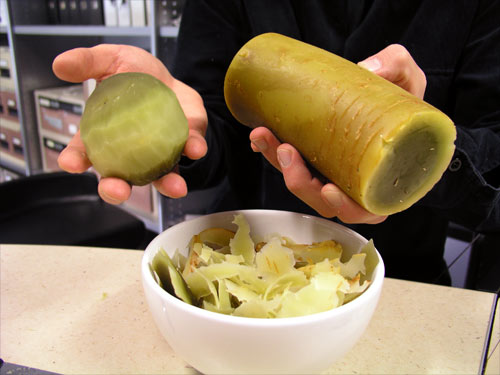
If you image-search "use for kelp" you're hit with a barrage of ideas for thick rings of pickle recipes and a lot of crafty ways with kelp.

Among the fascinating findings are the Seattle area sound performance artist Suzie Kozawa, who makes wind instruments from bull kelp; and Everett, Washington fiber artist Jan Hopkins who combines bull kelp with sturgeon skin and other materials in her conceptual vessels.

Picture
When a craft belies its materials the inherent beauty of that material is lost.
Picture
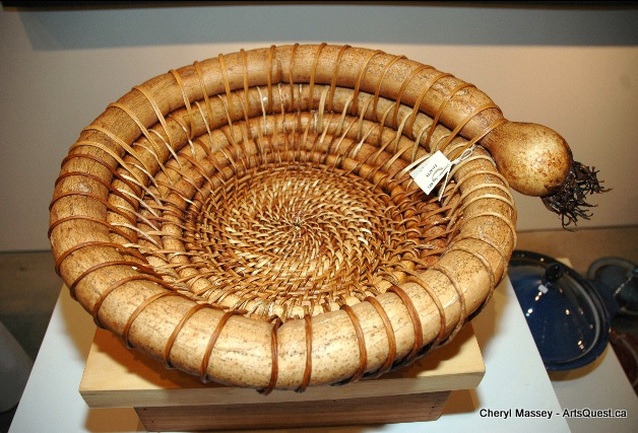
Whistler, BC maker Cheryl Massey celebrates the reducing diameter of the entire length of one bull kelp stem.
But the beauty of the google-search is finding what you're not looking for, the unintended learning. That happened when I came across American artist/designer/maker Scott Constable and his manifesto-in-the-making of  ‘exuberant frugality’ (fine video in that link) that defines what he calls Deep Craft, based on the principles of deep ecology. Like Constable, I am intrigued by the inherent qualities of bull kelp and am still playing with how to make the most of those characteristics. He is thinking about bronze-casting the bulb and thick stem portions as furniture legs. I will stick to the meditative motions that will grow the kelp skein while keeping me thinking.

Comments

QR button blanket: Epic fail or a larger reading?

3/21/2014

Comments

 
Picture
After three months of sewing one donated button after another into a giant QR code, the big moment arrived this week: time to stand back and scan that baby with a reader app, translating this quilt-thing to read, "The devil is in the details."

Except it didn't read. Don't panic!, I thought, then spent the entire next day working with a photo image of the QR Button Blanket, Photoshopping in more buttons and darker buttons and bigger buttons, trying to add the minimum amount of density for the software program to register the pattern and work its magic to produce the punchline. No luck; even a sliver of white in one button cluster puts a wrench in the wholecloth works. I filed this one under the category of Epic Fail, not worth finishing it as intended, framing it in black bias binding. I do not want to create something that is 'still' good; I want the thing to be good, full stop.

Picture
Failure demands confronting the why. Why conceive such a laborious, risky project in the first place?  Why endure the painstaking process when half-way through it was becoming abundantly clear that this was not going to 'read'?

But there is another power here, and that's tied to the process beyond the product. The achievement may lie in the endurance (in an increasingly A.D.D. world) that is not necessarily attached to the product after all. It may be in seeing it through, without the promise of a sure result. The power may lie in the humble, everyday materials and the community of women who contributed all those bits of plastic saved from the waste stream. (There should really be a global ban on production of billions of plastic buttons. Plant-based plastic, bone, wood, and leather- or fabric-wrapped tin buttons eventually return to the earth.)

But what's really starting to click in for me is the cultural reference of this button-grid design. A decade ago, it might have been viewed as an oddly arranged colour field or an abstracted grid but we're so acclimatized to codes that the pattern begs to be 'read.' The fact that this is irresolvable might be annoying. And that's interesting. 

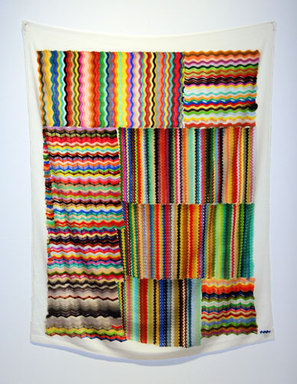
PictureWavy Gravy, marker on synthetic velvet, 58" x 43"
The possible multiple references could be more engaging than the one answer provided by a QR reader app. There's something to be learned in the discomfort of the open-endedness.

Moments like these, I seek out the artists who have embraced what New York artist Polly Apfelbaum calls the 'tough beauty' of visually exciting works that incorporate everyday materials in surprising ways. Apfelbaum, who calls herself a bad crafter, articulates the process of hard work in this video. 

"I work all the time," she says, without a schedule and in a highly experimental way. "You make the work and then you hope for the best." 

 "It's very important to get your fuck-you back."

I'm going with that.

Comments

Innovation can be a risky business

1/16/2014

Comments

 
Coming up with new ideas is not without its hazards. The world-renowned Noma restaurant is a case in point. Chef-patron Rene Redzepi uses what grows in the area, innovating astounding food creations famously foraged from the local land and sea. Sometimes the magic works; sometimes it doesn't. He's even admitted to his own spontaneous bowel reactions to his experiments.
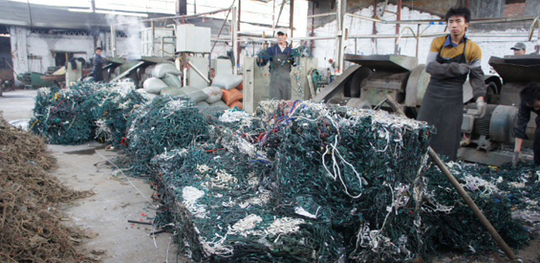
PictureMountains of Christmas lights headed for the grinder in Shijiao, China (Atlantic Magazine)
One outfit in the southern Chinese town of Shijiao has innovated a low-tech method for squeezing a livelihood out of the great bulk of broken Christmas lights. Making use of the empty shipping containers returning to the global export hub and North Americans' addiction to buying cheap throwaways, the strings are thrown into a grinder, then shovelled into a water bath that separates the heavier metal wire fragments from the plastic insulator bits. The metals are eventually separated into reusable copper and other metals, and the plastic is used in slipper soles. (Check out the fascinating video.)

Granted, there are problems, like the possibility of lead in the plastic that ends up cozying up to the soles of feet and the spewing pollution from copper processing.

That necessity to make a living is one mother of invention, a prime example of the hard birth of a global leader in innovation.

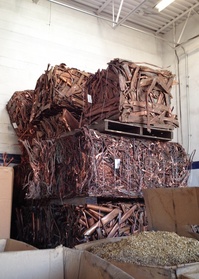
PictureBaled copper. Carlyn Yandle photo
Considering the glut of stuff and our continued rampant consumerism, it's becoming unconscionable to me to use materials that are not either post-market or readily re-usable. That's easy to face down in the making of sculptural objects. I find inspiration through foraging in my own environment, where culturally-weighty artifacts from spider-webby doilies to crushed copper play with concept. 

But I'm stymied when it comes to painting. I love the exploration but can't stand the materials. I rely on petroleum-based paints and resins, first-use softwood stretchers, brushes and canvasses. Acrylic paints allow me to do the layering I can't achieve in oils, creating that fine line between the handmade and digital.

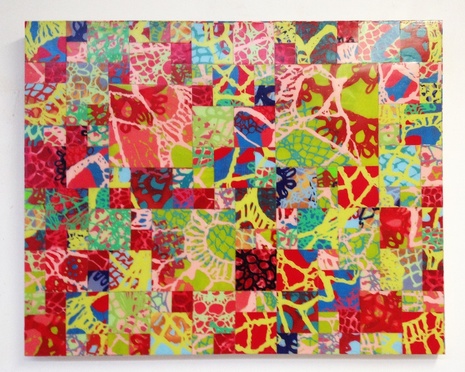
PictureUntitled, 2013, Distract series, acrylic on canvas, 24" x 30" on panel.
I feel it all coming to a head: Am I willing to lay down the paintbrush to reduce my own carbon footprint? Not quite.

But I am taking a few baby steps. I've been experimenting with composing larger paintings out of my painting studies, to incorporate the patterns of both the painted surface and the piecing, not unlike a quilt made up of well-chosen materials that have outlived their original purpose.

 It may just be that necessity to reduce my consumption that pushes me into innovating in painting. Like other innovations, there will be failures and disasters. Somewhere in there is a new way to approach painting.

Comments
<<Previous
    Cross-posted at
    carlynyandle.substack.com

    browse by topic:

    All
    Abject
    Abstract
    Abstract Embroidery
    Abstraction
    Abstract Painting
    Abundance
    Accumulations
    Acrylic
    Activism
    Additive
    Aesthetics
    Agency
    AgentC Gallery
    Aging
    Alison Woodward
    Aluminum
    Amanda Wood
    Anxiety
    Appropriation
    Arcade Fire
    Architecture
    Arleigh Wood
    Art
    Art Activism
    Art Blog
    Art Business
    Art Discourse
    Art History
    Artifact
    Artist
    Artist Residency
    Artist Statement
    Artist Talk
    Art Marketing
    Art Quilt
    Arts And Crafts
    Art School
    Art Show
    Art Spiegelman
    Assemblage
    Author
    Banksy
    Bauhaus
    Beauty
    Betsy Greer
    Big Data
    Billy Patko
    Binding
    Blogs
    Blog Tour
    Bob Krieger
    Body Of Work
    Books
    Boro
    Braided Rug
    Braiding
    Bruce MacKinnon
    Bruce Mau
    Building
    Bull Kelp
    Burlap
    Business
    Buttons
    Canadian Artist
    Carlyn Yandle
    Caroline Eriksson
    Cartoon
    Ceca Georgieva
    Challenge
    Charley Yandle
    Children
    Christmas
    Cindy Sherman
    Circular Thinking
    Cirque Du Soleil
    City As Site
    City Planning
    Cityspace Gallery
    Clay Yandle
    Climate Change
    Cluster
    Cob
    Cob Oven
    Collaboration
    Collage
    Collection
    Colonialism
    Color
    Colour
    Commission
    Community
    Community Building
    Composition
    Conceptual Art
    Conceptual Craft
    Connection
    Connie Sabo
    Construction
    Coronavirus
    Cosplay
    Costume
    Counter Culture
    Counter-culture
    Cover
    Cover-19
    Covid
    Craft
    Craft Blogs
    Craft Camp
    Craftivism
    Crafts
    Craftsmanship
    Creative Process
    Critique
    Crochet
    Cross-stitch
    Cultural Hub
    Cultural Studies
    Culture
    Culture Jamming
    Culturejammingc9d75664fd
    Current Conditions
    Cycling
    Dafen Village
    Dallas-duobaitis
    Dance
    Data-graphic
    Data-graphic
    David Weir
    Dear Human
    Decorations
    Deep Craft
    Denim
    Denyse Thomasos
    Design
    Digital Art
    Discomforter
    Display
    Dissent
    Distraction
    Distracts
    DIY
    Doilies
    Doily
    Domestic
    Domestic Interventions
    Douglas-coupland
    Draw Down
    Drawing
    Dressed
    Drip By Drip
    DSquared2
    Dude-chilling-park
    Dyeing
    Dystopia
    Eastend
    Eastside Culture Crawl
    ECUAD
    ECUAD MFA
    Editorial
    Edward Burtynsky
    Eggbeater Creative
    Embellishment
    Embroidery
    Emily Blincoe
    Emily Carr Cozy
    Emily Carr University
    Entanglements
    Environment
    Environmental Art
    Exhibit
    Exhibition
    Expanded Painting
    Experimentation
    Exploration
    Expression
    Fabric
    Fabricating
    Fabrication
    Facebook
    Failure
    Fashion
    Fashion Revolution
    Fast Fashion
    Feminisim
    Feminist
    Feminist Art
    Festival
    Fiber
    Fiber Artist
    Fiber Arts
    Fibre
    Fibre Arts
    Film
    First Saturday Open Studios
    Flo
    Flow
    Forage
    Foraging
    Form
    Form And Function
    Foundlings
    Found Materials
    Found Objects
    Fractal
    Fracture
    Free Store
    Fuckwit
    Fuzzy Logic
    Gallery
    Gallery-row
    Garden
    Gardening
    Garment
    Gathering
    Gentrification
    Geometric Art
    Gill Benzion
    Gingerbread
    Globalization
    Glue
    Goblin Core
    Grad 2020
    Graffiti
    Grannycore
    Granny Square
    Granville-island
    Green Space
    Grid
    Grief
    Guanajuato
    Guerrilla Art
    Guerrilla Girls
    Halloween
    Handmade
    Handmaking
    Hand Stitching
    Hand-stitching
    Handwork
    Hashtags
    Haywood Bandstand
    Healing
    Health
    Hearth
    Heirloom
    Hideki-kuwajima
    Hoarding
    Homelessness
    Homemade
    Hot Art Wet City
    Housing
    Hybrid Thinking
    Ian Reid
    Ian Wallace
    Ideas
    Identity
    Images
    Imagination
    Immersive Art
    Improvisation
    Incomplete Manifesto For Growth
    Industrial Design
    Industry
    Innovation
    Inspiration
    Instagram
    Installation
    Installation Art
    Intervention
    Intrusive Thoughts
    Invention
    Irena Werning
    Ironing
    Janet Wang
    Jeans
    Jeff Wilson
    Joel Bakan
    Joseph Beuys
    Joseph-wu
    Journalism
    Joyful Making In Perilous Times
    Joyfulmakinginperiloustimes
    Judith Scott
    Kamala Harris
    Kids Art
    Kim Piper Werker
    Kimsooja
    Kintsugi
    Knitting
    Knots
    Knotting
    Kyoto
    Labor
    Labour
    LA Fires
    Landon Mackenzie
    Landscape
    Leanne Prain
    Lecture
    Lighthouse
    Linen
    Liz Magor
    Log Cabin
    Logo Sweater
    LOoW
    Lost Painting
    Lumiere Festival
    Lynda Barry
    Macrame
    Maker
    Making
    Making Is Connecting
    MakingIsConnecting
    Malcolm Gladwell
    Male Gaze
    Mapping
    Maquette
    Marie Kondo
    Marine Palette
    Marketing
    Mark Lewis
    Martha Rosler
    Martha Stewart
    Masks
    Material Exploration
    Mathematics
    Maya
    Media
    Meditation
    Meditative
    Mending
    Mend In Public Day
    Mental Health
    Metalworker
    MFA
    Mister Rogers
    Mixed Media
    Mobile Art Practice
    Monique Motut-Firth
    Monster
    Monte Clark
    Mosaic
    Motivation
    Mt. Pleasant Community Centre
    Mud Girls
    Mural
    Mushroom
    Mycelium
    Narrative
    Natalie Jeremijenko
    Nature
    Needlework
    Neon
    Net
    Network
    Networking
    Neuroplasticity
    New Forms Festival
    Newspapers
    Nick Cave
    Noah Goodis
    Nodes
    North Vancouver
    Obtrusive Thoughts
    Omer Arbel
    Online Talk
    Openings
    Organization
    Origami
    Overabundance
    #overthinking
    Paint
    Painting
    Pandemic
    Paper
    Paper Sculpture
    Papier Mache
    Parkade Quilt
    Patchwork
    Patriarchy
    Pattern
    Pecha Kucha
    Pechakucha
    Perception
    Perfectionism
    Performance
    Performance Art
    Personalispolitical
    Photography
    Playing
    Political Art
    Political Satire
    Polly-apfelbaum
    Pompidou
    Poodle
    Pop-Up
    PopUp
    Port Coquitlam
    Portrait
    Practice
    Process
    Production
    Profession
    Project
    Protest
    Protest Art
    Psychedelic
    Public Art
    Pussy Hat
    Pussy-hat
    Qr Code
    Quilt
    Quilt Block
    Quilting
    Quilt Painting
    Rachael Ashe
    Rachel Lafo
    Ravages
    Raw Materials
    Rebar
    Recycle
    Recycling
    Reflection
    Reflektor
    Reimagine
    Renewal
    Repairing Is Caring
    RepairingIsCaring
    Repetition
    Research
    Residency
    Resistance
    Resurge
    Retreat
    Re-use
    Rhonda Weppler
    Richard-tetrault
    Richmond Art Gallery
    Right Brain
    Rondle-west
    Roses Against Violence
    Rote Activity
    Rug
    Ryan-mcelhinney
    Safe Supply
    Safety
    Sampler
    Sarah-gee-miller
    Sashiko
    Saskatchewan
    Scaffolds
    Scaffolds I
    Scale
    Scraps
    Sculpture
    Seasonal Decor
    Seattle Art Museum
    Seaweed
    Seismic Rug
    Semiotics
    Sewing
    Seymour Art Gallery
    SharingIsCaring
    Sharon Kallis
    Shawn Hunt
    Shigeru Ban
    Sketchup
    Slow Craft
    Smocking
    Social Art
    Socialart
    Social Distancing
    Social Distancing Hat
    Social Engagement
    Social-engagement
    Social History
    Social Justice
    Social Media
    Soft Sculpture
    South-granville
    Space Craft
    Spore
    Stitching
    Storage
    Street Art
    Studio
    Styrophobe
    Substack
    Subversive Stitch
    Surrealism
    Surrey
    Tactical Frivolity
    Tactility
    Tagging
    Talking Art
    Tapestry
    Tatjana Mirkov-Popovicki
    Tattoo
    Teamlab
    Technology
    Terry Fox Theatre
    Text
    Textile
    Textile Art
    Textiles
    Thrifting
    Thrift Stores
    @tinypricksproject
    Tiny Pricks Project
    TJ Watt
    TO DO
    Tools
    Toronto Design Offsite
    Toybits
    Trash
    Trash Art
    Travel Art
    Trevor Mahovsky
    Trump
    Typography
    Tyvek
    Unbridled
    Unfixtures
    Unravel
    Upcycle
    Upcycling
    Urban Design
    Use Object
    Use Objects
    Utility
    Value Village
    Vancouver
    Vancouver Art Gallery
    Vancouver International Airport
    Video
    Video Tour
    Visual Artist
    Visual Field
    Visual-field
    Visual Language
    Wabi-sabi
    Wallace Stegner House
    Wall Hanging
    Waterwork
    Wearable Art
    Weaving
    William Morris
    Women's March
    Wood
    Wool
    Work Wraps
    Wrap I
    Wrap II
    Writing
    Xenobia Bailey
    Yarn Bombing
    YVR
    Zaha Hadid
    Zendoodle
    Zero Waste Art
    Zero-waste Art

    Archives

    January 2026
    December 2025
    November 2025
    September 2025
    May 2025
    April 2025
    March 2025
    January 2025
    December 2024
    November 2024
    October 2024
    September 2024
    August 2024
    July 2024
    June 2024
    October 2022
    August 2022
    June 2022
    November 2021
    April 2021
    September 2020
    April 2020
    December 2019
    November 2019
    September 2019
    August 2019
    July 2019
    June 2019
    April 2019
    November 2018
    July 2018
    May 2018
    November 2017
    September 2017
    June 2017
    April 2017
    March 2017
    February 2017
    December 2016
    November 2016
    September 2016
    July 2016
    March 2016
    February 2016
    January 2016
    December 2015
    November 2015
    October 2015
    September 2015
    June 2015
    May 2015
    April 2015
    March 2015
    February 2015
    January 2015
    December 2014
    November 2014
    October 2014
    September 2014
    August 2014
    July 2014
    June 2014
    May 2014
    April 2014
    March 2014
    February 2014
    January 2014
    December 2013
    November 2013
    October 2013
    September 2013
    August 2013
    July 2013
    June 2013
    May 2013
    April 2013
    March 2013
    February 2013
    January 2013
    December 2012
    November 2012
    October 2012
    September 2012
    August 2012
    July 2012
    June 2012
    May 2012
    April 2012
    March 2012
    February 2012
    January 2012
    December 2011
    November 2011
    October 2011
    September 2011
    August 2011
    June 2011
    May 2011
    April 2011
    March 2011

Powered by Create your own unique website with customizable templates.
Picture