carlyn yandle
  • about
  • the creative process
  • crafted objects
  • public art
  • painting
  • exhibitions
  • contact

The nodes know

1/30/2026

 
Hope empowers quirky denim objects

I’ve had this exchange a few times this past week:
You’re so busy. What are you working on?
Uh… hard to say. 
​

It’s hard to put into words this curious crafty endurance with a deadline. Better to just hold up my needle-scarred fingers and gnarled hands. Hand-work stuff. For exhibition.
Picture
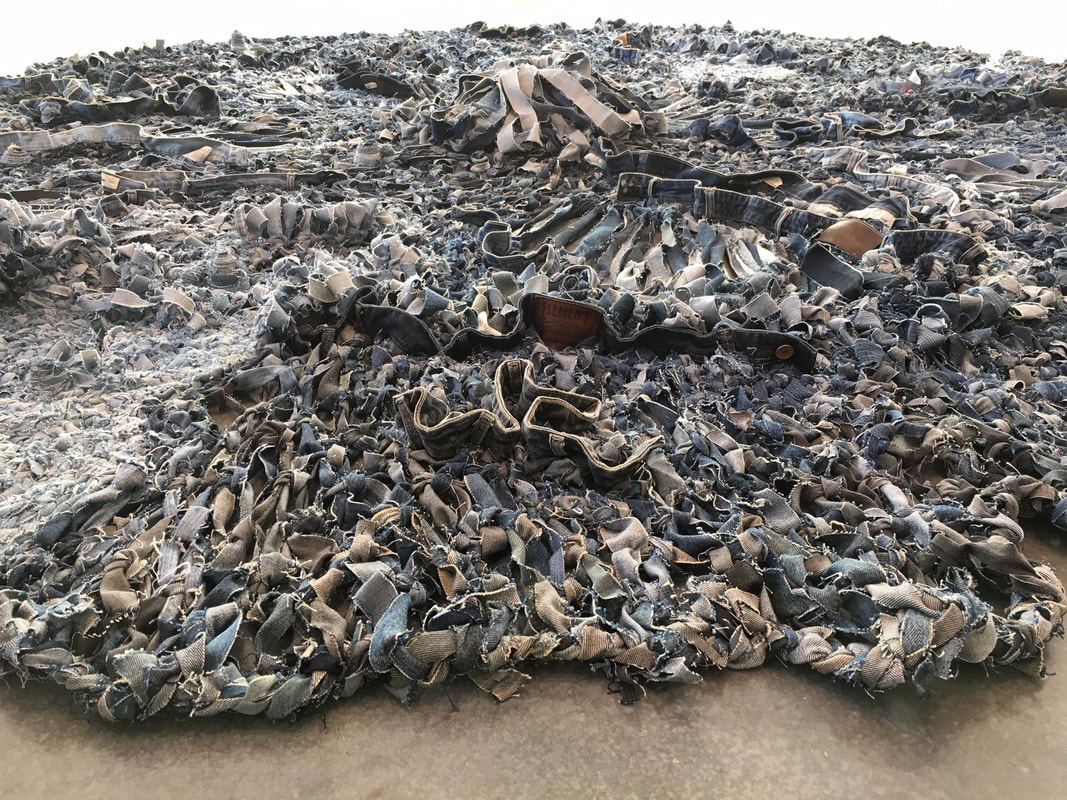
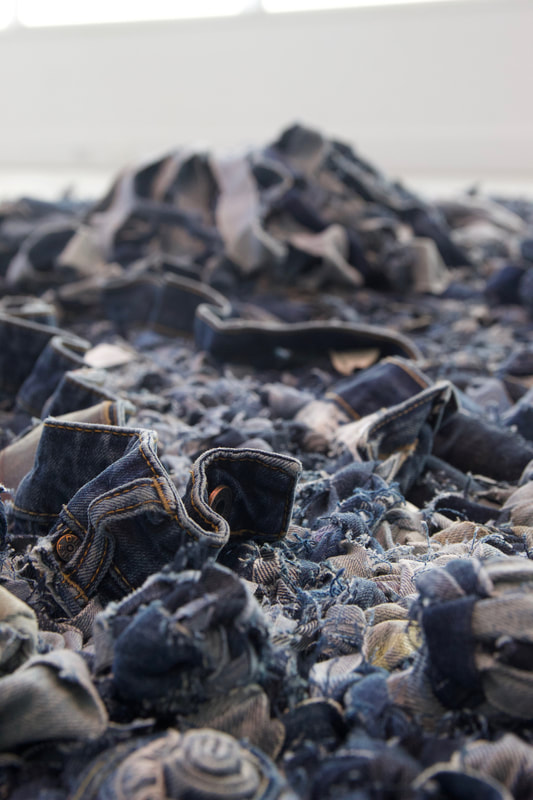
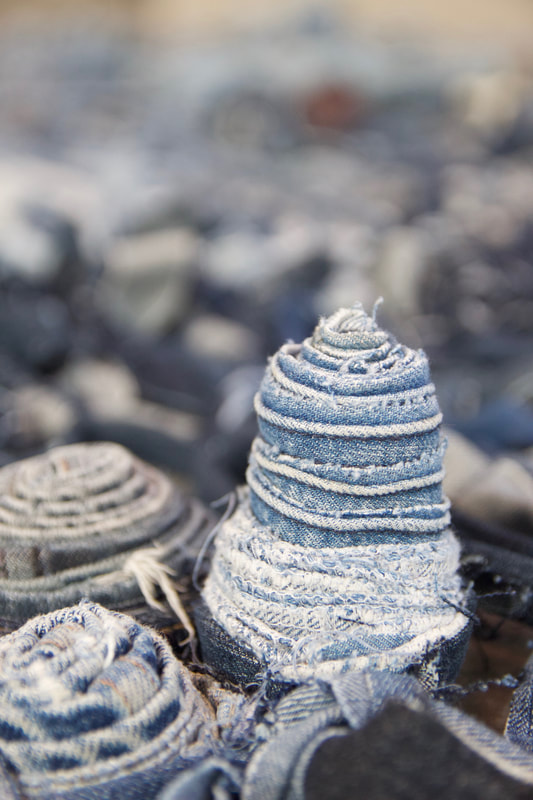
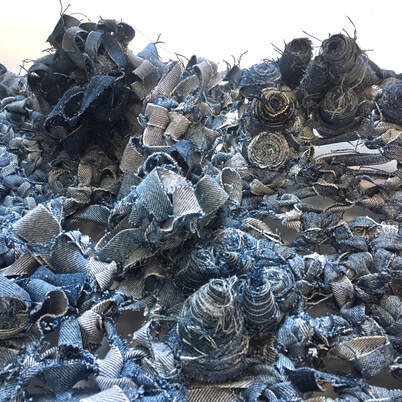
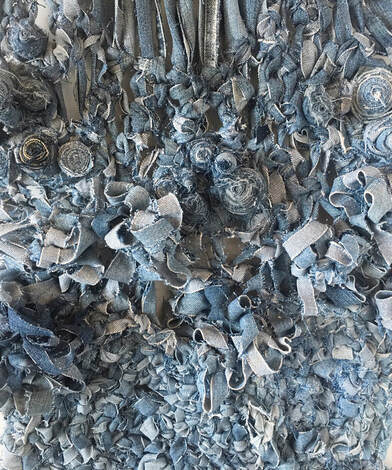
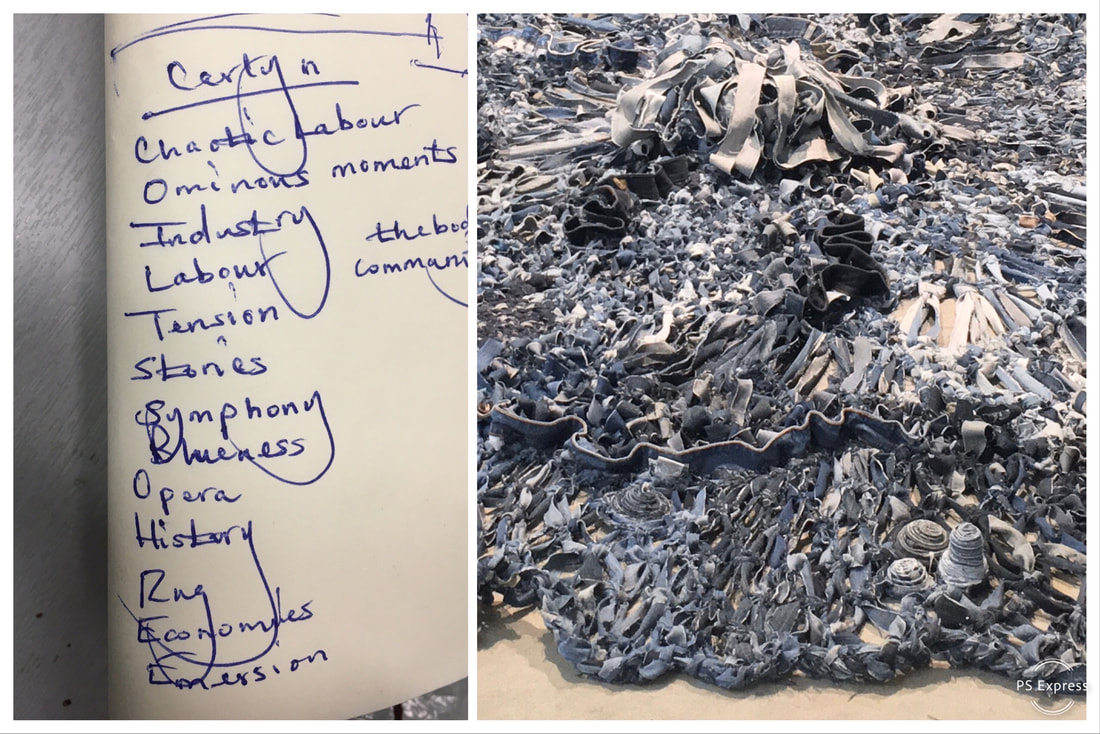
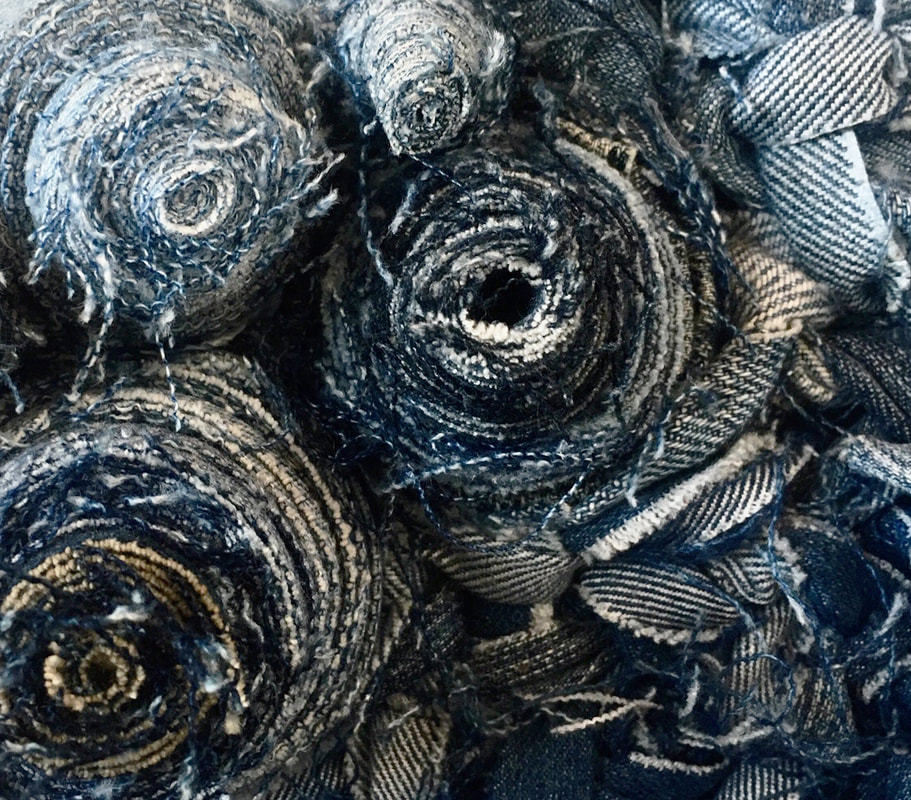
I have only myself to blame for spending these glorious foggy-sunny mid-winter days indoors cutting out seams and waistbands from discarded jeans and stitching them into quirky little coils and nodes. But they want to emerge, like characters in a novel that surprise even the author. They want to sprout like spores out of a knotted network of denim created back in the months before the global pandemic lockdown.
​
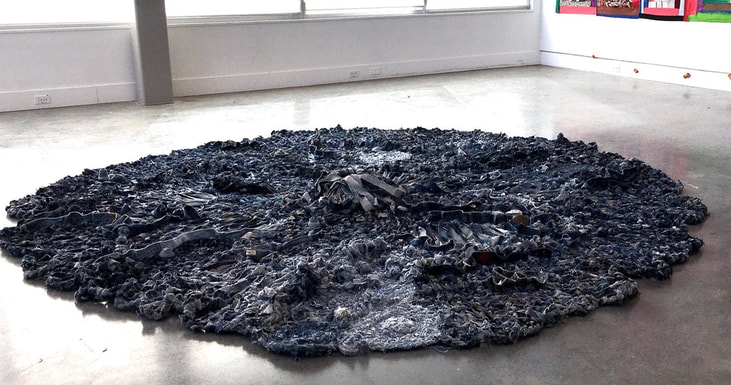
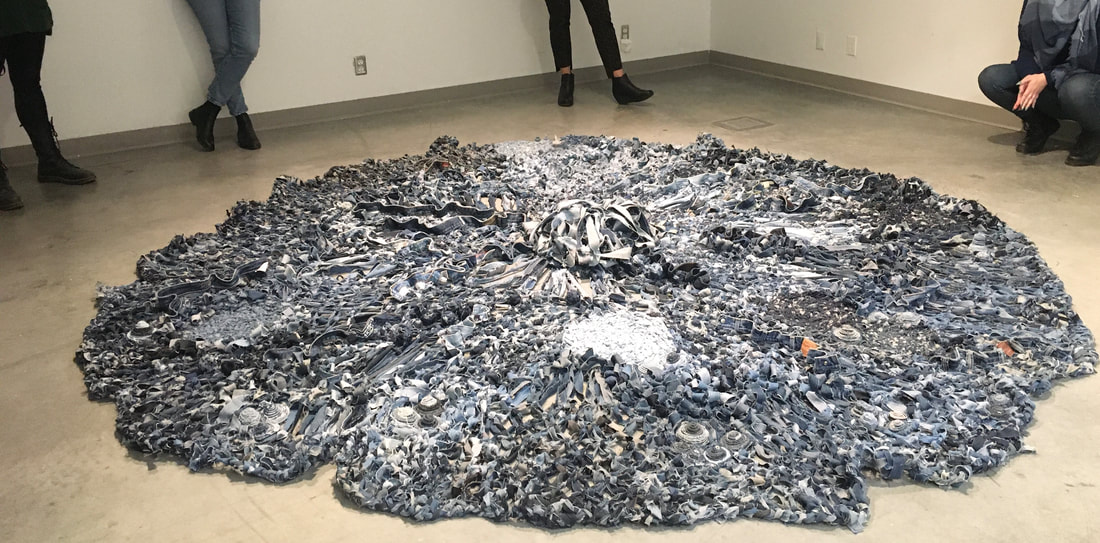
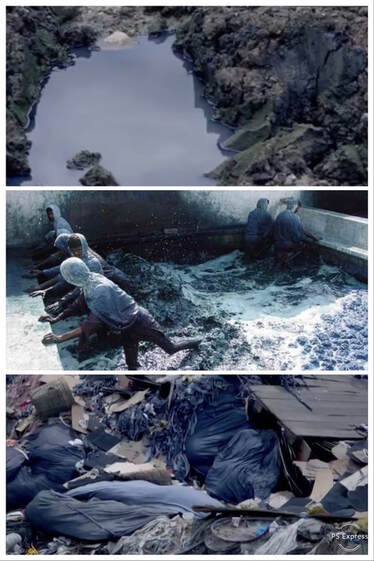
Resurge started as a compulsion during the first tempestuous Trump administration and soon after the release of an alarming report on climate change and rising sea levels. I fell into a daily rhythm of knotting and braiding a pile of discarded jeans, for the simple satisfaction of bringing new life to this particular abject material. The work revealed itself as a ground-zero eruption, an unstructured sprawl of frayed tendrils and rivulets of global brand logos in a very West Coast marine palette.
Picture
But now Resurge wants to rise above its heaviness, no longer limited to the floor but installed at a vantage point that suggests topography: a whole new world.
​

I didn’t overthink the urge to needle up a population of nodes to insert into a tumultuous water-scape. Instead I’m immersed in the material and the method, allowing the swirl of ideas and responses from local and global realities to infuse and entangle. The making is irrepressible, eclipsing my weekly writing time, as I make one benign conical object after another. Soon — hopefully — a critical mass will emerge that must be reckoned with.
Picture
In 2019, this slippery, shapeless sea of knots held space for more layers of meaning. In 2026 Resurge offers regrowth and resilience, from the fracture. I hope it will resonate in these perilous times.

​
(Cross-posted at https://carlynyandle.substack.com/)

​UNRAVEL, Mixed media works by Tatjana Mirkov-Popovicki, Amanda Wood and Carlyn Yandle runs from Feb. 3 - March 14, 2026 at Seymour Art Gallery, Deep Cove, B.C. Reception: Sunday, Feb. 8, 2 - 4 p.m.; “From Conversation to Practice” Program with Amanda Wood, Sunday, Feb. 22, 2 p.m.; “Hearth” social stitching event with Carlyn Yandle, Sunday, March 1, from 2 p.m.; artist talk with Tatiana Mirkov-Popovicki, Sunday March 8, 11 a.m.

From break to breakthrough

1/21/2026

 
Making space for the creative process, at home or away​
​

The following is a public service announcement for all those cowering from the liquid gunmetal-grey skies on this bone-chilling coast: Crank up the Vitamin D. We need 800-1000 IUs per day so pop a supplement or a teaspoon of cod liver oil, or eat wild salmon (600-1000 per 100 g or 3.5 oz.) regularly. Do it for your bones and teeth. For vegans it’s a bit trickier but here’s a fun fact: mushrooms, the only produce that contains Vitamin D, can generate a goodly dose when they’ve been exposed to sun or sunlamps — just like peoples — so feast on some UV-ray-enhanced mushrooms. Lecture over.

When other mushrooms are threatening to colonize the dark corners of my mind and between my toes, when the skies are as grey and shapeless as my sweatpants, I see these as signs that it’s time to let my skin generate some Vitamin D. I joined the throng of half of all Canadians taking winter breaks this year, with the largest percentage (30%) descending on Mexico and the Caribbean. Puerto Vallarta, just a five-hour flight south on this same west coast of North America, is lousy with Canuckleheads this year. 

I am not doing my country proud with my weak attempts to converse with the locals. Asking questions in that lovely romance language leads to answers I can’t understand so I tend to stick with agreement statements like Aquí hay mucho pollos asados. (“There are many roasted chickens here”). This is maybe why (or because) I spend most of the hot, sunny hours in the rental apartment pursuing my digital-nomad dream of making stuff and writing about it wherever I go.
​

It never works out as planned though I pack with the best intentions. My carry-on contains the usual bag of tricks: white linen cloth; a colourful selection of embroidery floss and hoop; two sashiko sewing needles (they always get through security screening); small containers of red, white, yellow and blue acrylic fluid; two thin paintbrushes; sketchbook and assorted black brush-pens.
Picture
A supplies kit for a mobile studio: paints, brushes, pens, linen, hoop in a dedicated toiletries bag. (Carlyn Yandle)
​Once I’m settled in the rental unit I set up my art supplies. I feel sort of obliged to artistically-render the luscious plants and birds, beaches and sunsets out there but I’m not really into it even if they do turn out which they rarely do. My overwrought sketches of philodendron leaves look like a waste pile of vein-y heart organs. I’m baffled at how to depict the papery folds of bougainvillia blossoms even when I try copying some online examples by other artists. The whole exercise is as onerous as Grade 6 map-colouring which also left me bad-tempered and bored. In the end, as it often happens, the paintbrush rag is more interesting than my tortured attempts.
Picture
The paintbrush rag holds more interest than the painting. (Carlyn Yandle)
It’s a wadded-up piece of two-ply paper towel from a roll I found under the sink but the paint has diffused in a way that reminds me of the surf or the jungly mountains above the Old Town so when it’s dry I smooth it out and pull apart the two bound layers into two translucent mirror images. I know these would be even more translucent if they were brushed onto a wood panel with acrylic medium and coated with a waxy finish.
​
I rummage around the kitchen and locate a glass baking dish and fill it with water to soak another half sheet from the paper-towel roll then lay each soaked sheet out on a glass shelf I removed from the refrigerator — this is the danger of renting your holiday home to artists — then drop or brush on different diluted mixed colours, adding some patterns here and there with the water-based brush pens. Soon I am as absorbed in this material exploration as the paint blooming in the soaked fibres. I set each swatch out on more paper towels to dry and when I run out of all horizontal surfaces I string them up like laundry lines across the open window frames and between chairs, laying down even more paper on the floor to catch the drips.
Picture
Experiments with different paint applications on paper towel.
​There are no photos of that creative process here. I normally make a point of posting photo-documentation but on the outside chance that the condo owner might see their vacation unit turned into a chaotic printmaking factory, that image is left up to the imagination.
Picture
A collection of tissue swatches for future consideration (Carlyn Yandle)
Now back home in this fresh, green coastal city on the foggy edge of a temperate rainforest my brain is still humming with ideas for collaging those test tissues as backgrounds for sketches of patterns captured in morning and evening walks through the streets of the Old Town.
Picture
Patterns from the streets of Puerto Vallarta’s Old Town, Mexico (Carlyn Yandle)
That stack of painted papers holds the creative energy for a new artwork series: the best souvenir of any travels.


Originally posted on Substack, Jan. 11, 2026

Fibre artwork drowning in metaphors

12/14/2025

 
As of this writing, those living or working on 500 properties just 60 kilometres away have been ordered to seek dry land. Those on another 1,000 properties are being told to be ready for word to flee the “slow-moving tsunami” from another flooded river south of the border. This is on the heels of a disaster in the same area four years ago due to an atmospheric river that was “about 60 per cent more likely to happen due to climate change.”
Like the waterlogged lands, this news is too much to absorb. “Atmospheric river” — an intense, narrow plume of water vapour that can transport a greater flux of water than the world’s largest river, the Amazon — didn’t exist as a term before the ’90s, never mind be associated with “climate change.” (That’s one of those banned words in the current US Administration’s Energy Department.)
It’s impossible to ignore these several-thousand-kilometres-long plumes, even outside the flood-risk zones. The rain pelts my windows as I tap away on my laptop. It bounces off and pools up all horizontal surfaces. It seeps through the studio skylight no matter how many times the maintenance guy caulks up the seams. And in this watery part of the world we’re in it for the long haul.
Picture
Water always finds its way and in this soggy space that includes artwork, sometimes even intentionally. Drip By Drip was conceived with water on the brain. I started by mixing up an acrylic paint wash of just the blueish Payne’s Grey to dye various found linens in spontaneous patterns. Later I ripped those pieces to expose the frays of warp and weft, then combined these uniform swatches into new patterns. 
Picture
I tacked a few of these squares on the wall in a row using a single sewing pin for each one, then added lapping rows above to cover each pin that in turn scalloped the bottom edge. This lapping, staggered construction was likely borne from the muscle memory of hand-nailing cedar shingles on all sides of a Gulf Island cabin one parched summer because using the generator risked sparking a ground fire. That lengthy, repetitive work in the hot sun opened up time to notice how the straight, grooved woodgrain was easy to split and nail, and to reflect on how any future repairs would only require replacing a shingle or two. I thought about how that straight grain and flanged edges would slough off the much-needed rain and how it would repel water even better if this was the oil-rich old-growth red cedar used for thousands of years by the Coast Salish peoples in this region to build shed-roof plank lelum̓ (houses).
Picture
Sketches from Architecture of the Salish Sea Tribes of the Pacific Northwest Shed Roof Plank Houses by Christina Wallace (2017) and Cedar by Hilary Stewart (1984)
I still think a lot about how that long history of best construction practices seen in some of the largest lelum̓ in North America before European contact might be used today, and the hubris in trying to beat back the forces of nature through short-term fixes or just pretend it’s all a green energy scam.
Drip By Drip has unlimited growth potential. It can be seen as an expanding painting practice or an artifact of the right-to-dye socials that went into making this frilly field of fibre. I see it as an ethereal shingled barrier in the futile gesture of trying to hold back the next climate calamity, pretty and pretty disturbing.
Picture
"Drip By Drip": An ever-growing ombré shingling of dyed found linens and sewing pins (Carlyn Yandle)
Picture

Taking it Outside

5/1/2025

 
Escaping the dark world of scrolling the socials

“Take it outside” was a standard parenting directive back in the 1900s, shouted at the kids when pro-wrestling or trying to extricate a running shoe from the dog’s lock-jaw or whining for no reason. Taking it outside is harder to do if you live in an apartment tower but there’s no alternative if you’re a teenager hoping for a social life.

My old high school was surrounded by condo towers and mid-rise apartment buildings that are now being razed for higher towers. Hanging out indoors was not an option for many of my friends who lived in one-bedrooms with a single parent. Instead, we migrated from one friend’s building to another, buzzing intercoms to meet them in their lobbies and then go harass some other friend on shift at the Shoppers Drug Mart or hover in front of the fish-and-chips place to try to get the cute server to notice us. We mingled outside at the mini parks and the beach until we were old enough to get inside the clubs.

The club life is a dim memory but I am still compelled to take it outside. When the pandemic lockdown hit, I switched from working in an art studio to hand-stitching a large project on my porch. As the weather improved, I brought any old small thing to stitch to the neighbourhood park, two metres apart from others. That evolved into an improvisational mobile, outdoorsy art practice that begins with a piece of found linen, usually an old stained tablecloth that nobody wants.

Before heading outside I set the linen in the hoop then do a little table work, diluting paint with water and dropping it on the linen to watch the pigments spread through the taut fibres. Sometimes I sprinkle on more water or more undiluted pigment to saturate the colour or increase the bleed, or throw on some salt or soil or a slop of my coffee and observe those effects. I let that dry. I repeat all this in different sections of the linen, maybe including some of the tablecloth design or stitching, then decide which section could use some embroidery embellishments. I cut out that one preferred area, then choose a palette of embroidery floss. My mobile art practice is ready to go wherever I go.
Picture
Embroidery-painting essentials: one 8-inch hoop with ongoing linen project, small primary-colour paint set of liquid acrylics, a mechanical pencil, one small paint brush, fold-up scissors, a bag of a embroidery floss and two embroidery needles. (This art go-bag has passed airport security many times.)
Taking it outside the studio has become my way of working when travelling or during these months of long daylight hours. It is my summer work: some are working, some are not (har-har). No matter; it’s all just practice — practice in learning embroidery stitches (heather and blanket, french knot, woven rose), traditional sashiko patterns, and the personal and social histories of found linens. It is in learning mindfulness, by breaking the habit of scrolling through the socials or fixating on iPhone games and engaging with the world.
​

Inside is for the wintery work of queen-sized quilts and hooked rugs. For the next six months the art studio is simply a storage facility for the large-scale stretched painting canvases, fibre-art hangings, and the clutter of tubes of paint, rags and brushes. This is the season for shedding all that bulk, reducing this art practice to fit into a toiletries bag that lives in the daypack that I take on bike rides all over the city. I pull it out in ferry-passenger lounges, on long bus rides, at park picnics.
Picture
An evolving mobile, outdoorsy art practice confined by materials and method.
Inside is where all the screens are, the source of the unfathomable, dark news of the dismantling of democracy and political extortion. Outside is where all the social and political action is. That includes the global Mend in Public Day last Saturday, April 26, a Fashion Revolution creative action to resist the cycle of excess, through repair and reuse. This year in Vancouver, that was at the Main Street and East 21st Avenue plaza and Granville Island.

Resistance can be beautiful

4/6/2025

 
Hand-making outside the dominant economic system
The news is inescapable. The Trump tariffs announced last week will “rupture the global economy,” warns the Prime Minister. This is on top of the inflationary wallop on 45 per cent of Canadians who reported that rising prices were “greatly affecting their ability to meet day-to-day expenses in the spring of 2024, up 12 percentage points from two years earlier,” according to Statistics Canada. Further, almost one-third of Canadians are “experiencing financial difficulties,” up from 18.6 per cent in 2021. It’s all led to a “gradual deterioration in life satisfaction” especially among younger adults and those with financial difficulties. On top of all this, Canada is in the throes of a snap federal election.

Yet life goes on. That robin outside my window is still doing its 4 a.m. wake-up call. The cherry tree it perches on is about to burst into pink snowballs. Below the tree canopy the Amazon vans still roar through the neighbourhood and the UberEats drivers still double-park to keep up with their orders.

Maybe, and I’m just spit-balling here, we can be like the blossoms and flourish independent of the consumer economy and the attention economy, that battleground that has us in a near permanent state of distraction. I searched how reverse life dissatisfaction and received this AI Overview:

“To reverse life dissatisfaction, focus on identifying the root causes, setting realistic goals, practicing self-care, engaging in meaningful activities, and seeking support when needed.”
​
Even this banal Google-bot response on the general theme of self-reflection begins with the word ‘focus’, followed by ‘practicing’, ‘engaging’, ‘meaningful’, ‘activities’, ‘seeking’ and ‘support’ — words in direct opposition to ‘distraction’, ‘escaping’, ‘frivolous’, ‘inertia’, ‘ignoring’ and ‘undermine.’ There are no Tips and Tricks in the AI Overview for reversing life dissatisfaction through retail therapy, no easy instructions to move fast and break things, or buy bit-coin, self-medicate, move somewhere else or to hang on tight to your privilege.
​

The beautiful thing about having a number of ongoing art projects is that there’s always one that fits the moment. Right now that’s Hearth.

Picture
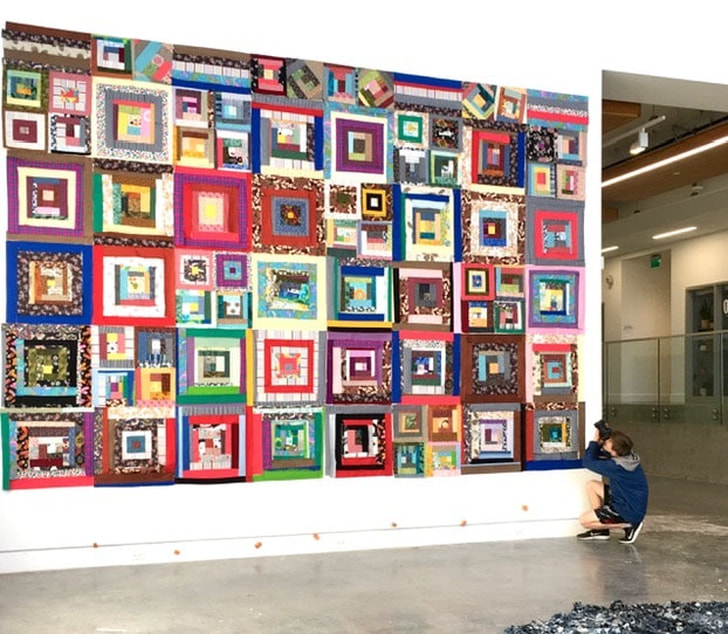
Social making sessions resulted in this first installation of 'Hearth.' (Carlyn Yandle)
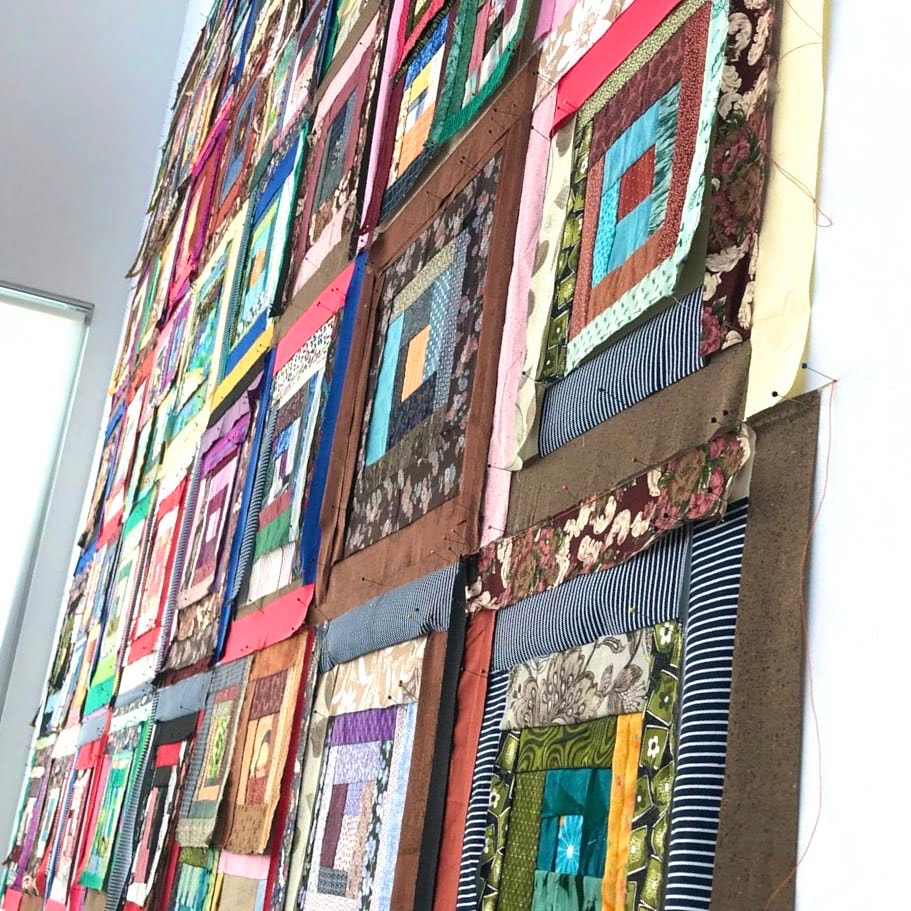
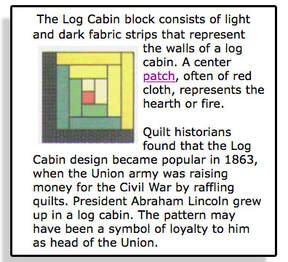
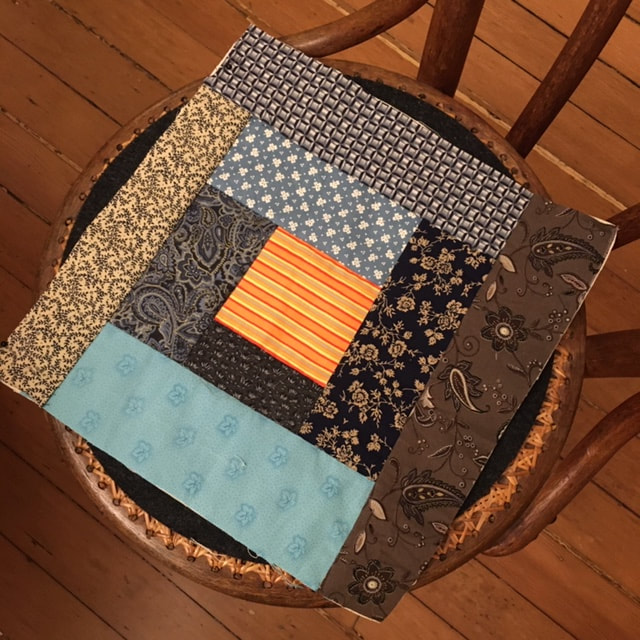
Started back in the beforetimes of 2019, Hearth is an infinitely-expanding grid of log-cabin quilt blocks that began with an idea: What kind of art-making would be engaging and easy enough to attract a diverse population, a big-picture zero-waste project that would cost nothing? What could create the chance to learn a new skill, meet people beyond one’s usual social circle, that would include the joys of giving and receiving, all toward a gallery exhibition?
​

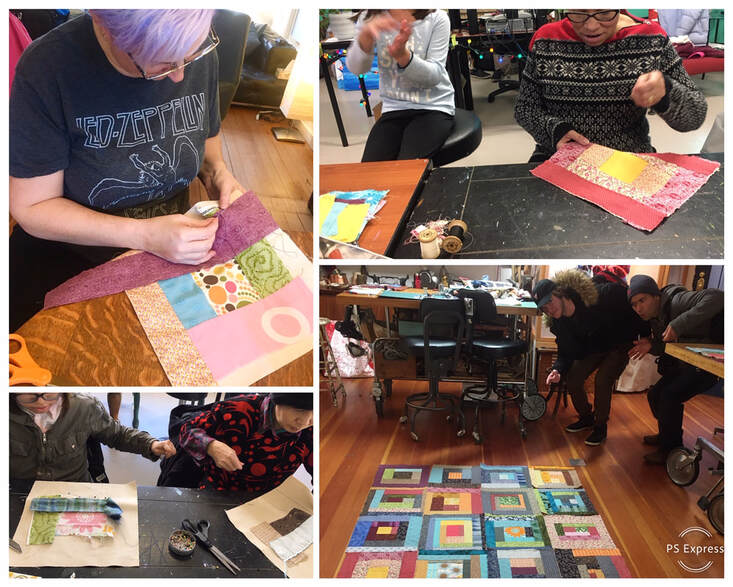
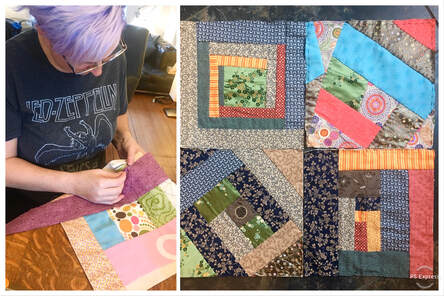
Over the next six months, dozens of friends and friends-of-friends, neighbours, colleagues and people just happening by gathered at art studios, porches, around kitchen tables and living rooms. In groups from two to a dozen, we hand-stitched log-cabin-style quilt blocks from strips of donated fabric in improvised spirals around a central (“hearth”) square.
Picture
Some early stitching sessions (Carlyn Yandle photos)
The blocks were eventually all installed into a massive wall installation as part of my MFA thesis exactly one day before the university shut its doors for several months. We didn’t give up our will; we organized contact-free fabric swaps and took the project online, sharing ideas and stitching instead of drinking.
Picture
Socializing at a distance: a Zoom stitching session (Carlyn Yandle)
When the lockdown rules relaxed, Hearth was instrumental in rekindling social activity. Any in-person awkwardness dissipated as we focused on hand-stitching or just dug through the heap of fabric strips to create a pleasing palette, for our own blocks or to offer someone else.
Picture
RE-START: An early post-lockdown session with MFA colleagues
Picture
A street-front gallery show in the early post-pandemic; interior detail
It takes about two hours for anyone who can hold a needle to stitch a block, about the same time as any social visit. The makers, many of whom learned that in fact they could sew a straight line, were free to take their finished piece home, maybe to use as a cushion cover, placemat or the beginning of a quilt top. Most contributed their blocks to the Hearth project so their own handwork would be a part of a gallery show, with due credit.
​

As normal daily activity resumed, I moved the one bin of fabric strips and the other of finished blocks into deep storage. But just as sure as that cherry tree outside my window will burst into bloom, that project is coming back out for a show of its own. It’s a new chance to focus on practicing engaging, meaningful activity designed for those seeking connection and support outside this dominant, volatile economic system, away from forces screaming for our attention. In these perilous times we’re creating something bigger than our individual selves, one stitch, one block at a time.​

Letting go and getting on it

3/22/2025

 
Our job as artists is to imagine different futures
(Originally published Feb. 23, 2025 on Substack)
I made a bit of a scene when Friedrich Irrgang confirmed that he was retiring after 62 short years in the timepiece-repair business. And just what will become of my wristwatch that he’s been bringing back from the dead on an irregular basis?, I asked him. The inner workings are falling apart, he said in the kind manner of a veterinarian examining someone’s geriatric bag-of-bones cat. True, the watch was a gift for my 30th birthday which was not yesterday or even this century but to let go of the watch and this neighbourhood shop at the same time? That, Herr Irrgang, is a brücke too far!
​
I know; this reaction was unbecoming for the full-grown woman that I am but the little personal losses are piling onto the big public losses like, say, faith in the future of democracy. It’s harder to counter the latest attack on societal norms with “At least” replies but I know I must stay positive, even when it comes to the small stuff! For example, instead of getting alarmed at my thinning hair, I can just go outside and brush out all my falling-out hairs for the birds to use for their nests! Or like when I spiral-fractured my arm but then turned the plaster cast into a model for sleeves I fashioned from dyed doilies. Lemons to lemonade!
Picture
Above: “Coverup No. 2”, 2019: Found doily, plaster cast (Carlyn Yandle)
I’ve also found some buoyancy in reading over-privileged tourists’ one-star reviews of exotic travel excursions. (“The glow worms were disappointing” is a standout.) And I’m always making something with my hands to stop myself from wringing them, so there’s that.
Picture
Above: Recontextualized disintegrating polypropylene rope found on a West Coast shoreline plays with ideas of ‘pretty’ and ‘pretty disturbing.’ (Carlyn Yandle)
Even my own painting disasters can bring me joy when I allow myself to fuck aroundexperiment with materials and ideas.
Picture
Picture
Above: “Regrowth”, 2019: A 24” x 24” acrylic-on-canvas painting from 2013 re-emerges as wall sculpture attached by sewing pins. (Carlyn Yandle)
In summary: Less teeth-gnashing over what is lost or becoming lost; more creative engaging with materials and people; more investigating ways to transform the truly terrible; more joyful making in these perilous times.

The future is fungal

1/18/2025

 
Mushrooms and more for troubled times
When you spend a good portion of your winter cowering from the cold and the rain, it’s hard to fathom the fiery desert winds that are obliterating entire neighbourhoods just a three-hour flight south. In the near-real-time images and video only chimneys, mangled metal and concrete driveways hint at what used to be.

But then you notice the vestiges of palm trees, bougainvillea vines, laurel hedges, tufts of sisal and succulents. Before the last tendrils of smoke dissipate and the insurance battles begin, these plants hold the promise that buds and leaves will sprout and new colonizer species will emerge, boosted by an ashy soil. They are a reminder that whether it’s our perilous planet or our own contorting guts, flora heals.
​
This front line in ground recovery is below the surface, a mycelium network of fungal lace that can erupt in reproductive spores, most noticeably after wildfire as a bright orange carpet of tiny caplets.
Picture
Mapping entanglements: Crocheted cotton, acrylic on panel, 12”x12” (Carlyn Yandle)
Mycelium is all the rage these days, embraced for its regenerative properties. I may be a little disturbed by the tiny fungal ecosystem flourishing in a dark corner of my damp art studio, and mushrooms on my tongue may feel like phlegm balls, but I get excited at the news that mycelium is being explored to fight cancer cells and alleviate physical and psychological trauma.

​The earth-sustaining potential of mycelium is unlimited: just one bus-ride away from my studio, at UBC’s Biogenic Architecture Lab, bricks and other building 
materials are being made from edible fungi like oyster-mushroom mycelium; the late actor Luke Perry’s final wish was to be wrapped up in mycelium embedded in a Mushroom Death Suit for his green burial. (And he was.)
Picture
Mapping entanglements II: acrylic on panel, 12”x12” (Carlyn Yandle)
Mycelium spores, unlike seeds, are resilient to toxic compounds, high temperatures, drought and radiation — food for thought as footage of those Los Angeles homes, typically composed of and containing a wide array of synthetic polymers, go up in poisonous, cancer-causing smoke.
Picture
Spore: Acrylic and mercerized cotton thread on found linen, 12”x 9” (Carlyn Yandle)
I see mycelium as a pattern for social regeneration after natural and unnatural disaster and scorched-earth policies. Its spreading network of tendrils mirrors our innate need to connect with one another, finding and nurturing our common ground despite divisive forces. Those thickening entanglements bring comfort and joy because we are pack animals. It is in our human nature to come together; we can see it right there in the aftermath of LA fires.
​

We may be on shaky ground but I can feel the rumblings as we emerge/erupt/bloom, mycelium-like, when the conditions call for fresh energy. Bloop! Bloop!

Beyond a cozy retreat

1/10/2025

 
Handmade quilts of found fabrics layer up multiple meanings
The squirrels that inhabit my head have been threatening to start a roller derby so I’ve shut it all down by doing something constructive: I’m literally wrapping myself up in my ongoing Perfectly Imperfect quilt project.
​

I’m a construction team of one these dark days, bound up in binding together found satins, brocades and denim with cotton batting and mattress ticking. In this inherent need to make, I am a lady-in-waiting, making myself useful while the MAGA/Trump/tech-oligarchy snarl takes hold later this month.
Picture
Hand-stitching around design elements that are more sawtooth than circular in the Perfectly Imperfect quilt.
I made my first quilt out of old bedsheets and pillowcases as a teenager for my little sister shortly after my mother gave me my first sewing machine and before I knew what I was doing. When my skills were adequate, I advanced to birthday and Christmas gifts and my own homey items like table runners and cushion covers, then moved on to crib quilts for babies, many of whose names I’ve forgotten and are now in their 30s, and for weddings for couples who are still together or have since divorced.
​
Many moons ago an aunt gave me a spiral-bound notebook with a picture of a quilt on the cover so I used it to stuff in all the photos, notes, design sketches and written correspondence related to each project. I see this book now as a personal history of learning about pattern, colour and cloth. I try not to wince at the early projects in the way that you should not berate the kid you once were. That bulging notebook is as multilayered as the under-construction Perfectly Imperfect quilt. Both are useful, improvisational objects embedded with explorations in form and function, and memories of the endurance, joy, frustration, satisfaction and an acceptance that the maker herself is a work in progress.
Picture
Laying down the layers for basting in place. An added border of string-pieced satins and silk echo the inner design and bring the quilt to my preferred dimension of queen-size.
By the time I left the newspaper and started art school the notebook was full so it felt like the end of those life chapters. I relied on some of those skills to lead hand-stitching sessions during post-graduate work but it took a pandemic lockdown to see the connective power of quilt-making. Friends and strangers found ways to share unwanted fabrics via drop-offs and pickups through social-media groups and met up online for hand-stitching sessions that opened up a safe space for talking through these curious times.
Picture
For those of us without a long-arm sewing machine, ‘in-the-ditch’ machine-stitching a queen-sized quilt is an endurance test.
I finally bought another spiral notebook and started gluesticking in photos and design sketches from my more useless quilt-y artworks. Then two years ago last Fall, after increasingly difficult weeks caring for my brother, I pulled out a stack of six-inch-square blocks in a pale palette of aqua-blues, creams, greys, and pinks left over from my 16-year-old nephew’s crib-sized quilt. I grounded the palette by adding twice as many matching blocks in earthy browns and navy blues, stitching them all into rows and then into a queen-sized quilt top. I call that one Rough Patch, fittingly unfinished.
​

A quilt makes its mark at births, birthdays, seasonal holidays or political moments, marriages, friendships, illnesses and in remembrance. I like the idea of a quilt for a new human who isn’t here yet or may arrive after I’m gone. Imperfectly Perfect, composed of unstable, slippery, fraying fabric scraps and made during the time when Americans fell for the grift of the century, feels like it’s for that person. I hope they like it.

When going back is good

11/23/2024

 
Past failures are invaluable teaching tools
​

This is my picking-up-the-pieces post, which is literally what I’m doing these days (and late nights).

With the outlook looking very dark indeed I turned to my colourful stash of fabrics that I keep at eye level in a wine crate on the wall. The ‘BACK’ and ‘NEXT’ sign plates — evoking the buttons on the bottom of every online form — are courtesy of an artist friend, so I texted him for his opinion on how to proceed in these times of need:
Picture
Turns out things are going back politically, now that the majority of Americans have voted in villains to run the show. I’m going back too, but only to revisit those failures for the lessons they hold for moving forward.
​

Exhibit A: Here I spent a good portion of one day heating a tapestry needle with a Bic lighter and poking it through a piece of stiff synthetic paper. Over and over. I loved the subtractive mark-making (also known as ‘burning holes’) and the increase in density that culminated in a large negative space. I was working as an artist-research assistant with astrophysicists and other big brains at the time so I think I was trying to get a grip on the concept of black holes or negative energy (not so much). Learning outcome: Breathing in melting synthetic paper fumes creates a whopper of a headache. Not an indoor sport.
Picture
Exhibit A
My father was a lifelong painter of mostly landscapes but I knew he was losing his mind when he looked at the last work-in-progress on his easel and declared, “Well I don’t know what’s going on here!” This is how I feel when I look at Exhibit B: A four-panel collage painting of lacy construction-crane patterns topped with bits of Tyvek building wrap and strips of acrylic skins. Learning outcome: I need to add a letter to my will requesting that all weird artwork be destroyed upon my demise.
Picture
Exhibit B
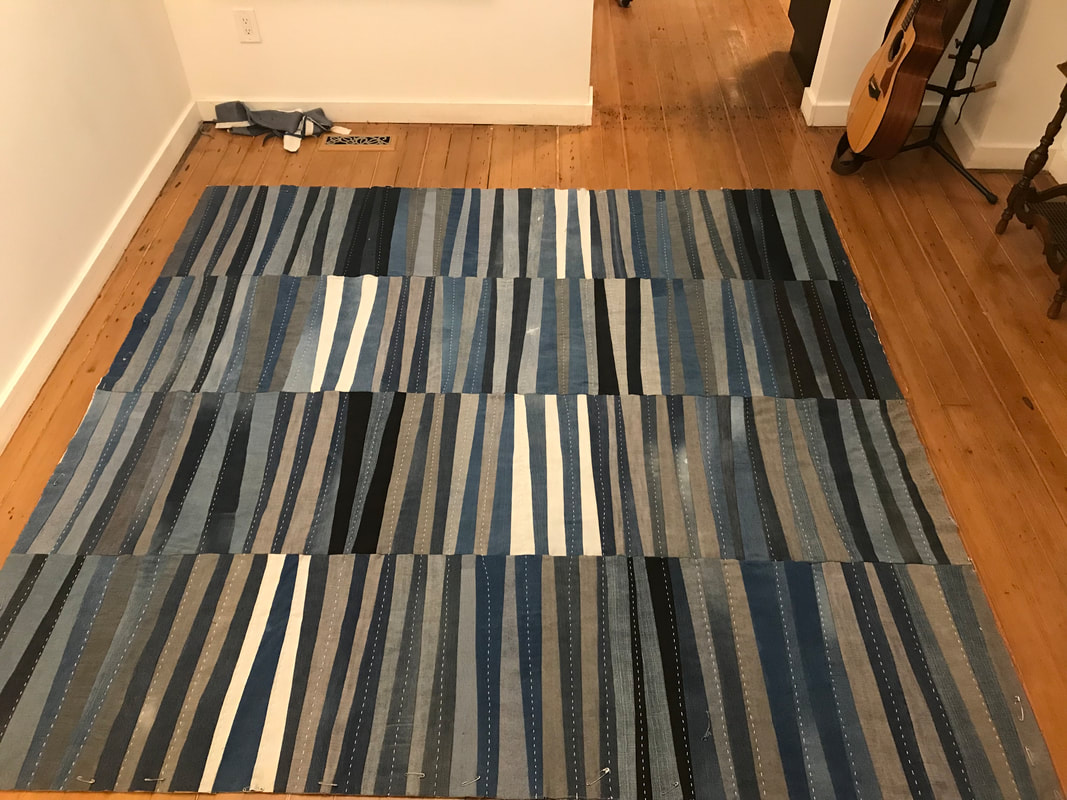
Moving on to Exhibit C: some jeans with all fabric removed and re-configured as a net or scaffolding. Maybe a more clever artist could write a profound statement about this that could land it in an Important Art Exhibit, perhaps something about togetherness or workers united, or maybe the hollowing out of union labour. It said nothing to me but the materials and technique were eventually incorporated into two distinct large-scale artworks. Learning outcome: Even dead-end projects contain something to build on.
Picture
Exhibit C
Exhibit D is a collection of coffee-bean sacks attached to a wall with sewing pins. I was exploring the sculptural possibilities of burlap, the shadow effects and warm tones, the varying weaves and the fonts of the silk-screened labels. But tacking bunched-up bags wasn’t enough.
Picture
Exhibit D
I doubled down, stitching one bag after another to a rusty concrete-forming tie, then pulling out most of the weft from the weave, macramé-ing them, then coating them with ready-use concrete mix. Meh. I knotted up the deconstructed sacks following designs of specific architecture, including a cathedral. I lashed the steel ties together and suspended the lot of them in an overly ambitious arrangement that called for a dozen more of these time-sucking labours from hell. I was stuck in that encrusted, fibrous rabbit hole for most of 2021. Learning outcome: Going bigger isn’t the answer when it’s not working and it’s okay to drop the project despite the large investment in time. Also, turns out my lungs don’t react well to the burlap-fibre dust bunnies floating around the studio.
Picture
Detail of concretized burlap macramé experiments
I finally received a sign to restart a couple of weeks ago when another artist gave me a collection of silky striped fabric swatches. They reminded me of some finicky, slippery satin quilt blocks I started a decade ago. I pulled out the fraying, wonky squares that had defeated me but decided to work with them. This will be a queen-sized memory quilt of my perfectly imperfect past. Learning outcome: Failures may need time for new energy, ideas and skill to arrive. This is that time.
Picture
Work in progress: Piecing together an abandoned project with new energy.

On radical self-care

11/20/2024

 
Making ourselves whole through making
​

First there is shock. I saw it in a coffee shop in a small US city the morning Trump was elected — again. The place was full but hushed. “Are you okay?”, one customer after another whispered to the three female baristas. Nods. Shrugs. Back to work.

Another shock hit the next day, when a friend confirmed our worst fears: the cancer had spread, nothing more for it. Silence, then tears all around.

First the shock, then the rage. Why? Why now? Why them? Why us? We cast around for blame. Eventually we arrive at the only thing for it: regrouping, starting from the self and working out from there.

My no-nonsense inner grandlady tells me to Get a hold of yourself, advice I take in the most loving way. I hold myself up by burrowing in for a nap, taking a walk wherever the trees are, sinking into a hot bath. There is a kind of exquisiteness during this inward time of radical self-care. This engagement with the physical world is a humane activity that breaks the paralysis, the start of ‘getting it together’ or gathering oneself.

Gathering is also a trauma response to life-shattering events (look at hoarding). The urge to collect the shards and scraps is an attempt to make ourselves whole. I find solace in pulling together material scraps of handwork by other makers and other traditions, not to recreate the past but to consider new possibilities, new forms. Puzzling over textures and techniques is quiet, contemplative work. There is no pre-planning, no goal-setting to be achieved; I’m simply forging connections, intent on finding a fresh beauty in the rejected and damaged remains, one stitch at a time in a sort of personal/political practice.

After we collect ourselves we collect up with others because we humans are pack animals. We share our grief because we know that that emotion is a monster not to be ignored. Even the kitties or pups instinctively know when the moment calls for cozying up to their people.
​
Some of us share our art because we have to. We brew up a mug of Bengal Spice tea, clear a space on the table heaped with scraps of fabric, unravelling lace and stained embroidered linens, plug in the laptop and open an empty screen. And we reach out.
Picture
Donated hand-stitched linens and lace offer a further layer of meaning to an expanded painting practice (detail). (Carlyn Yandle)
<<Previous
    Cross-posted at
    carlynyandle.substack.com

    browse by topic:

    All
    Abject
    Abstract
    Abstract Embroidery
    Abstraction
    Abstract Painting
    Abundance
    Accumulations
    Acrylic
    Activism
    Additive
    Aesthetics
    Agency
    AgentC Gallery
    Aging
    Alison Woodward
    Aluminum
    Amanda Wood
    Anxiety
    Appropriation
    Arcade Fire
    Architecture
    Arleigh Wood
    Art
    Art Activism
    Art Blog
    Art Business
    Art Discourse
    Art History
    Artifact
    Artist
    Artist Residency
    Artist Statement
    Artist Talk
    Art Marketing
    Art Quilt
    Arts And Crafts
    Art School
    Art Show
    Art Spiegelman
    Assemblage
    Author
    Banksy
    Bauhaus
    Beauty
    Betsy Greer
    Big Data
    Billy Patko
    Binding
    Blogs
    Blog Tour
    Bob Krieger
    Body Of Work
    Books
    Boro
    Braided Rug
    Braiding
    Bruce MacKinnon
    Bruce Mau
    Building
    Bull Kelp
    Burlap
    Business
    Buttons
    Canadian Artist
    Carlyn Yandle
    Caroline Eriksson
    Cartoon
    Ceca Georgieva
    Challenge
    Charley Yandle
    Children
    Christmas
    Cindy Sherman
    Circular Thinking
    Cirque Du Soleil
    City As Site
    City Planning
    Cityspace Gallery
    Clay Yandle
    Climate Change
    Cluster
    Cob
    Cob Oven
    Collaboration
    Collage
    Collection
    Colonialism
    Color
    Colour
    Commission
    Community
    Community Building
    Composition
    Conceptual Art
    Conceptual Craft
    Connection
    Connie Sabo
    Construction
    Coronavirus
    Cosplay
    Costume
    Counter Culture
    Counter-culture
    Cover
    Cover-19
    Covid
    Craft
    Craft Blogs
    Craft Camp
    Craftivism
    Crafts
    Craftsmanship
    Creative Process
    Critique
    Crochet
    Cross-stitch
    Cultural Hub
    Cultural Studies
    Culture
    Culture Jamming
    Culturejammingc9d75664fd
    Current Conditions
    Cycling
    Dafen Village
    Dallas-duobaitis
    Dance
    Data-graphic
    Data-graphic
    David Weir
    Dear Human
    Decorations
    Deep Craft
    Denim
    Denyse Thomasos
    Design
    Digital Art
    Discomforter
    Display
    Dissent
    Distraction
    Distracts
    DIY
    Doilies
    Doily
    Domestic
    Domestic Interventions
    Douglas-coupland
    Draw Down
    Drawing
    Dressed
    Drip By Drip
    DSquared2
    Dude-chilling-park
    Dyeing
    Dystopia
    Eastend
    Eastside Culture Crawl
    ECUAD
    ECUAD MFA
    Editorial
    Edward Burtynsky
    Eggbeater Creative
    Embellishment
    Embroidery
    Emily Blincoe
    Emily Carr Cozy
    Emily Carr University
    Entanglements
    Environment
    Environmental Art
    Exhibit
    Exhibition
    Expanded Painting
    Experimentation
    Exploration
    Expression
    Fabric
    Fabricating
    Fabrication
    Facebook
    Failure
    Fashion
    Fashion Revolution
    Fast Fashion
    Feminisim
    Feminist
    Feminist Art
    Festival
    Fiber
    Fiber Artist
    Fiber Arts
    Fibre
    Fibre Arts
    Film
    First Saturday Open Studios
    Flo
    Flow
    Forage
    Foraging
    Form
    Form And Function
    Foundlings
    Found Materials
    Found Objects
    Fractal
    Fracture
    Free Store
    Fuckwit
    Fuzzy Logic
    Gallery
    Gallery-row
    Garden
    Gardening
    Garment
    Gathering
    Gentrification
    Geometric Art
    Gill Benzion
    Gingerbread
    Globalization
    Glue
    Goblin Core
    Grad 2020
    Graffiti
    Grannycore
    Granny Square
    Granville-island
    Green Space
    Grid
    Grief
    Guanajuato
    Guerrilla Art
    Guerrilla Girls
    Halloween
    Handmade
    Handmaking
    Hand Stitching
    Hand-stitching
    Handwork
    Hashtags
    Haywood Bandstand
    Healing
    Health
    Hearth
    Heirloom
    Hideki-kuwajima
    Hoarding
    Homelessness
    Homemade
    Hot Art Wet City
    Housing
    Hybrid Thinking
    Ian Reid
    Ian Wallace
    Ideas
    Identity
    Images
    Imagination
    Immersive Art
    Improvisation
    Incomplete Manifesto For Growth
    Industrial Design
    Industry
    Innovation
    Inspiration
    Instagram
    Installation
    Installation Art
    Intervention
    Intrusive Thoughts
    Invention
    Irena Werning
    Ironing
    Janet Wang
    Jeans
    Jeff Wilson
    Joel Bakan
    Joseph Beuys
    Joseph-wu
    Journalism
    Joyful Making In Perilous Times
    Joyfulmakinginperiloustimes
    Judith Scott
    Kamala Harris
    Kids Art
    Kim Piper Werker
    Kimsooja
    Kintsugi
    Knitting
    Knots
    Knotting
    Kyoto
    Labor
    Labour
    LA Fires
    Landon Mackenzie
    Landscape
    Leanne Prain
    Lecture
    Lighthouse
    Linen
    Liz Magor
    Log Cabin
    Logo Sweater
    LOoW
    Lost Painting
    Lumiere Festival
    Lynda Barry
    Macrame
    Maker
    Making
    Making Is Connecting
    MakingIsConnecting
    Malcolm Gladwell
    Male Gaze
    Mapping
    Maquette
    Marie Kondo
    Marine Palette
    Marketing
    Mark Lewis
    Martha Rosler
    Martha Stewart
    Masks
    Material Exploration
    Mathematics
    Maya
    Media
    Meditation
    Meditative
    Mending
    Mend In Public Day
    Mental Health
    Metalworker
    MFA
    Mister Rogers
    Mixed Media
    Mobile Art Practice
    Monique Motut-Firth
    Monster
    Monte Clark
    Mosaic
    Motivation
    Mt. Pleasant Community Centre
    Mud Girls
    Mural
    Mushroom
    Mycelium
    Narrative
    Natalie Jeremijenko
    Nature
    Needlework
    Neon
    Net
    Network
    Networking
    Neuroplasticity
    New Forms Festival
    Newspapers
    Nick Cave
    Noah Goodis
    Nodes
    North Vancouver
    Obtrusive Thoughts
    Omer Arbel
    Online Talk
    Openings
    Organization
    Origami
    Overabundance
    #overthinking
    Paint
    Painting
    Pandemic
    Paper
    Paper Sculpture
    Papier Mache
    Parkade Quilt
    Patchwork
    Patriarchy
    Pattern
    Pecha Kucha
    Pechakucha
    Perception
    Perfectionism
    Performance
    Performance Art
    Personalispolitical
    Photography
    Playing
    Political Art
    Political Satire
    Polly-apfelbaum
    Pompidou
    Poodle
    Pop-Up
    PopUp
    Port Coquitlam
    Portrait
    Practice
    Process
    Production
    Profession
    Project
    Protest
    Protest Art
    Psychedelic
    Public Art
    Pussy Hat
    Pussy-hat
    Qr Code
    Quilt
    Quilt Block
    Quilting
    Quilt Painting
    Rachael Ashe
    Rachel Lafo
    Ravages
    Raw Materials
    Rebar
    Recycle
    Recycling
    Reflection
    Reflektor
    Reimagine
    Renewal
    Repairing Is Caring
    RepairingIsCaring
    Repetition
    Research
    Residency
    Resistance
    Resurge
    Retreat
    Re-use
    Rhonda Weppler
    Richard-tetrault
    Richmond Art Gallery
    Right Brain
    Rondle-west
    Roses Against Violence
    Rote Activity
    Rug
    Ryan-mcelhinney
    Safe Supply
    Safety
    Sampler
    Sarah-gee-miller
    Sashiko
    Saskatchewan
    Scaffolds
    Scaffolds I
    Scale
    Scraps
    Sculpture
    Seasonal Decor
    Seattle Art Museum
    Seaweed
    Seismic Rug
    Semiotics
    Sewing
    Seymour Art Gallery
    SharingIsCaring
    Sharon Kallis
    Shawn Hunt
    Shigeru Ban
    Sketchup
    Slow Craft
    Smocking
    Social Art
    Socialart
    Social Distancing
    Social Distancing Hat
    Social Engagement
    Social-engagement
    Social History
    Social Justice
    Social Media
    Soft Sculpture
    South-granville
    Space Craft
    Spore
    Stitching
    Storage
    Street Art
    Studio
    Styrophobe
    Substack
    Subversive Stitch
    Surrealism
    Surrey
    Tactical Frivolity
    Tactility
    Tagging
    Talking Art
    Tapestry
    Tatjana Mirkov-Popovicki
    Tattoo
    Teamlab
    Technology
    Terry Fox Theatre
    Text
    Textile
    Textile Art
    Textiles
    Thrifting
    Thrift Stores
    @tinypricksproject
    Tiny Pricks Project
    TJ Watt
    TO DO
    Tools
    Toronto Design Offsite
    Toybits
    Trash
    Trash Art
    Travel Art
    Trevor Mahovsky
    Trump
    Typography
    Tyvek
    Unbridled
    Unfixtures
    Unravel
    Upcycle
    Upcycling
    Urban Design
    Use Object
    Use Objects
    Utility
    Value Village
    Vancouver
    Vancouver Art Gallery
    Vancouver International Airport
    Video
    Video Tour
    Visual Artist
    Visual Field
    Visual-field
    Visual Language
    Wabi-sabi
    Wallace Stegner House
    Wall Hanging
    Waterwork
    Wearable Art
    Weaving
    William Morris
    Women's March
    Wood
    Wool
    Work Wraps
    Wrap I
    Wrap II
    Writing
    Xenobia Bailey
    Yarn Bombing
    YVR
    Zaha Hadid
    Zendoodle
    Zero Waste Art
    Zero-waste Art

    Archives

    January 2026
    December 2025
    November 2025
    September 2025
    May 2025
    April 2025
    March 2025
    January 2025
    December 2024
    November 2024
    October 2024
    September 2024
    August 2024
    July 2024
    June 2024
    October 2022
    August 2022
    June 2022
    November 2021
    April 2021
    September 2020
    April 2020
    December 2019
    November 2019
    September 2019
    August 2019
    July 2019
    June 2019
    April 2019
    November 2018
    July 2018
    May 2018
    November 2017
    September 2017
    June 2017
    April 2017
    March 2017
    February 2017
    December 2016
    November 2016
    September 2016
    July 2016
    March 2016
    February 2016
    January 2016
    December 2015
    November 2015
    October 2015
    September 2015
    June 2015
    May 2015
    April 2015
    March 2015
    February 2015
    January 2015
    December 2014
    November 2014
    October 2014
    September 2014
    August 2014
    July 2014
    June 2014
    May 2014
    April 2014
    March 2014
    February 2014
    January 2014
    December 2013
    November 2013
    October 2013
    September 2013
    August 2013
    July 2013
    June 2013
    May 2013
    April 2013
    March 2013
    February 2013
    January 2013
    December 2012
    November 2012
    October 2012
    September 2012
    August 2012
    July 2012
    June 2012
    May 2012
    April 2012
    March 2012
    February 2012
    January 2012
    December 2011
    November 2011
    October 2011
    September 2011
    August 2011
    June 2011
    May 2011
    April 2011
    March 2011

Powered by Create your own unique website with customizable templates.
Picture