carlyn yandle
  • about
  • the creative process
  • crafted objects
  • public art
  • painting
  • exhibitions
  • contact

Awkward family moment informs art-making aesthetic

7/14/2024

 
When I first started out as a suburban-newspaper reporter I had a single original artwork tacked to the wall in my basement suite. It was a life-sized acrylic-on-paper, a nude holding her maybe-pregnant belly against a landscape of spewing factories and techni-coloured streams.

I watched this gaunt, world-weary figure emerge in watery brushstrokes from the hand of the newspaper photographer's girlfriend. This is how she worked, in their basement suite, pulling yardage from a large roll of cheap paper, painting straight from her head and heart, with no plan to keep or show or sell her paintings. She saw that this one resonated with me too — what twenty-something in a committed relationship doesn’t have this weighing on her mind? So she gave it to me.

Hanging it felt like supporting an ally, even if it was only hanging in my dark, featureless space that nobody would see besides the boyfriend on weekends. Then one day some of his family made the trip for a visit. They complimented my hanging flower baskets, my thrifty decor. I didn’t hear until much later that the painting had become a topic of conversation among various relatives, a bit of a joke about that subject and, by extension in my mind, this girlfriend.

I had none of the inner fortitude to see this painting or my choices as acceptable and eventually I rolled it up and hid it in a closet. I married into that family within three years. The boxed wedding dress joined the poster tube containing the offending painting for two more moves until I finally ditched the artwork at the Sally Ann. The dress is another story.
Picture
Detail from 'Unbridled,' the artist's handmade silk wedding dress embroidered with significant events. (Carlyn Yandle photo)
Picture'I Dissent,' aesthetic design with a political position marking the death of Ruth Bader Ginsburg. Acrylic on panel, 2020 (Carlyn Yandle)
But I did keep something from that painting: some lessons that have informed an aesthetic that I carry to this day but might not even recognize until after each artwork is completed, or is at least on its trajectory.

The first is the power of attraction. Not to be confused with the pseudoscientific Law of Attraction, this is a drive to create aesthetically-pleasing, familiar domestic objects and fields that upon closer inspection have something else to say besides cozy or pretty. An early example of one of my pretty/pretty disturbing objects is Clutch (2007). Hundreds of sewing pins were pierced into a thrifted clutch purse in a colourful beaded pattern covering the entire surface. The clasp opens to reveal an impenetrable thicket of steely pointy ends.

Another valuable lesson is context, or time and place. Gallery-goers may prepare themselves to be confronted by artwork but I don’t wish that on houseguests. There are none of those Live-Love-Laugh type directives or IKEA Eiffel Towers and tulips on the walls at home, but what is there is selected to engage, not repel. Home is a place to feel safe. The studio is a place to not play it safe, but it’s still a covert operation, playing on that first impression of domestic objects that reveal cracks in the beauty of the everyday.

I’ve also learned that my creative energy comes from joy, not pain. I have no urge to make when I barely have enough hope for the day to put on pants. Heavy realities may be the driving force but the work develops from a position of hope for comfort and social connection, a hunger for nourishment of new ideas and new materials to explore. The joy is in learning while doing, imagining new collective futures.

Picture
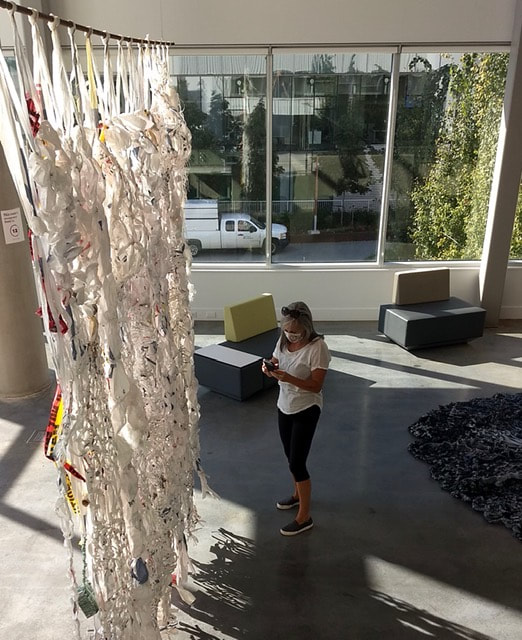
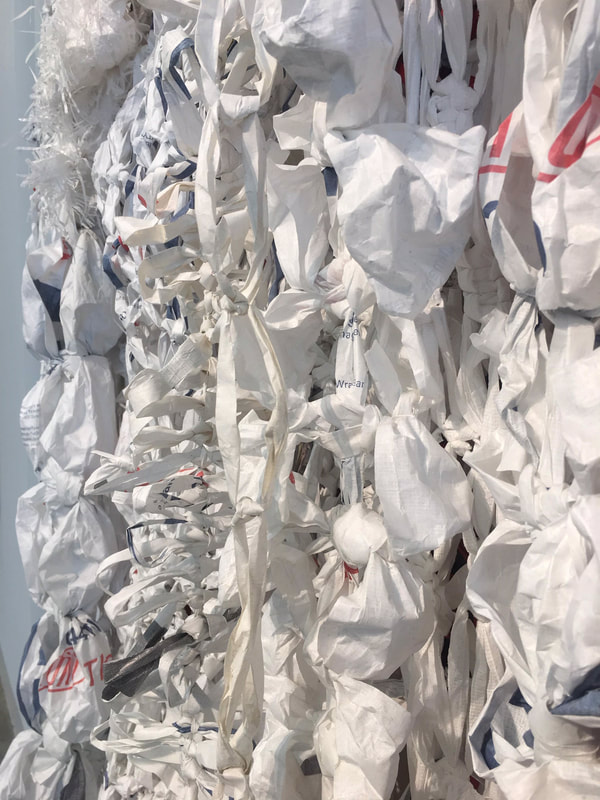
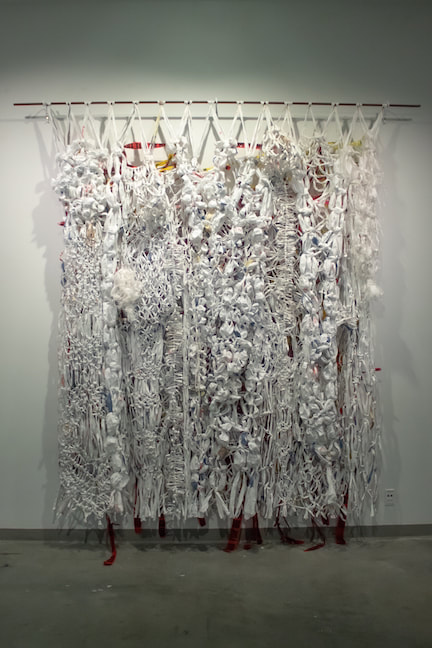
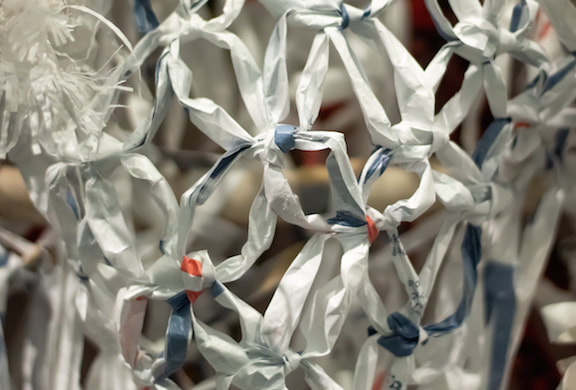
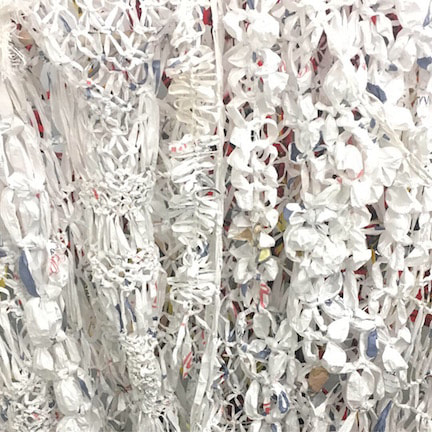
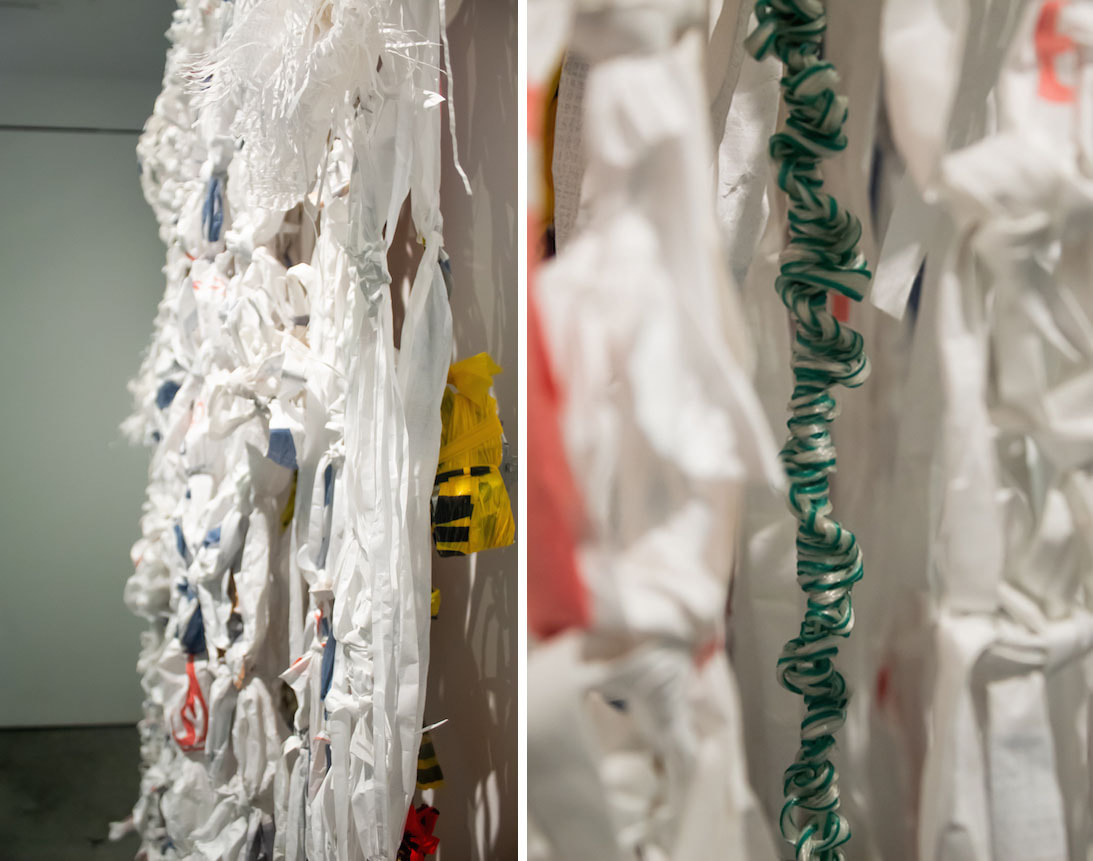
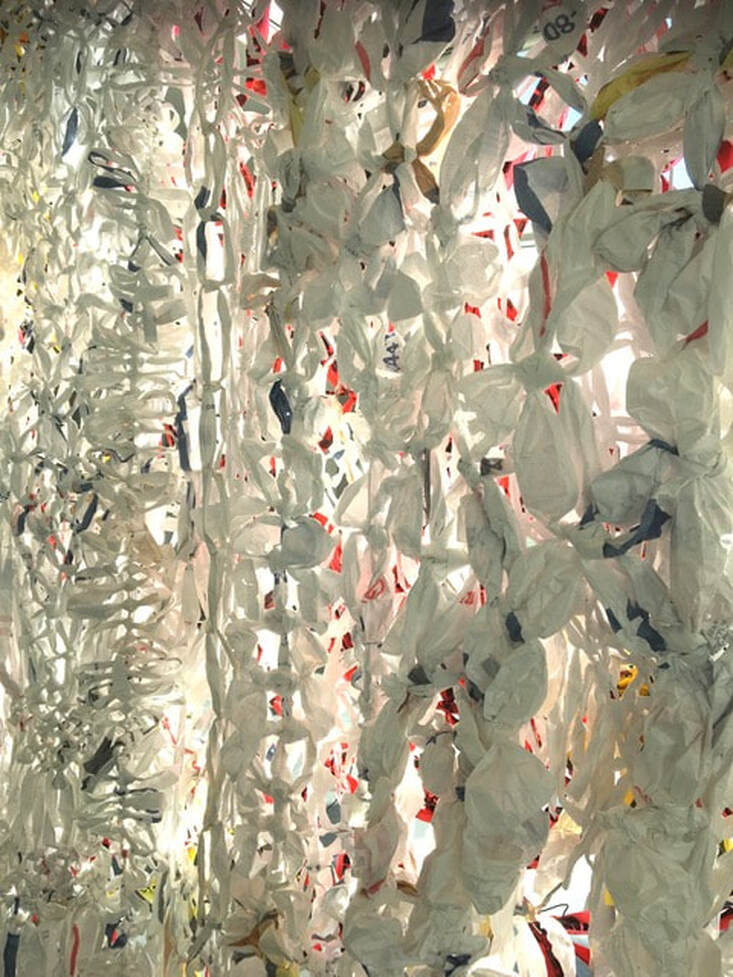
What first appears as a frilly white textile barely conceals the chaotic armature of conduit casing, hazard tape, metal pipes, and other construction-site debris behind layers of discarded Tyvek building wrap. (Nate Yandle photos)
Finally, my position is not fixed. In my mind I have that 1985 photo portrait of Lily Tomlin in a black T-shirt with white lettering that screams EVOLVE OR DIE. And look at her now. My sensibilities are always shifting and I am growing more at peace with the idea that what other people say about me is none of my business. When an artist friend turned 50 on an artists’ retreat the rest of us toasted her in a welcome to the I Don’t Give a Shit Club. When you’re part of that club you stop second-guessing every decision and tending to other people’s feelings first.

This is how I recently became the owner of Fuckwit. I was attracted by the sweet rosebud fabric appliqued in tiny blanket stitches precise as Letraset on a lacy linen. I like the artist's choice of font and word. It’s an overt, uncomplicated work that hangs near the front door, visible before guests would even have their coat off. If people get offended, blame the artist, not me. I just like the beauty in that crack.
Picture
Original artwork by Kathryn Lissack (@kathrynlissack)
Joyful Making in Perilous Times

9/10/2020

 
Where is the joy when you’re living in a time of a global coronavirus pandemic and a local toxic-drug epidemic? What is the use of making when your city is seized by global investment-real estate schemes, when there’s too much stuff in a overheated planet and a hateful, superpower president next door?

These questions ricochet around my brain, only abating when this futile, exhausting expenditure of energy hones in on the rote activity of knotting and needleworking. The hand-wringing falls into rhythm as I grasp at lost, tossed threads that I make whole and into whole new ideas.

Making is a very personal physical reaction to perilous times and unstable circumstances but working with found fibre is also an intrinsically social action that weaves in disparate economic circumstances, language, race, age and abilities. Braiding, stitching, knotting, needleworking create resilient connective tissue between one body and another. Strands thicken into solid links between the ancient and the modern, utility and self-expression, the digital and the physical, the personal and the political.

By exploring the inherent qualities of abject manufactured material, the body binds with other bodies and other places, some known, some not. It is work, but outside the tumultuous dominant economic system. It is an experience of the history of production and distribution through the material at hand.

Even in these times, when gathering around a table is a hazardous activity, when our pack species is feeling at loose ends, masked up and reluctantly apart, the tactility of rote hand-making grounds us into the here and now, one stitch, one loop, one knot at a time. We grasp at the tendrils, continuing the work, with the results standing as artifacts of a time, place and our individual and collective states of being.​

Three major works created over one year remind me of the uncertainty, the panic, the perilousness of these times, and of the solace gained through individual making and the joy of making with others. The three are relics of two years of material research that culminated in a Master of Fine Arts 2020 exhibit set up one day before the university locked down.

1. Scaffolds

Picture
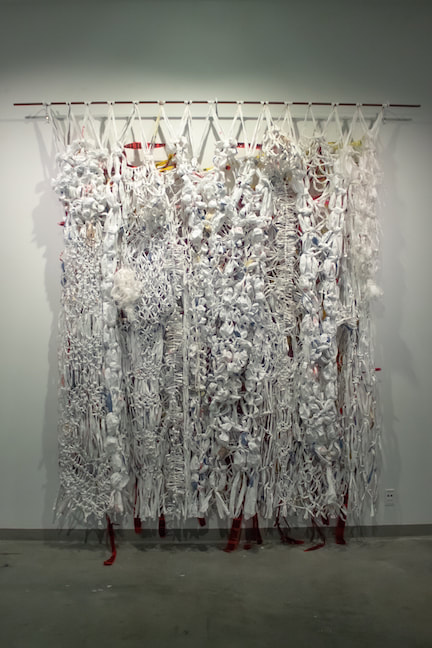
'Scaffolds': 2019, 10' x 10' x 8" All materials gathered by workers at residential tower construction sites in the Vancouver area.

2. Resurge

Picture
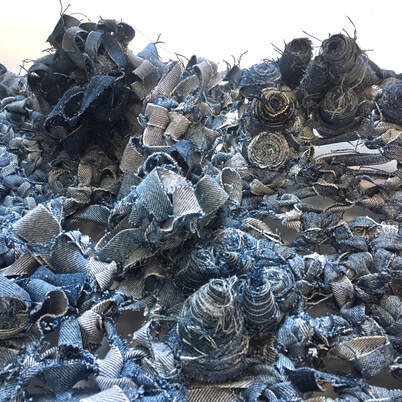
'Resurge' is inspired by the palette of the West Coast foreshore where it began.
Picture
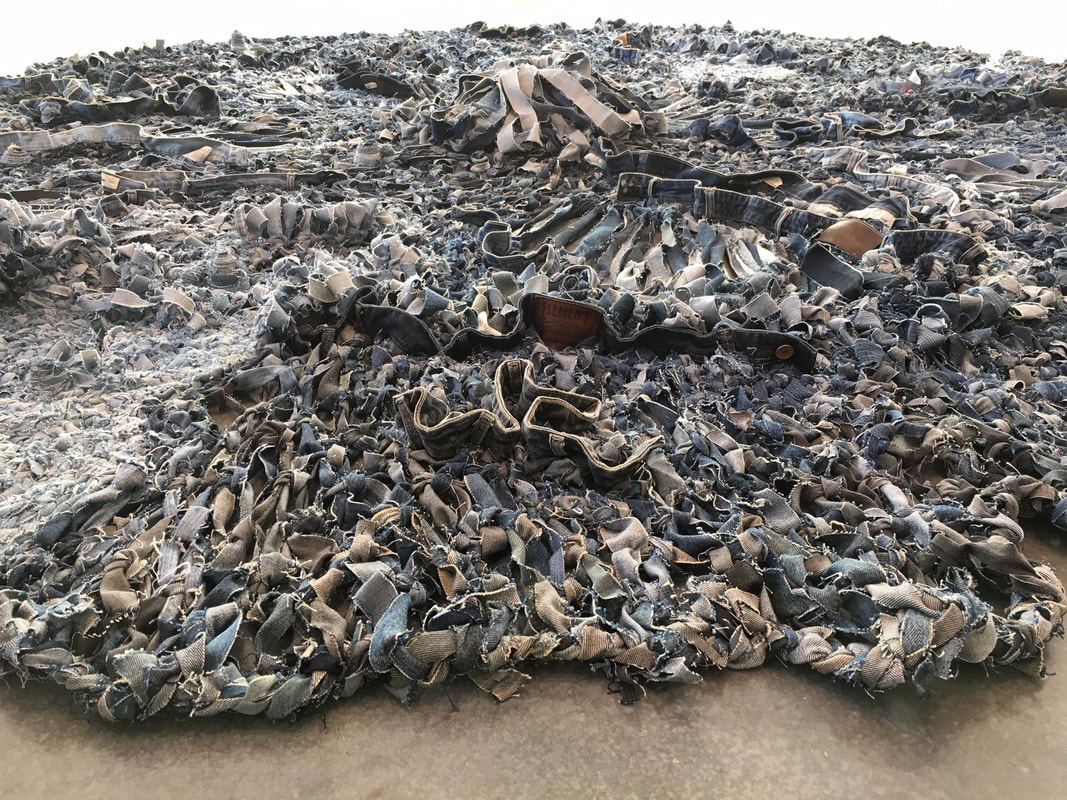
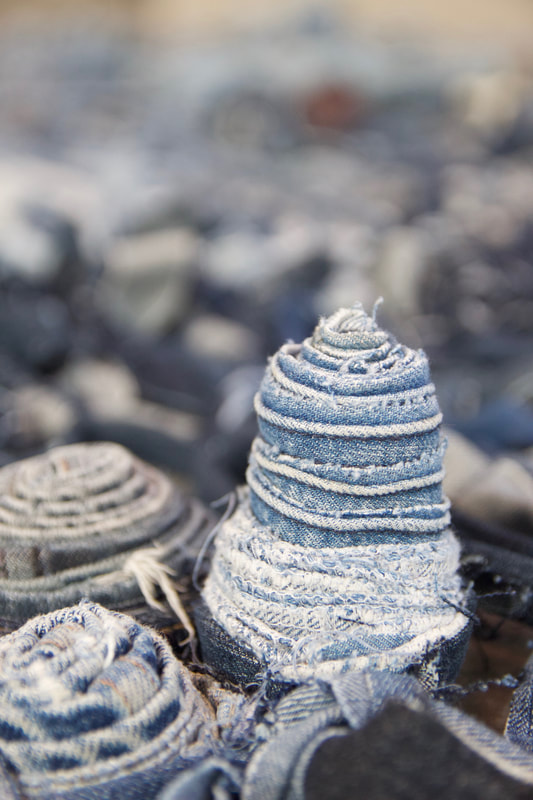
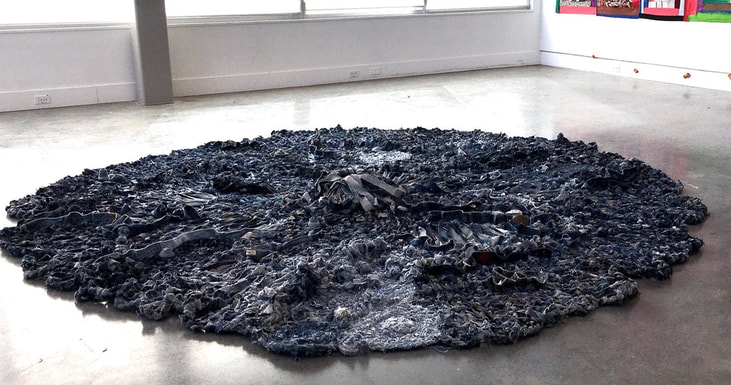
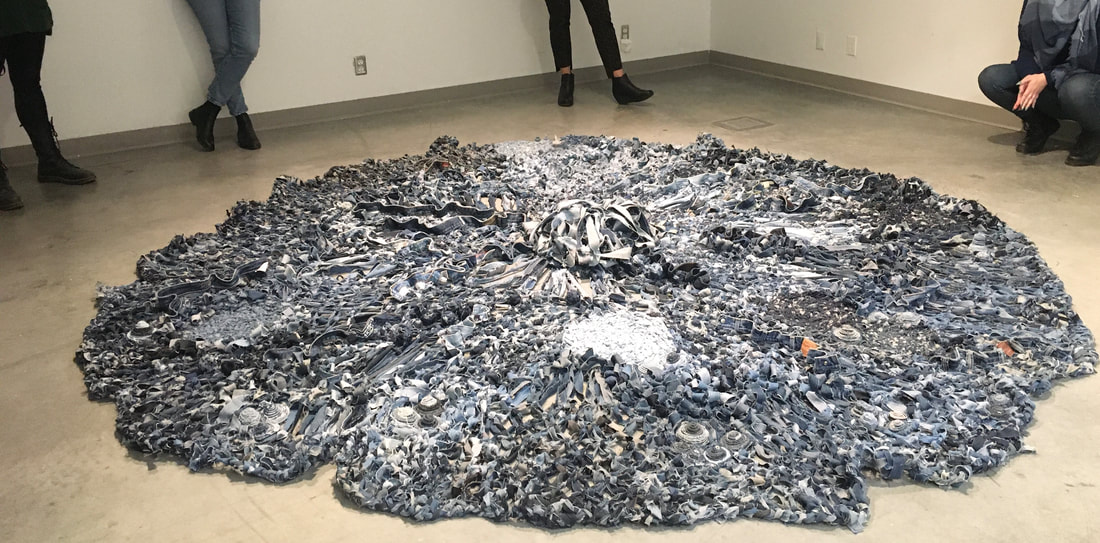
Spanning 12 feet in diameter and grounded to the floor, 'Resurge' troubles distinctions between utility craft and visual art.

3. Hearth

Picture
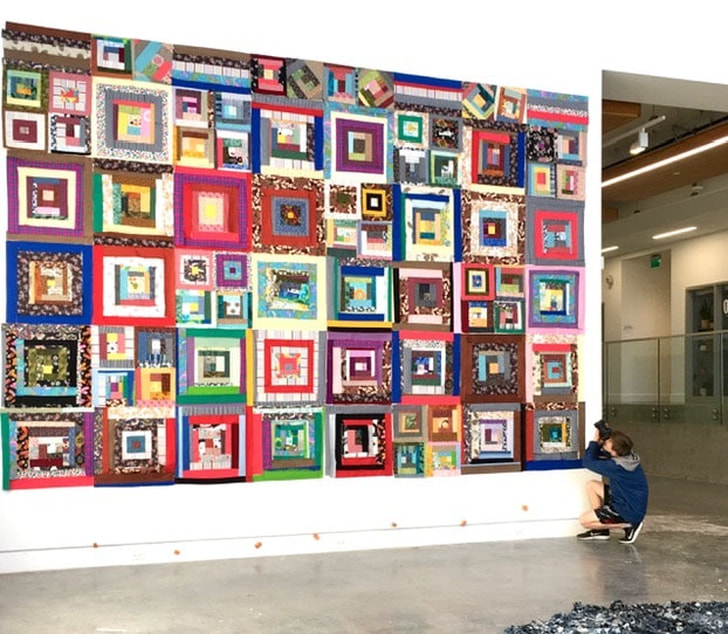
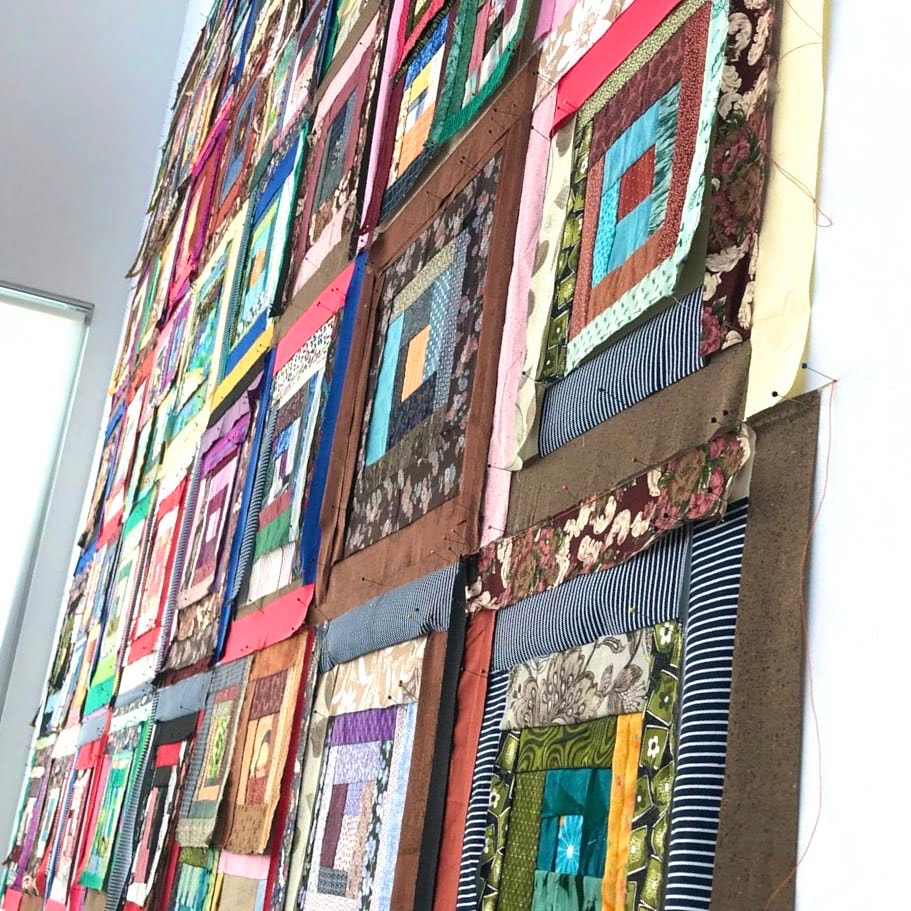
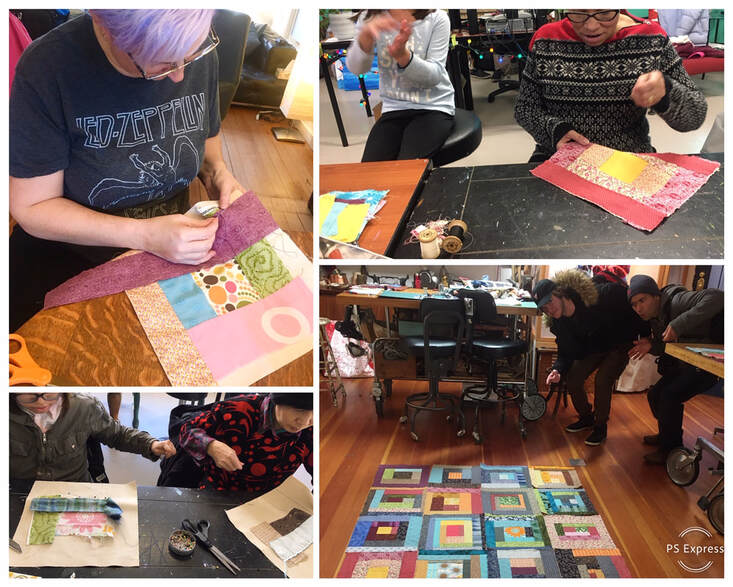
'Hearth' serves as a visual archive of five months of community hand-stitching sessions at kitchen tables and art studios.
Picture
A close-up view of the wall installation reveals provisionally-composed strips of fabric and sewing pins framing the several dozen hand-stitched "log cabin"-style quilt blocks by many hands.
Picture
The simple blocks were made by artists and members of the community at large during five months of open weekly sessions.

Tripping on this troublesome rug

12/6/2019

 
In the final critique of my final work in this second-to-final semester of graduate studies, I could see that there was going to be trouble. 
Picture
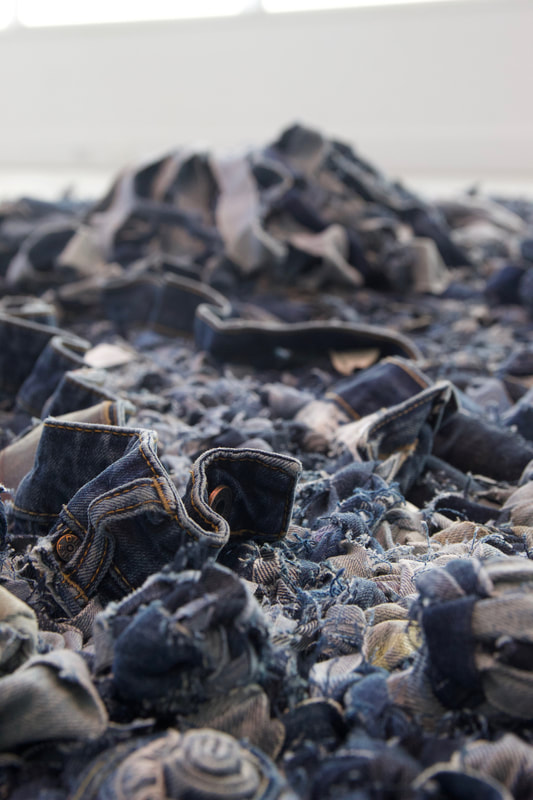
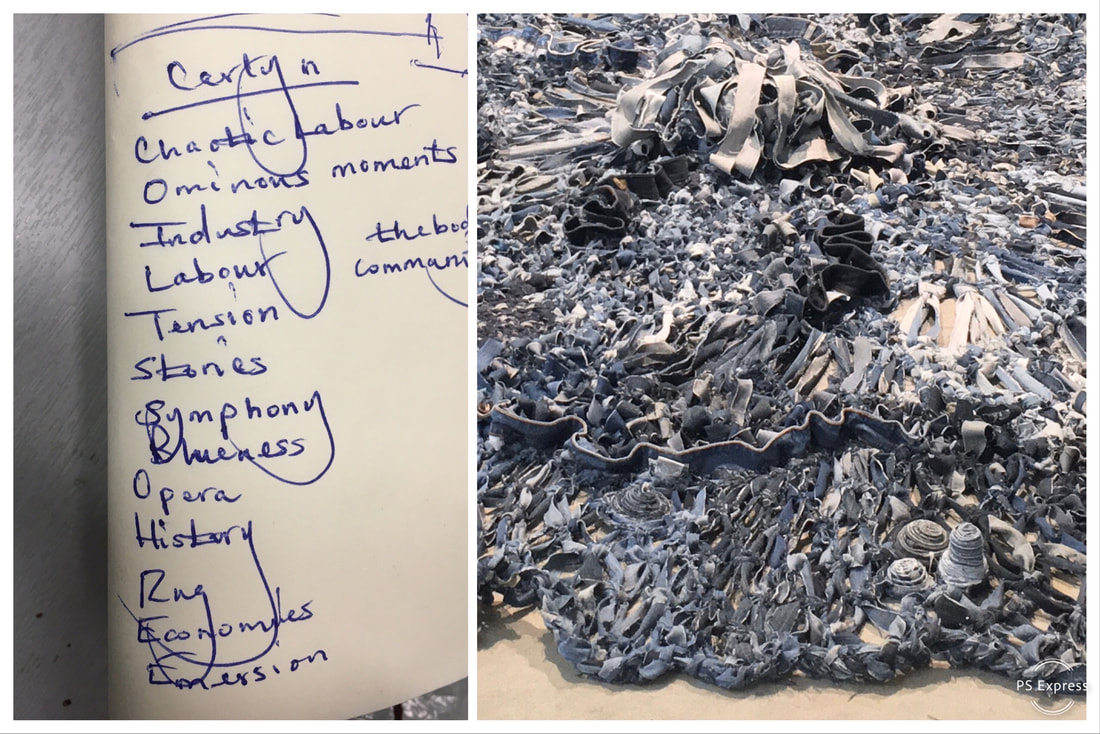
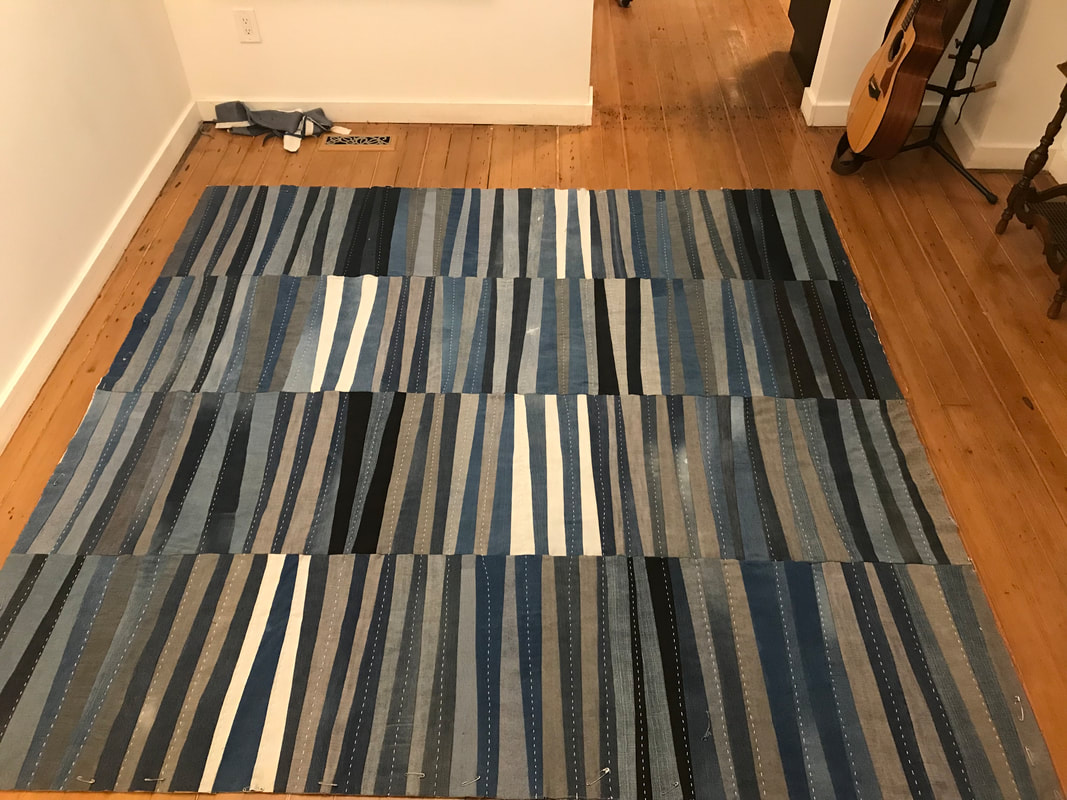
​From the start, there was the trouble of actually getting a full view of this sprawling, chaotic, twisted mass of deconstructed jeans. It required everyone to stand around the perimeter of the low-lit white-cube gallery, in a circle, facing in, looking down at this problem child.
 
There was the troubling of its position: Why not on the wall or hung from the ceiling? Since it’s sprawled out on the floor, does it invite being walked on?
 
There was the troubling of method: Why the knotting and weaving and braiding? Why the obvious waistbands and labels? Why spend all this time and labour? Why not just a pile of denim strips?
 
And there was the troubling over concept: Is it too obvious? Too simple? Too many signifiers? Not enough points of entry? Or too many? Is it art or craft? Who is this talking to? And to what end?
 
And those are just my questions. 

Picture
​I question everything, especially as I work, with my hands, intuitively. But my first line of questioning is directed at the material itself. What do you want from me? (Or, to borrow from my then-eight-year-old nephew, in an inexplicable situation: What are we even doing here?)
 
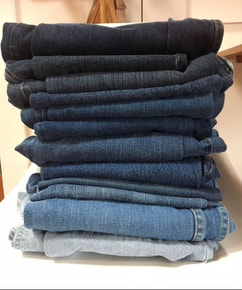
As much as I could have sat and gazed at the striated piles of folded jeans collected, machine-washed and line-dried by my mother and hauled to my studio by my others, now those jeans demanded more of me.
 
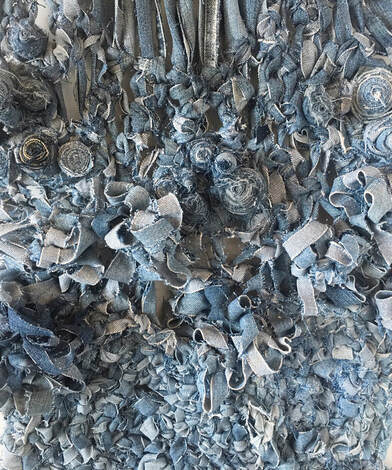
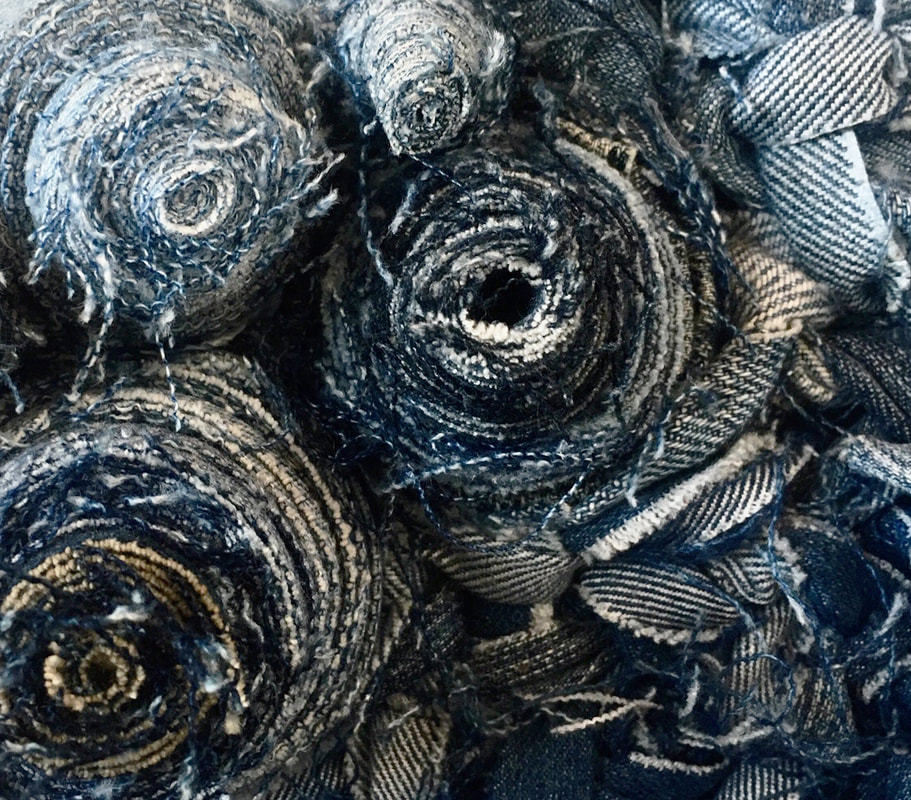
Seams, the index of the work by mainly women in foreign factories, needed to be exposed, so I cut them away from the yardage, bound them up in my own hand-stitching into tight, potent fast-fashion/slow-craft units. For what? For now, just for today: my daily reminder not to overthink or force solutions.
 
The labels and tags required daylighting, too, and the more collisions the better between fonts and texts and all that those brands try to stand for.
 
That left the denim textile, the fabric of this whole fraught, toxic industry. Shucked from their constraints of style and function, I ripped them into strips and watched them fall from my cutting table into heaps on the floor like tidepools.

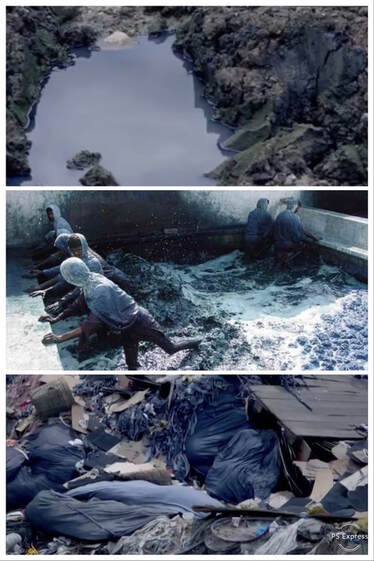
PictureImage-searching "jeans industry" produces a blue-stained global-reality horror show.
As much as I love the immersive works of minimalist textile installations, more would be more here. I would be mining all my own making methods and circulating them into this circles-within-circles piece, in allegiance with all of those who work with their hands for a living or for the love of material. Or both.
 
Like most makers I know, I love the challenge of constraining the work to some specific rules of material engagement so I limited mine to a single material, a knotting/binding additive process and two tools: scissors and sewing needle (well, three, if you count my hands).
 
I intrinsically start from the centre in an almost innate process learned over a lifetime, from macramé plant-hangers (1970s) to braided rugs (1990s) to crocheted giant doilies (2000s) created to cover and protect in the public sphere.

​The work begins with a gathering of material-energy into a tight nucleus of force (I’ve been mixing up issues of 
astrophysics and making over the last year) and spreads outward, finding pattern then breaking that pattern toward new horizons. It’s a process of allowing the material to ebb then roil up again into forces that break into near disintegration, a rhythm that keeps me in the swim of things. As it flows outward into small tsunamis, then eddies, I feel an oceanic, topographic, geologic personality wash over this thing.

Picture
And this definitely wants to be a thing, not an immersive installation. This is an object that requires some finishing, a symphony of soundwaves that started with a bang but wants to end in a hum, in the round. It is a rug you can’t walk on, borne of Seismic Rug that emerged while I was confined to the floor with sciatica,  watching footage of the horror of the 2011 Japan Tsunami flood in.
 
It is a resurgence of that making, and that fear of that flood and of the oncoming higher waters, but also the resurgence of my ability to grab hold of physically-challenging handwork after falling on the low-tide foreshore this summer and breaking my ‘good’ arm in two places. I cast aside those fears of not being able to make/do from the cast-offs of this unsustainable era of human history.
 
Resurge feels right for the piece formerly known as the Monster that raises issues from the ground up, this fuzzy menace.

Picture
Left: A colleague lists initial reactions during critique; right: pattern and collapse seen in one section.
Picture

A useless thing with many functions

4/10/2019

Comments

 
The brilliant part about being an aging female is your growing self-acceptance. Maybe this is because you don't feel that ever-present gaze anymore so you’re not feeling as judged. Or maybe it’s because you’ve just had enough of all that and it’s tiresome and dammit you like to be cozy so screw them.
 
Part of my self-acceptance is stepping out of the ‘should-storm’  of art-making and doing what I love to do with my hands: hunting down materials that have already had their first use and playing up their inherent qualities through knotting, weaving, tying, stitching and binding. I want to work repetitively, easily, without technological assistance and without haste or waste. And in doing so I’m carving out space and time to calm down, reflect and to think deeper — more crucial as the distractions threaten to take over.
PictureNate Yandle photo
In this way the work is not just in the form or connotations but the well-being and challenge that is relatable to makers who may or may not self-identify as artists. Wrapped up in there are issues of endurance, innovation, history of labour, the learning of the skill, dedication (and frustration), the specific culture and history of the method, the muscle memory that extends back to childhood, and the relationships built through the gathering of the materials.
 
Through this making I make some hay over the established boundaries between the privileged art world and real life, between craft and sculpture, between tactile and political action.
 
Scaffolds is composed of found spun-polyester building wrap, tarp and nylon cord over an armature of waste construction materials including caution tape, PVC piping, rebar, conduit, baling wire, and junction boxes, all attached through simple knots.
 
Special thanks goes to the construction workers who delivered these materials from their many jobsites to my studio for my useless work with many functions.

Picture
Nate Yandle photos
Comments

Pretty, and pretty toxic denim inspires new work

7/6/2018

Comments

 
Picture
There ought to be an international law against the dirty business of jeans manufacturing.

It poisons waterways, mainly in China, prompting environmental groups to raise the alarm against the devastation to communities and local ecosystems, yet consumers around the world continue to cycle through jeans, for work and in slavish loyalty to fashion trends.

Even on the small off-the-grid Gulf island of Lasqueti where I do much of my work, there is a constant oversupply of denim at the local Free Store. Too ugly or thrashed to be snapped up for the price of zero, they are destined for the landfill where the toxic dyes are left to leach into the ground.

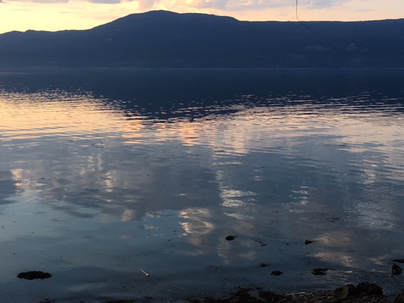
PictureJeans reflect the West Coast palette. Carlyn Yandle photo
But, honestly, if they weren't so pretty, I wouldn't be saving them from the dump. It's that very West Coast denim palette that compels me to rescue these ripped, stained or just outdated jeans, skirts, jackets and dresses and mess with them.

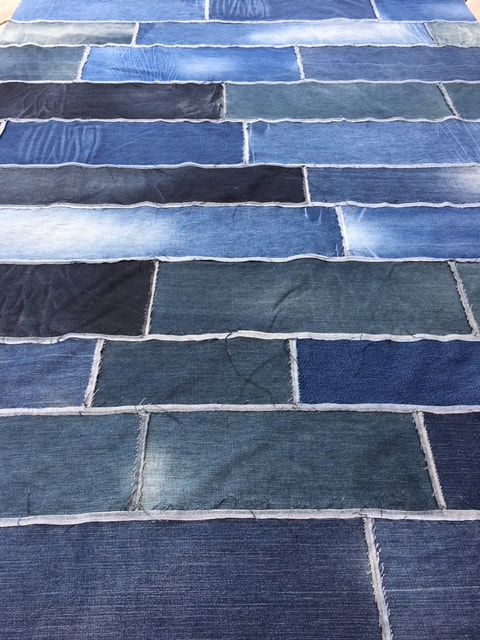
​For the past few years I've been cutting them into usable pieces and sewing up utility items — bags, oven mitts, hot-pot mats, lumbar cushions — and before long I fell into my own tiny cottage industry stitching up utility aprons.

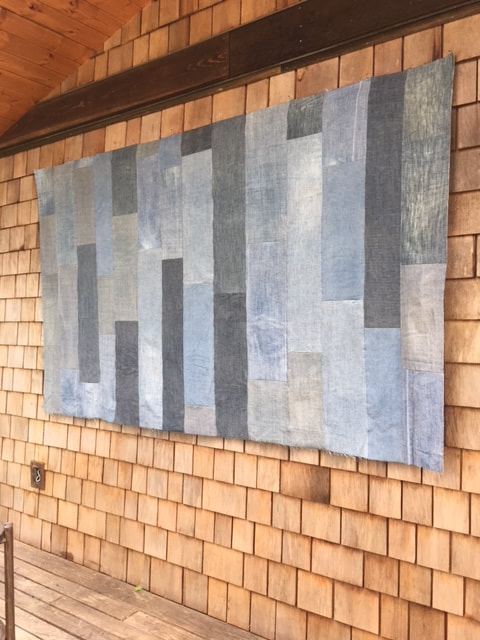
​Lately I've been working them up in quilts of high-contrast hues with frayed exposed seams or muted reverse greys, all in conversation with the coastal views just beyond my sewing table.

So for environmental reasons and the pretty, durable nature of old denim, I keep innovating new uses, but my explorations into non-utility pieces (the stuff we call Art) is more about the culture embedded in all those jeans: the worn knees, the rips, the stains that all speak to the physical work people do on this off-the-grid island community to sustain them.

I dabbled with undulating appliquéd fields inspired by the coastal climate and vistas but lately I've been more interested in exploiting the sculptural possibilities of this weighty, stiff fabric.

​Enter my latest exploration: large-scale macrame. ​
Picture
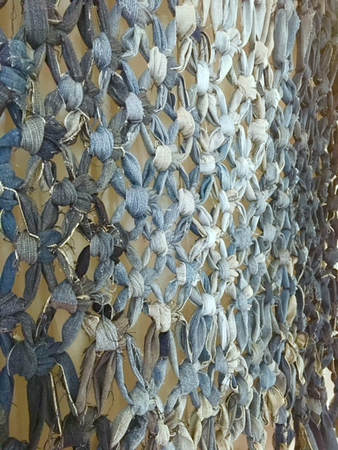
Knotting seemed like a natural way to enhance dimension, and it's relevant to this island community where knowing a few useful knots is an essential skill and in wide evidence. It also speaks to the late-'60s/early '70s back-to-the-land counterculture that defines Lasqueti. I liked the idea of creating a large-scale fringe for this place on the fringes of urban life. (Fun fact: The 13th-century Arabic weavers' word for "fringe" is "migramah", which eventually became known as "macrame".)

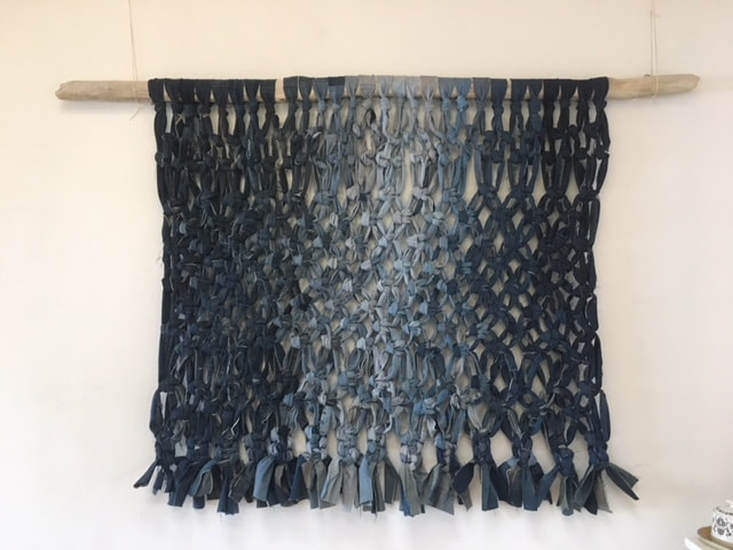
I gave myself some rules of engagement (like I do) to create a pattern. 1) The strands would be all three-inch strips. 2) The overall length would be largely determined by the number of strips I could squeeze out of an average size of jeans. 3) I would work from dark jeans to light to dark fabrics, to create a highlight in the centre of the piece. 4) The overall width of this super-fringe would be determined by the piece of driftwood I selected. 

Fifty-five hours of knotty work later I completed 28 Jeans: Denim Ombré, a wall-mounted macrame work that continues to inspire more ideas and more questions: How can I achieve a more sculptural effect? How can I find that beautiful place between pattern and collapse? And most importantly: Why did I throw away my old macrame magazines??

Picture
28 Jeans: Denim Ombré, 2018 by Carlyn Yandle. Found jeans, driftwood, 60" x 45"
Comments

Mammoth social sculpture going up at Draw Down event

6/5/2015

Comments

 
I'm not knocking social media. Hitting 'Like' to one posted act of injustice after another is nothing like joining a sit-in at your MP's office or marching in protest. But I also get that there is power in those tweets and online petitions. We saw it this week when Tim Hortons decided it had had enough bad press and was breaking its ad deal with Enbridge.

Still, there's a lot we lose by going through life connecting with one another mostly via screen-pecking 'like' or tweeting or 'gramming. We are, after all, a social species; our well-being is dependent on sharing space in the actual physical world. Consider this: If someone took away your ability to connect on social media you might get seriously miffed. If you were allowed unlimited social media access but had to connect in physical isolation from all other humans, you might get seriously unhinged.
PictureEarly days of the Network. Photo by Debbie Tuepah
There is something profoundly healthy about being around the energy of other people. It's the why for clubs and associations, parties and gatherings. And it's the why behind the Network sculpture/social engagement project.

Artist Debbie Tuepah and I came up with the idea just a few years after the birth of Twitter and Facebook, and within a year of the debut of Instagram and Pinterest. We felt a need to create a physical alternative to all this virtual social networking — some low-barrier, small-footprint way to bring people together. Something that would be collaborative but less skill-based than, say, a quilting bee, but offering similar tactile engagement.

This thread of an idea soon joined other threads: the materials should be found/donated and should be the stuff that ordinarily ends up in a landfill. Synthetic, petroleum-based fabrics and sheeting would do the trick. (No one knows what to do with those lurid-coloured Fortrel bedspreads and vinyl shower curtains.)

PictureThe more people work on it, the more visually interesting it becomes.
We cleared the decks and hung several strands from a hook in the studio ceiling, like I did as a kid when making those macrame plant hangers. We added one strand to another by simple knotting. We held parties and invited friends to bring their friends to tie one on. Kids got knotty and businessmen who thought the whole thing a little weird at first were soon weaving free-style. 

We knew we were onto something. A year later it made its public debut at the Mini Maker Faire at the PNE, where it grew into the gargantuan piece it is today.

Picture
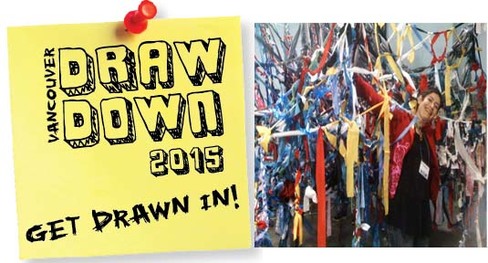
The Network is too big for any studio parties now. This mammoth collaborative sculpture demands the kind of space like the Atrium of the Mount Pleasant community centre, where it will be suspended on Saturday, June 20, 10 a.m.-2 p.m. as part of the city-wide Draw Down event. 

Come on down, tie one on, grab a thread and take part in this social medium in the actual, physical world.


Comments

Defending the doily in 20 images, 20 seconds each

1/23/2015

Comments

 
This just uploaded... Six and a half minutes devoted to that question I get a lot:
"What's up with the doilies?"

(Video courtesy of Terry Fox Theatre's PechaKucha program. More info on the entertaining, informative and globally-popular PechaKucha format here.)
Comments

A Season of snarls

7/11/2014

Comments

 
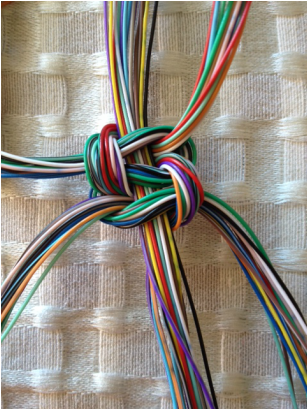
PictureMacrame-ing cable wire. Carlyn Yandle photo
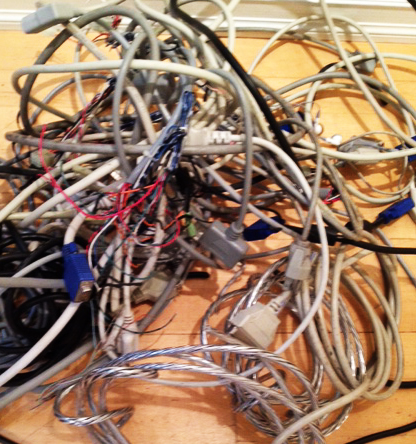
A big shout-out to the recycling staffer at my local Return-It depot who painstakingly went through a bin full of snarls of computer cables to select the ones with the most colourful clusters of wire for me.

I find it tough to march right into these kind of dirty, noisy man places but a girl's gotta do what she needs to do for her art. And I needed some cables to macrame for an upcoming show.

I'm in love with cable wire because it almost vibrates with the culture of our times and can be used in place of and in reference to traditional fibers. It's in overabundance (wireless home - hah!) and really pretty.

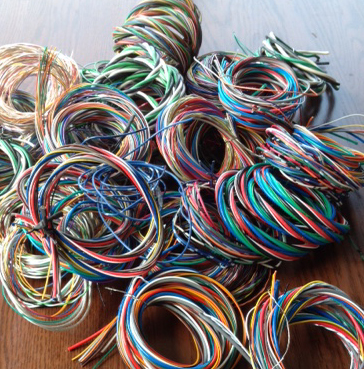
But to get it you've got to do some shucking. And this is how I came to spend many of these past fine days decapitating each, uh, connector-plug thing, skinning the plastic conduit with an X-acto knife, pulling away insulating woven aluminum or cellophane wraps and bundling the colourful clusters into skeins. (Below: before and after.)

PictureFlorence, Italy-based artist Kasey McMahon's life-sized 'Connected.'
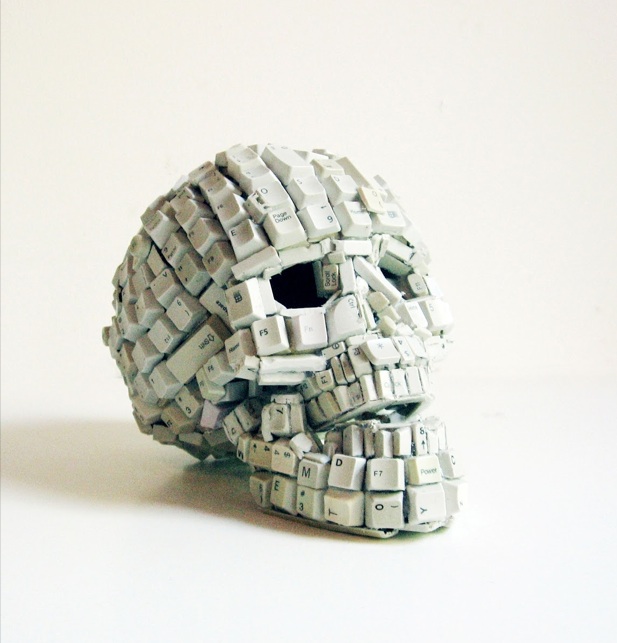
I can't resist mixing traditional fiber arts with industrial materials as a starting point and letting the materials kind of take over, shaping concepts. Sure, you could make a few bracelets or wrap a few light fixtures with the stuff but the power of the mountains of those wires, cables, old plastic laptops and toxic dead rechargeable batteries resonates with issues of globalization, environmental hazard, over-work and over-connectedness. Yum!

No surprise that there is an emerging — no, burgeoning — genre of sculptural and installation work that uses tossed computer bits to evoke those themes.

Below left, Democratic Republic of Congo artist Maurice Mbikayi's "Anti-social Network I" is one in a series of works that attempts to grapple with his "digital demons." Below right,  it took Polish sculptor Marek Tomasik three years to install an enclosure composed of old computer parts in a 14th Century castle in Poland.

Comments

Art trumps ads by just a whisper

11/1/2013

Comments

 
Picture

They say if you want someone's attention, whisper. Or maybe that was just a line from a Whisper pantyhose commercial back in the '70s.

Whispering to get attention isn't easy in an image-packed urban landscape where slick marketing messages infiltrate our entire field of vision, from pop-up ads on our screens to the clutter of billboards.

There's so much of it that we subconsciously absorb, dismiss then ignore each image as we move through the visual bombardment. And we wonder why we're mentally exhausted at the end of the day.

That's what makes the experience of public artwork in the city landscape so compelling. No call to buy or to back a product or political organization or private enterprise. With no aspirational words (Believe! Passion! Simplify!) or branded images, logos, phrases or text of any kind to cue our automatic-piloted brain to overlook the visual image, a slight confusion sets in. Whoa. What the hell is that? 

Picture
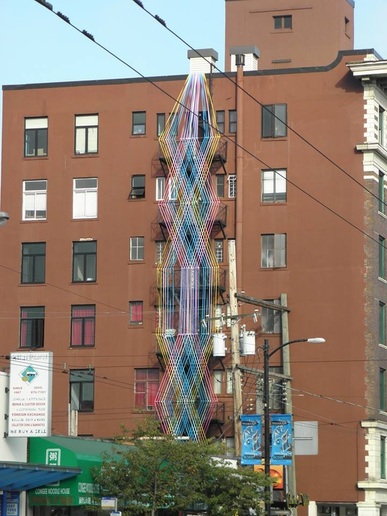
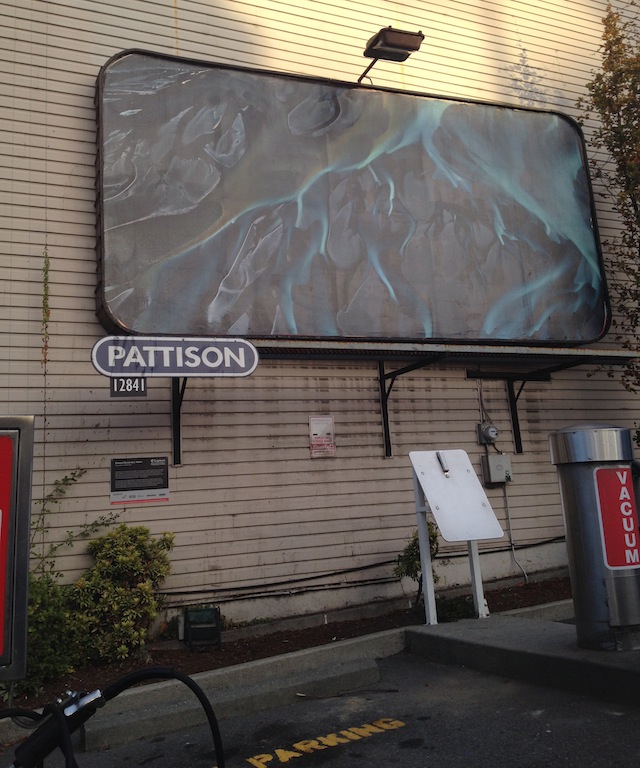
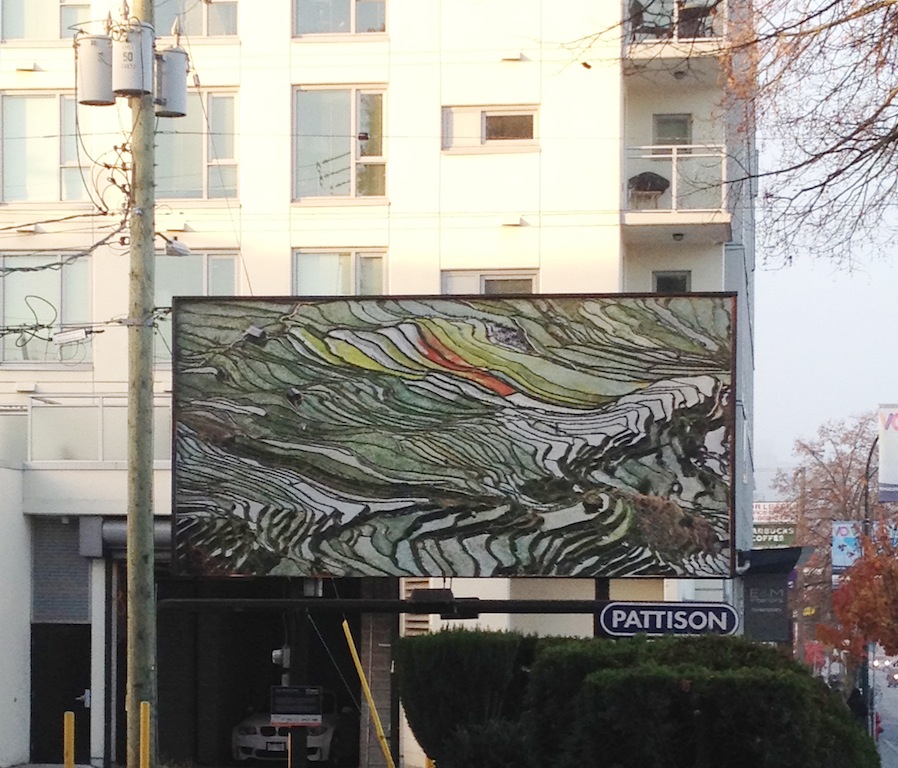
First comes the double-take, then out comes the smart-phone camera. The proof of the attention-grabbing power of commercial-free artwork on the city environment can be measured by the number of similar google images. You'd be hard pressed to find that Telus panda ad on a Flicker photo stream, but you'll run across multiple images of a single public artwork, like this giant macrame-esque installation created by Jasminka Miletic-Prelovac, at the only tall building (for now) at Main and Broadway. Or Edward Burtynsky's images on Pattison billboards (spotted along West 4th Avenue, below).

These message-free images that appropriate buildings and billboards are enough to compel viewers to investigate further. Turns out Miletic-Prelovac's work was this year's commission to highlight the livable laneways movement. And Burtynsky's images are from his latest book and new documentary, Watermark.

No logos. No brands. No text. These are whispers that can create a small roar.

Comments

Maker's mecca in downtown Toronto (for now)

11/9/2012

Comments

 
Picture
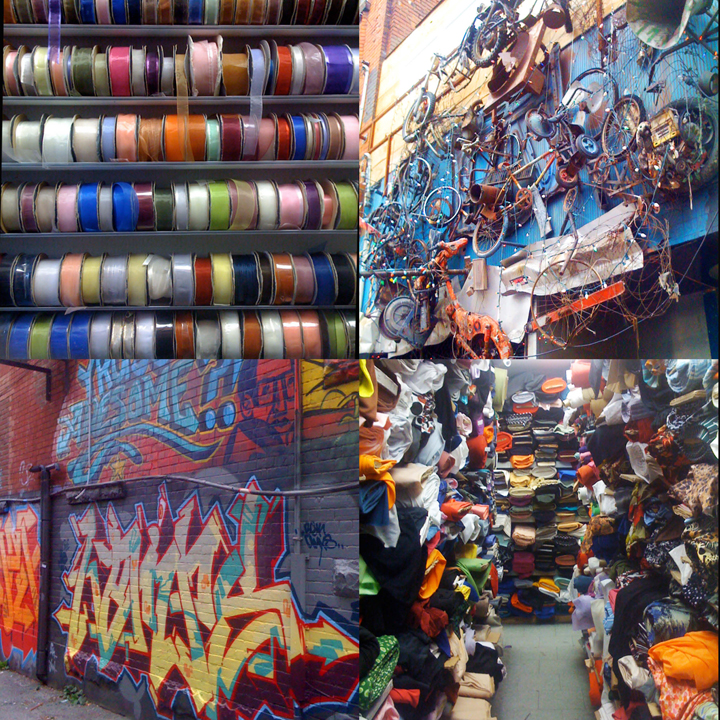
A real trip: Toronto's textile-retail district is a visual feast for any kind of maker. (Carlyn Yandle photos)
Picture
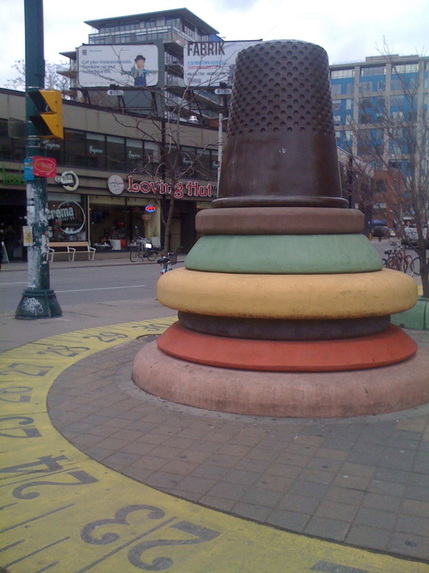
Stephen Cruise's 1997 public artwork at Richmond and Spadina. (Carlyn Yandle photo)
Like other Vancouver makers, I mourn the latest closures of stores dedicated to those who work with their hands, hearts and heads, for love or livelihood. Last month it was the needlework shop in my neighbourhood. Dressew is fast becoming the city's last great fabric store standing.

So the first chance I got while in Toronto last week I headed to the mecca for fibre-arts-makers: the Queen/Richmond/Spadina area. This bit of heaven boasts 100-year-old storefronts jam-packed with notions both humble and grand: a button shop — just buttons — next to one devoted to beads or ribbon or wool or shiny embellishments. Across from a luxury textiles boutique is a warehouse crammed with tables heaped with remnants. All in the space of a couple of blocks, and right in the thick of the city.

Yet even Canada's biggest textile retail district appears threatened by encroaching condo towers. (Note the billboard in this photo hawking pre-sale units in the "Fabrik" development on the site of the old King Textiles building.) 

Just when you think you're the last fabric-hound standing there's the World of Threads festival to restore the soul. This multi-venue Oakville-Toronto event showcases staggeringly skillful works embedded with rich ideas and spaces to consider, and to transcend. Despite the diversity of media and methods, a thread runs though this fest: in an all-too-consumptive art world these artists are grateful for the chance to show. The value of the work is not foremost in commericial saleability but is in the maker's connection to the material itself, the often transcendent physical experience of the making, and the connectedness to the pattern of art forms that pass down through families and through every culture.


Comments
<<Previous
    Cross-posted at
    carlynyandle.substack.com

    browse by topic:

    All
    Abject
    Abstract
    Abstract Embroidery
    Abstraction
    Abstract Painting
    Acrylic
    Activism
    Additive
    Aesthetics
    Agency
    AgentC Gallery
    Aging
    Alison Woodward
    Aluminum
    Anxiety
    Appropriation
    Arcade Fire
    Architecture
    Arleigh Wood
    Art
    Art Activism
    Art Blog
    Art Business
    Art Discourse
    Art History
    Artifact
    Artist
    Artist Residency
    Artist Statement
    Artist Talk
    Art Marketing
    Art Quilt
    Arts And Crafts
    Art School
    Art Show
    Art Spiegelman
    Assemblage
    Author
    Banksy
    Bauhaus
    Beauty
    Betsy Greer
    Big Data
    Billy Patko
    Binding
    Blogs
    Blog Tour
    Bob Krieger
    Body Of Work
    Books
    Boro
    Braided Rug
    Braiding
    Bruce MacKinnon
    Bruce Mau
    Building
    Bull Kelp
    Burlap
    Business
    Buttons
    Canadian Artist
    Carlyn Yandle
    Caroline Eriksson
    Cartoon
    Ceca Georgieva
    Challenge
    Charley Yandle
    Children
    Christmas
    Cindy Sherman
    Circular Thinking
    Cirque Du Soleil
    City As Site
    City Planning
    Cityspace Gallery
    Clay Yandle
    Climate Change
    Cluster
    Cob
    Cob Oven
    Collaboration
    Collage
    Colonialism
    Color
    Colour
    Commission
    Community
    Community Building
    Composition
    Conceptual Art
    Conceptual Craft
    Connection
    Connie Sabo
    Construction
    Coronavirus
    Cosplay
    Costume
    Counter Culture
    Counter-culture
    Cover
    Cover-19
    Covid
    Craft
    Craft Blogs
    Craft Camp
    Craftivism
    Crafts
    Craftsmanship
    Creative Process
    Critique
    Crochet
    Cross-stitch
    Cultural Hub
    Cultural Studies
    Culture
    Culture Jamming
    Culturejammingc9d75664fd
    Current Conditions
    Cycling
    Dafen Village
    Dallas-duobaitis
    Dance
    Data-graphic
    Data-graphic
    David Weir
    Dear Human
    Decorations
    Deep Craft
    Denim
    Denyse Thomasos
    Design
    Digital Art
    Discomforter
    Display
    Dissent
    Distraction
    Distracts
    DIY
    Doilies
    Doily
    Domestic
    Domestic Interventions
    Douglas-coupland
    Draw Down
    Drawing
    Dressed
    DSquared2
    Dude-chilling-park
    Dyeing
    Dystopia
    Eastend
    Eastside Culture Crawl
    ECUAD
    ECUAD MFA
    Editorial
    Edward Burtynsky
    Eggbeater Creative
    Embellishment
    Embroidery
    Emily Blincoe
    Emily Carr Cozy
    Emily Carr University
    Entanglements
    Environment
    Environmental Art
    Exhibit
    Exhibition
    Expanded Painting
    Experimentation
    Exploration
    Expression
    Fabric
    Fabricating
    Fabrication
    Facebook
    Failure
    Fashion
    Fashion Revolution
    Fast Fashion
    Feminisim
    Feminist
    Feminist Art
    Festival
    Fiber
    Fiber Artist
    Fiber Arts
    Fibre
    Fibre Arts
    Film
    First Saturday Open Studios
    Flo
    Flow
    Forage
    Foraging
    Form
    Form And Function
    Foundlings
    Found Materials
    Found Objects
    Fractal
    Free Store
    Fuckwit
    Fuzzy Logic
    Gallery
    Gallery-row
    Garden
    Gardening
    Garment
    Gathering
    Gentrification
    Geometric Art
    Gill Benzion
    Gingerbread
    Globalization
    Glue
    Goblin Core
    Grad 2020
    Graffiti
    Grannycore
    Granny Square
    Granville-island
    Green Space
    Grid
    Grief
    Guanajuato
    Guerrilla Art
    Guerrilla Girls
    Halloween
    Handmade
    Handmaking
    Hand Stitching
    Hand-stitching
    Handwork
    Hashtags
    Haywood Bandstand
    Healing
    Health
    Hearth
    Heirloom
    Hideki-kuwajima
    Homelessness
    Homemade
    Hot Art Wet City
    Housing
    Hybrid Thinking
    Ian Reid
    Ian Wallace
    Ideas
    Identity
    Images
    Imagination
    Immersive Art
    Improvisation
    Incomplete Manifesto For Growth
    Industrial Design
    Industry
    Innovation
    Inspiration
    Instagram
    Installation
    Installation Art
    Intervention
    Intrusive Thoughts
    Invention
    Irena Werning
    Ironing
    Janet Wang
    Jeans
    Jeff Wilson
    Joel Bakan
    Joseph Beuys
    Joseph-wu
    Journalism
    Joyful Making In Perilous Times
    Joyfulmakinginperiloustimes
    Judith Scott
    Kamala Harris
    Kids Art
    Kim Piper Werker
    Kimsooja
    Kintsugi
    Knitting
    Knots
    Knotting
    Kyoto
    Labor
    Labour
    LA Fires
    Landon Mackenzie
    Landscape
    Leanne Prain
    Lecture
    Lighthouse
    Linen
    Liz Magor
    Log Cabin
    Logo Sweater
    LOoW
    Lost Painting
    Lumiere Festival
    Lynda Barry
    Macrame
    Maker
    Making
    MakingIsConnecting
    Malcolm Gladwell
    Male Gaze
    Mapping
    Maquette
    Marie Kondo
    Marketing
    Mark Lewis
    Martha Rosler
    Martha Stewart
    Masks
    Material Exploration
    Mathematics
    Maya
    Media
    Meditation
    Meditative
    Mending
    Mend In Public Day
    Mental Health
    Metalworker
    MFA
    Mister Rogers
    Mixed Media
    Mobile Art Practice
    Monique Motut-Firth
    Monster
    Monte Clark
    Mosaic
    Motivation
    Mt. Pleasant Community Centre
    Mud Girls
    Mural
    Mushroom
    Mycelium
    Narrative
    Natalie Jeremijenko
    Nature
    Needlework
    Neon
    Net
    Network
    Networking
    Neuroplasticity
    New Forms Festival
    Newspapers
    Nick Cave
    Noah Goodis
    North Vancouver
    Obtrusive Thoughts
    Omer Arbel
    Online Talk
    Openings
    Organization
    Origami
    #overthinking
    Paint
    Painting
    Pandemic
    Paper
    Paper Sculpture
    Papier Mache
    Parkade Quilt
    Patchwork
    Patriarchy
    Pattern
    Pecha Kucha
    Pechakucha
    Perception
    Perfectionism
    Performance
    Performance Art
    Personalispolitical
    Photography
    Playing
    Political Art
    Political Satire
    Polly-apfelbaum
    Pompidou
    Poodle
    Port Coquitlam
    Portrait
    Practice
    Process
    Production
    Profession
    Project
    Protest
    Protest Art
    Psychedelic
    Public Art
    Pussy Hat
    Pussy-hat
    Qr Code
    Quilt
    Quilt Block
    Quilting
    Quilt Painting
    Rachael Ashe
    Rachel Lafo
    Ravages
    Raw Materials
    Rebar
    Recycle
    Recycling
    Reflection
    Reflektor
    Reimagine
    Renewal
    Repairing Is Caring
    RepairingIsCaring
    Research
    Residency
    Resistance
    Resurge
    Retreat
    Re-use
    Rhonda Weppler
    Richard-tetrault
    Richmond Art Gallery
    Right Brain
    Rondle-west
    Roses Against Violence
    Rote Activity
    Rug
    Ryan-mcelhinney
    Safe Supply
    Safety
    Sampler
    Sarah-gee-miller
    Sashiko
    Saskatchewan
    Scaffolds
    Scaffolds I
    Scale
    Scraps
    Sculpture
    Seasonal Decor
    Seattle Art Museum
    Seaweed
    Seismic Rug
    Semiotics
    Sewing
    SharingIsCaring
    Sharon Kallis
    Shawn Hunt
    Shigeru Ban
    Sketchup
    Slow Craft
    Smocking
    Social Art
    Socialart
    Social Distancing
    Social Distancing Hat
    Social Engagement
    Social-engagement
    Social History
    Social Justice
    Social Media
    Soft Sculpture
    South-granville
    Space Craft
    Spore
    Stitching
    Storage
    Street Art
    Studio
    Styrophobe
    Subversive Stitch
    Surrealism
    Surrey
    Tactical Frivolity
    Tactility
    Tagging
    Talking Art
    Tapestry
    Tattoo
    Teamlab
    Technology
    Terry Fox Theatre
    Text
    Textile
    Textile Art
    Textiles
    Thrifting
    Thrift Stores
    @tinypricksproject
    Tiny Pricks Project
    TJ Watt
    TO DO
    Tools
    Toronto Design Offsite
    Toybits
    Trash
    Trash Art
    Travel Art
    Trevor Mahovsky
    Trump
    Typography
    Tyvek
    Unbridled
    Unfixtures
    Upcycle
    Upcycling
    Urban Design
    Use Object
    Use Objects
    Utility
    Value Village
    Vancouver
    Vancouver Art Gallery
    Vancouver International Airport
    Video
    Video Tour
    Visual Field
    Visual-field
    Visual Language
    Wabi-sabi
    Wallace Stegner House
    Wall Hanging
    Waterwork
    Wearable Art
    Weaving
    William Morris
    Women's March
    Wood
    Wool
    Work Wraps
    Wrap I
    Wrap II
    Writing
    Xenobia Bailey
    Yarn Bombing
    YVR
    Zaha Hadid
    Zendoodle
    Zero Waste Art
    Zero-waste Art

    Archives

    September 2025
    May 2025
    April 2025
    March 2025
    January 2025
    December 2024
    November 2024
    October 2024
    September 2024
    August 2024
    July 2024
    June 2024
    October 2022
    August 2022
    June 2022
    November 2021
    April 2021
    September 2020
    April 2020
    December 2019
    November 2019
    September 2019
    August 2019
    July 2019
    June 2019
    April 2019
    November 2018
    July 2018
    May 2018
    November 2017
    September 2017
    June 2017
    April 2017
    March 2017
    February 2017
    December 2016
    November 2016
    September 2016
    July 2016
    March 2016
    February 2016
    January 2016
    December 2015
    November 2015
    October 2015
    September 2015
    June 2015
    May 2015
    April 2015
    March 2015
    February 2015
    January 2015
    December 2014
    November 2014
    October 2014
    September 2014
    August 2014
    July 2014
    June 2014
    May 2014
    April 2014
    March 2014
    February 2014
    January 2014
    December 2013
    November 2013
    October 2013
    September 2013
    August 2013
    July 2013
    June 2013
    May 2013
    April 2013
    March 2013
    February 2013
    January 2013
    December 2012
    November 2012
    October 2012
    September 2012
    August 2012
    July 2012
    June 2012
    May 2012
    April 2012
    March 2012
    February 2012
    January 2012
    December 2011
    November 2011
    October 2011
    September 2011
    August 2011
    June 2011
    May 2011
    April 2011
    March 2011

Powered by Create your own unique website with customizable templates.
Picture