carlyn yandle
  • about
  • the creative process
  • crafted objects
  • public art
  • painting
  • exhibitions
  • contact

When more is more

11/5/2025

 
I’ve learned to live with a head full of bees but these days it’s all about wasps.
​
So. Many. Wasps. Wasps that retreated indoors last week after the pest-control guy shot up the kitchen fan vent with a killer powder. Wasps that just wouldn’t stay away even after two pest-control guys came back to deal with the discovery of an impressive-sized nest metastasizing inside the wall. I spent most of the week whacking at wasps and sucking them up in the hand-held vacuum cleaner. Whacking and sucking, whacking and sucking.
It’s not the sight of a single curled-up carcass that gives me the willies; it’s the sheer volume of them. A ladybug on my forearm might prompt that little rhyme, Ladybug, ladybug, fly away home / Your house is on fire, your children are burned… Wait, what is that all about? My point is, if a cloud of ladybugs landed on my arm I would be screaming like Tippi Hedren in The Birds. Hitchcock knew all about the power of numbers to turn bird-friendly movie-goers into ornithophobes.
Picture
Poster art from the 1963 Hitchcock classic, “The Birds.”
A large mass of harmless insects doesn’t even need to touch me to get my skin crawling, like the summer when I watched my mother slap at a few flying ants on the window with her fly-swatter while behind her a black mass of hatchlings oozed out of a wood ceiling beam and swarmed the room. Even writing about that overabundance gives me the heebie-jeebies.
Large accumulations of a single object — animate or inanimate — cranks up the visual volume. Canadian artist-photographer Edward Burtynsky introduced viewers to the extreme-scale reality of global trade in Manufactured Landscapes from the first scene of some sewers bent over their machines in the Hongqingting Shoe Factory, Wenzhou, Zhejiang Province, China. There is no commentary as the camera slow-pans down the length of what emerges as a stadium-sized building full of several hundred workers, allowing us to fully grasp the enormity of this production. (And that was 20 years ago.)
Picture
Edward Burtynsky’s large-format photograph, Manufacturing #17, Deda Chicken Processing Plant, Dehui City, Jilin Province, China, 2005 via Public Delivery (https://publicdelivery.org/edward-burtynsky-china/)
But the power of increased scale, accumulation of objects and repetition of patterns isn’t always in service for horror; how or when to use that power comes into question whenever I’m developing new work. Is more more here? Or does repeating the unit or method dilute its essence, reducing the overall work to an underwhelming pattern? More importantly, is my interest in pumping up the volume in art just hoarding?
Picture
An accumulation of matchbooks is just a collection.
Picture
“Matchy Matchy”, an atypical presentation of an accumulation of matchbooks (left) and a three-hour painting-sketch of that collection (right). (Carlyn Yandle)
Picture
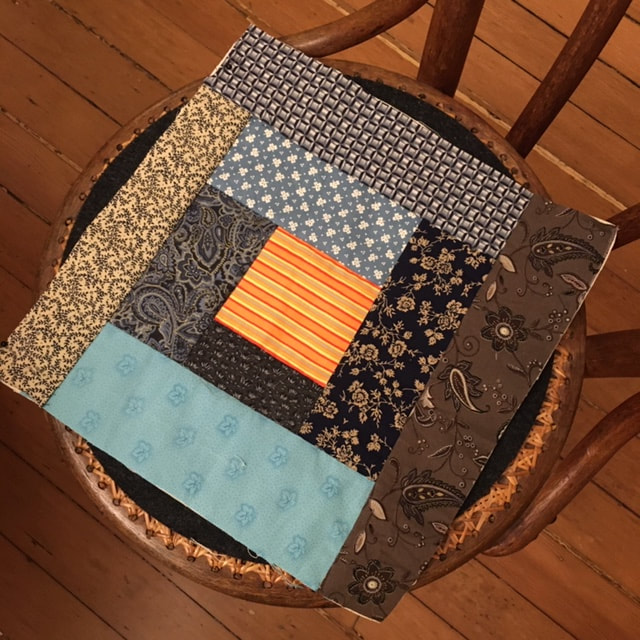
A benign single ‘log cabin’ hand-stitched quilt block.
Picture
The growth potential of “Hearth” (2020), hand-stitched log-cabin quilt blocks of different sizes, is limitless. (Carlyn Yandle)
Picture
When more is more: A large scale painting of an overabundance of layered squares aims to overwhelm in “PopUp: Triptych,” 2010, acrylic on panel, 96”Wx48”H
These are the busy-busy bees’ questions that mostly come at night when the wasps have gone to sleep, resting up to torment me another day.
​

Quilting and connecting

9/7/2025

 
If you stitch it (in public) they will come
​

An artist-instructor friend advised me, as I was preparing my portfolio to apply to art school, that if I was planning to include images of my quilts and rag rugs and mosaic’d vessels, I should group these as Craft Use Objects.

I’m sure she didn’t mean it but the word ‘craft’ seemed to have a stink to it. And the fact that these items were for actual use (as opposed to useless?) was also a bit whiffy. I spent the following six years of fine-arts studies needling at the question, What’s the use of art?

I eventually found two good uses for creating exhibition-type paintings, sculptures, floorworks and fibre installations: making use of used, disused or misused materials instead of consuming new materials; and growing community through the gathering of those materials. I monkeyed around with job-site debris delivered by construction workers; broken toys from my sister’s kids and her friends’ kids; old embroidered linens, doilies and buttons from my mother’s friends and other artists; jeans from my brother and others; old paintings from my father; burlap coffee bags from the coffee-roaster; pennies from friends; and businessmen’s white linen shirts from, well, businessmen.

In the end it all boiled down to one three-word artist statement: Making is connecting. This is not an original idea and maybe a little obvious but it’s been my roadmap for creating ever since.
​
Which brings me to “Shatter”, the title of my latest virtually/almost/nearly finished not-at-all-stinky Craft Use Object. (After many decades of making quilts I’ve decided that any quilts that are not direct copies of a pattern, that have taken on a personality of their own, deserve a title just as much as Artwork.) This one has emerged as a field of shattered circles, a project that shatters any expectations for this quilt and this quilter. It also relates to the times of its making, November 2024 to June 2025 — need I say more? “Shatter” is a cozy, slightly chaotic project that embeds silks and satins gifted by friends, as well as hours of focus, frustration and endurance, all in the service of creating the many meanings of comfort.
Picture
Hand-quilting detail, Shatter quilt, 2025 (Carlyn Yandle)
The sunny, warm weather this past week made it possible to take “Shatter” to the park to spread out for a few hours of the victory lap in quilt-making: encasing the mess of batting and threads in a precise frame of binding through hand-stitching. We made it! And it’s square! -ish!
Picture
AN OUTDOOR TRADITION: When there’s no room indoors to spread out a queen-sized project, quilting is necessarily a seasonal activity. (Carlyn Yandle, 2003)
“Shatter” is an attention-getter. The pie-piece blocks of satin and gold top-stitching shimmer in the sun against the matte midnight-blue cotton background. It compelled some park visitors to comment as I bent over the binding. Nice quilt. I love quilts. Did you make this yourself? My grandmother was a quilter. I would love to learn to quilt. I found a great vintage quilt. Do you fix zippers? (Please stop asking me if I fix zippers.) By the end of the day “Shatter” was also the site of a long discussion with a friend broken up by her break-up. When all was said and done we stood up, hugged and I rolled up the quilt, the equivalent of seeing someone out of the office.
It remains rolled up, ready as another sunny, social setting or a cozy, tears-absorbent spot to stretch out on or curl up in.
Picture
MAKING IN PUBLIC: The neighbourhood park on a sunny, dry day is the perfect/only space for hand-stitching a large project.
Originally published on Substack earlier this summer.

Resistance can be beautiful

4/6/2025

 
Hand-making outside the dominant economic system
The news is inescapable. The Trump tariffs announced last week will “rupture the global economy,” warns the Prime Minister. This is on top of the inflationary wallop on 45 per cent of Canadians who reported that rising prices were “greatly affecting their ability to meet day-to-day expenses in the spring of 2024, up 12 percentage points from two years earlier,” according to Statistics Canada. Further, almost one-third of Canadians are “experiencing financial difficulties,” up from 18.6 per cent in 2021. It’s all led to a “gradual deterioration in life satisfaction” especially among younger adults and those with financial difficulties. On top of all this, Canada is in the throes of a snap federal election.

Yet life goes on. That robin outside my window is still doing its 4 a.m. wake-up call. The cherry tree it perches on is about to burst into pink snowballs. Below the tree canopy the Amazon vans still roar through the neighbourhood and the UberEats drivers still double-park to keep up with their orders.

Maybe, and I’m just spit-balling here, we can be like the blossoms and flourish independent of the consumer economy and the attention economy, that battleground that has us in a near permanent state of distraction. I searched how reverse life dissatisfaction and received this AI Overview:

“To reverse life dissatisfaction, focus on identifying the root causes, setting realistic goals, practicing self-care, engaging in meaningful activities, and seeking support when needed.”
​
Even this banal Google-bot response on the general theme of self-reflection begins with the word ‘focus’, followed by ‘practicing’, ‘engaging’, ‘meaningful’, ‘activities’, ‘seeking’ and ‘support’ — words in direct opposition to ‘distraction’, ‘escaping’, ‘frivolous’, ‘inertia’, ‘ignoring’ and ‘undermine.’ There are no Tips and Tricks in the AI Overview for reversing life dissatisfaction through retail therapy, no easy instructions to move fast and break things, or buy bit-coin, self-medicate, move somewhere else or to hang on tight to your privilege.
​

The beautiful thing about having a number of ongoing art projects is that there’s always one that fits the moment. Right now that’s Hearth.

Picture
Social making sessions resulted in this first installation of 'Hearth.' (Carlyn Yandle)
Started back in the beforetimes of 2019, Hearth is an infinitely-expanding grid of log-cabin quilt blocks that began with an idea: What kind of art-making would be engaging and easy enough to attract a diverse population, a big-picture zero-waste project that would cost nothing? What could create the chance to learn a new skill, meet people beyond one’s usual social circle, that would include the joys of giving and receiving, all toward a gallery exhibition?
​

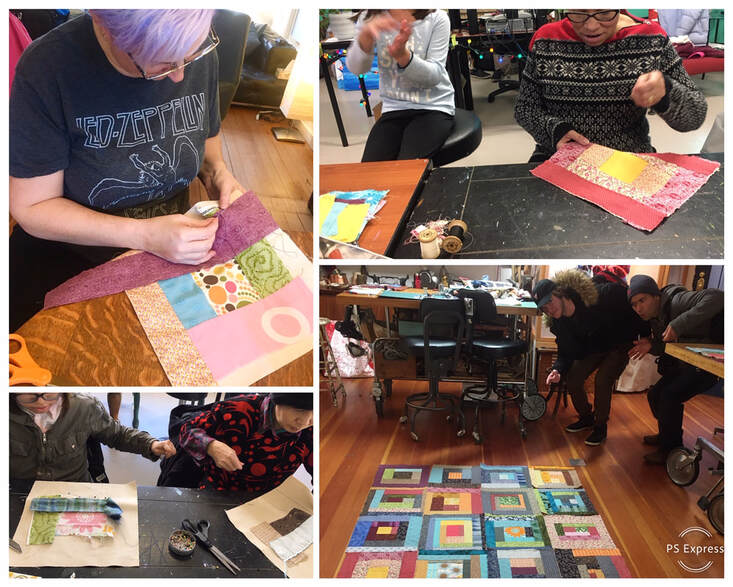
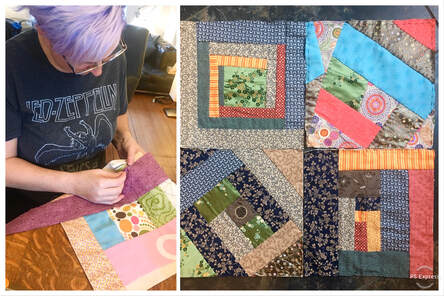
Over the next six months, dozens of friends and friends-of-friends, neighbours, colleagues and people just happening by gathered at art studios, porches, around kitchen tables and living rooms. In groups from two to a dozen, we hand-stitched log-cabin-style quilt blocks from strips of donated fabric in improvised spirals around a central (“hearth”) square.
Picture
Some early stitching sessions (Carlyn Yandle photos)
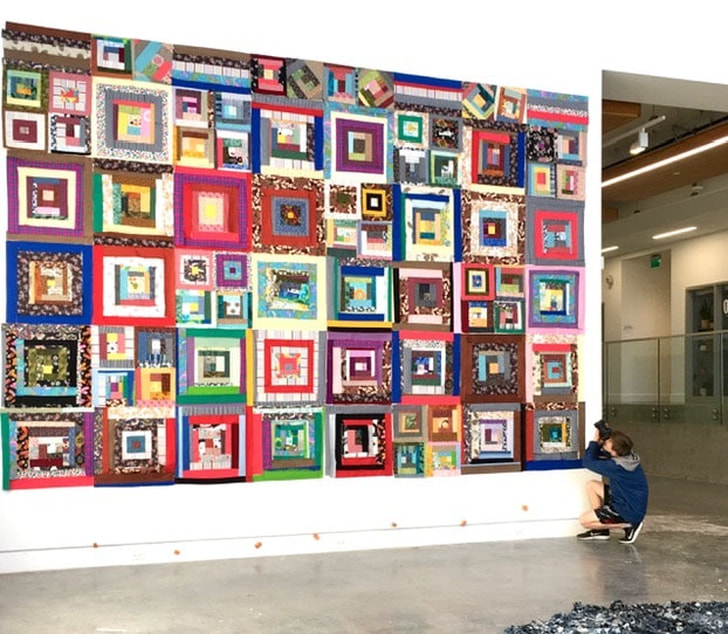
The blocks were eventually all installed into a massive wall installation as part of my MFA thesis exactly one day before the university shut its doors for several months. We didn’t give up our will; we organized contact-free fabric swaps and took the project online, sharing ideas and stitching instead of drinking.
Picture
Socializing at a distance: a Zoom stitching session (Carlyn Yandle)
When the lockdown rules relaxed, Hearth was instrumental in rekindling social activity. Any in-person awkwardness dissipated as we focused on hand-stitching or just dug through the heap of fabric strips to create a pleasing palette, for our own blocks or to offer someone else.
Picture
RE-START: An early post-lockdown session with MFA colleagues
Picture
A street-front gallery show in the early post-pandemic; interior detail
It takes about two hours for anyone who can hold a needle to stitch a block, about the same time as any social visit. The makers, many of whom learned that in fact they could sew a straight line, were free to take their finished piece home, maybe to use as a cushion cover, placemat or the beginning of a quilt top. Most contributed their blocks to the Hearth project so their own handwork would be a part of a gallery show, with due credit.
​

As normal daily activity resumed, I moved the one bin of fabric strips and the other of finished blocks into deep storage. But just as sure as that cherry tree outside my window will burst into bloom, that project is coming back out for a show of its own. It’s a new chance to focus on practicing engaging, meaningful activity designed for those seeking connection and support outside this dominant, volatile economic system, away from forces screaming for our attention. In these perilous times we’re creating something bigger than our individual selves, one stitch, one block at a time.​

An iron will is needed now

11/4/2024

 
Working out those wrinkles is so satisfyingIf you’re uselessly wringing your hands right about now, pump some iron.
Hear me out: Ironing is useful, which, in the few days left before the US election, is the opposite position of those of us watching who can’t vote or compel Americans to vote. With democracy itself teetering on the brink it’s best to stop flitting about, pants on fire, and instead grab onto something stable and practical. Just maybe don’t do it in front of the latest broadcast of any of the mega-rich misogynists’ rallying cries; the TV screen is no match to an overhand launch of an iron.
If you’re rolling your eyes at this suggestion you may still be triggered by the iron as symbol of just more unpaid women’s housework, promoted through those post-war images of an ecstatic housewife standing before the only board she has access to. If you view her hubby’s freshly starched white shirt as his day pass out of one of those little boxes made of ticky-tacky, you are still afflicted.
I get it; letting go of the iron-as-shackles connection doesn’t come easy when you are born into that milieu. My cousin recently shared a photo of the two of us, as young as six, standing knock-kneed in skirts and knee-socks at a kid-sized ironing board, playing ironing yet there was little evidence of ironing activity in my own childhood home. This shit was insidious. 
Inflation was hitting hard those days, and the petrochemical industry found an opportunity: pushing polyester as the time-saver for women who by choice or necessity entered the workforce. When my grandmother found herself single in her 40s she traded her home-sewn floral cotton dresses for Sears Fortrel mix ’n’ match coordinates, got her teacher’s certificate and moved to a remote town for work. My McDonald’s uniform was an itchy kelly-green combo of stretch pants and striped zip-up collared top.
Skip forward a few decades and we’re barely treading water in the synthetic polymersea of fast-fashion clothing that fuels microplastic pollution.

Ironing has no role in this wrinkle-free, race-to-the-bottom system. It’s part of the repairing-is-caring continuum toward a circular economy of natural-fibre clothing and toward our own well-being. It relaxes both rumpled, creased woven cottons and linens and our fine selves. You can’t doom-scroll when you’re gliding across a soft surface, settling wrinkles with puffs of steam. Ahhhhhh. 
Quilters know all about the rewards of ironing following hours of wrestling bits of fabric into new arrangements with a temperamental sewing machine. Even the wonkiest quilt blocks in that stack “will all press out.” Ohhhmmm.
The time spent ironing favourite linens and natural-fibre clothing is an investment in those pieces, a time for personal reflection on their making and their makers. Grandma Flo may have embraced her wash-and-wear polyester pieces but she never abandoned ironing her quality dressy things or her fine cutwork table linens hand-stitched by her sisters. When it was my turn to have her over for tea she would tsk-tsk at my creased tablecloth. That it was thrifted was no excuse; all linens deserved pressing. 
A decade after her death I created a part-figurative alterpiece anchored by a Teflon iron plate. The assemblage of found objects reflects her strength in the face of tumultuous change and the little pleasures of her everyday like teatimes, decoration and costume jewelry.
Picture
Two views of “Teflon Flo”: Found lamp base, iron plate, jelly mould, tea strainer, chandelier crystals (Carlyn Yandle)
At this writing, it is Dia de los Muertos and Teflon Flo is front and centre and shining its light. A few feet away from this ofrenda is a deep scorch mark in the circa-1898 wood floor that, judging by its diminutive footprint, dates back decades. I take it as a warning from a past homemaker — I’ve conflated her with my grandmother — to unplug the iron or it will all burn down. Which I am not thinking will happen if Trump is elected. Not thinking about that at all.
Picture
A warning from decades past: Don’t let it all burn down (Carlyn Yandle)

Faith is key when you're cutting up family heirlooms

6/7/2024

 
Is it easy to cut up hand-embroidered linen tablecloths, runners, pillowcases?

It is not. As an adequate hand-stitcher I understand the skill, labour, time and patience that goes into each linen. I understand the desire to cherish these vintage domestic-craft objects made for the joy of it that are eventually passed around and down the generations only to be hidden in some drawer or closet. I understand the impulse to rescue them from the humiliation of their thrift-store price tags of maybe five dollars.

Cutting through all these layers of meaning feels a little like slicing into someone else’s skin. What right do I have?
PictureAm I ruining family heirlooms? Or daylighting unused linens that have been in the dark for decades? (Carlyn Yandle photo)
As word got out that I was amassing old embroidered linens for an artwork I gratefully received donations from friends and family. It’s a lot easier to be the rescuer of those tragic cases dotted with stains or holes. At least I can console myself that I’m ending the quandary over whether to keep this piece of Grandma or let it go.

But the weighty, pristine Irish linen tablecloths that bloom with finely stitched bouquets and drawn threadwork borders are quite another thing. I take a deep breath and make mental apologies and thanks to the unknown or long-gone maker. I remind myself that I’m not ruining a family heirloom but daylighting the work of handmade things that have been in the dark for decades. Then I let the rotary-cutter rip. I am Edward Scissorhands. I can’t help myself. Sorry, not sorry.

This is the struggle behind Forage, an under-construction field of improvisational log-cabin blocks in my preferred scale of queen-sized. Each embroidered scrap is a literal snippet of a larger piece, the analogue equivalent of a digital thumbnail image. Machine-stitched together the blocks are as cacophonous as an Instagram Explore field.

Picture
That effect grows exponentially as the blocks are stitched into rows, then rows onto rows. I’m now part-way through constructing the thing as a single field (“top”, in quilt language). Viewed horizontally it is a chaotic community garden of 42 unwieldy plots that spill out into the paths (“sashing”). I find new patterns for connection while merging the embroidered elements of one block into another block through the sashing, in a sort-of snail’s trail of stitches. As I mimic these markings of those makers, I feel a connecting thread. I am walking in their stitch-steps.

Despite the garden-plot references, this work is defying the horizontal, offering a reverse-side textural experience of an unstable grid of frayed edges. The maker-contributors never intended for the ‘wrong side’ to be seen, but when it’s all brought into the light, the translucent stained-glass effect cannot be denied. Suddenly I see connotations of religious symbolism, and I’m wondering about the power of the loose threads and those cryptic-looking stitches when viewed from behind the scenes. Something about sacrifice or at least about having faith that the discomfort in detaching from nostalgia is for good, not evil.

That openness is rich ground, another area to forage.
Picture
Connecting embroidered elements feels like walking in the stitch-steps of past makers. (Carlyn Yandle photos)
Picture
A backlit view of this work-in-progress adds further layers of pattern, texture and symbolism. (Carlyn Yandle photos)

Circular thinking can be a flow state too

6/2/2024

 
Picture
I opened up my studio yesterday to the public to get some general feedback on a new series of paintings. Because even though I’m compelled to keep working on it and even though I’m enjoying a growing proficiency in this mash-up of stitching and painting I’m having trouble articulating why — or if — they’re not just pretty faces. Mostly I've been answering their questions with questions of my own.

“Why” has always been the trouble. Also aggravating: Why ask why?
This is the reason I’ve named this growing collection of paintings that all basically follow my own set of rules of engagement Circular Thinking. The connotation is negative but hear me out.

Asking ourselves existential questions while we create is infuriating (Shut the hell up, Inner Critic) but it’s also part of a process that can guide us to where we want to land. I would like to be settled with the obvious reason that it’s my route into flow, or actual, real fun. (The “so fun” episode of the We Can Do Hard Things podcast here was recommended to me by my sister.) And they do get me there: into the flow of playing with colours and opacities, of focusing on one stitch at a time, watching how each layer of paint or stitching changes perception.

But I can’t settle with just what’s in it for me. Making is my way of connecting with the world. Much of my work is collaborative, so those involved naturally have a stake in the final projects. Often that’s in the gathering of abject materials, or the actual simple hand-working methods that bring folks together. So it’s easy to see the ‘why’ in these crafted objects and fields; beyond their own resonance they stand as an archive of the social interaction, an artifact of the engagement with materials.

The Circular Thinking series has none of that. Each painting is a singular, intimate effort. It does not reveal any agency embedded in unwanted/useless materials and objects. So in the making, despite the flow part, I feel a whisper of guilt and shame that many women of a certain age might also hear when not doing for others: selfish, self-indulgent, self-absorbed.

There is definitely something in the ‘self’ there that is the driving force in these improvisational, unpredictable and unsettling paintings: self-care. I ache for solid, reliable ground in these perilous times so I start with a grid, like the criss-cross of rebar that sets the concrete footings in every new tower crowding the Vancouver skyline, or a typical nine-patch quilt block. Nine eight-inch-diameter circles in a 24" x 24" "block" anchor to that grid and then I’m off, free of all straight lines, off-setting those circles by half in paint, offsetting again with more layers of colour in paint or thread until I arrive at an attractive/distractive done-ness. It is an improvisational process of revealing and concealing (repeat!) petal-like sections of circles, creating unsettling, kaleidoscopic fields. It is the kind of all-consuming process that reduces hours to minutes, that absorbs all attention, a safe space away from the visual onslaught of social media, yet reflective of our ‘everything is awesome’ screen-field of vision.

​It might be easier to eat this elephant one bite at a time by knocking down specific why-questions:
​

Why paint?
Colour-play. Especially important in this watery corner of the world. It can also act as a dye/stain.

Why canvas?
It’s fabric, with so much possibility for exploring its essential characteristics.
​
Why the wood stretcher?
Another fibre product that is a natural with fabric. It's basically a quilt frame or embroidery hoop for painters. Building stretchers and stretching the canvas is an investment in the project ahead (a trick I learned from my father @dennisyandle).

Why the stitching?
I like to needle at the hierarchy of painting over craft processes. Each stitch feels like I’m sticking it to convention. Stitching into painting offers the digestible label of “expanded painting practice.”

Why all the quilt references?
The geometry of quilt designs is fascinating, mesmerizing. I have little aptitude but a lot of respect for the beauty of mathematics. The tactility of that geometry connects to present and past makers of objects that exist as art pieces or as items of comfort, utility and gifts, an expression of love. This is a less-digestible "expanded quilting practice": improvisational, mixed-media works with none of that cushy filling.
Picture
The geometry of circular quilt designs remains a beautiful, captivating mystery.
Why this scale?
24" x 24” is my standard sample-block size. I dream of an exhibit of all my sample blocks blanketing white-cube gallery walls. 

Why two-dimensional?
Closer inspection reveals the third dimension, in the stitching. Also, the aforementioned sample-block dream show is a three-dimensional, immersive space of pattern and colour chaos. (I want to go to there.)
​
Circular Thinking is both the name of this latest series of grid paintings and shorthand for how I approach every new project: 
play, think, write, share, think, research, share, write, repeat.

Through this writing part of that feedback loop I can see I just might stop torturing myself with the existential Why and get back into that flow.

@carlynyandle
Picture

VIDEO tour: 'Joyful Making in Perilous Times'

4/21/2021

 
Picture
Click HERE for a 10-minute journey through the methods and motivations behind this MFA thesis. (Film made by Ana Valine, Rodeo Queen Pictures, August 2020)

Joyful Making in Perilous Times

9/10/2020

 
Where is the joy when you’re living in a time of a global coronavirus pandemic and a local toxic-drug epidemic? What is the use of making when your city is seized by global investment-real estate schemes, when there’s too much stuff in a overheated planet and a hateful, superpower president next door?

These questions ricochet around my brain, only abating when this futile, exhausting expenditure of energy hones in on the rote activity of knotting and needleworking. The hand-wringing falls into rhythm as I grasp at lost, tossed threads that I make whole and into whole new ideas.

Making is a very personal physical reaction to perilous times and unstable circumstances but working with found fibre is also an intrinsically social action that weaves in disparate economic circumstances, language, race, age and abilities. Braiding, stitching, knotting, needleworking create resilient connective tissue between one body and another. Strands thicken into solid links between the ancient and the modern, utility and self-expression, the digital and the physical, the personal and the political.

By exploring the inherent qualities of abject manufactured material, the body binds with other bodies and other places, some known, some not. It is work, but outside the tumultuous dominant economic system. It is an experience of the history of production and distribution through the material at hand.

Even in these times, when gathering around a table is a hazardous activity, when our pack species is feeling at loose ends, masked up and reluctantly apart, the tactility of rote hand-making grounds us into the here and now, one stitch, one loop, one knot at a time. We grasp at the tendrils, continuing the work, with the results standing as artifacts of a time, place and our individual and collective states of being.​

Three major works created over one year remind me of the uncertainty, the panic, the perilousness of these times, and of the solace gained through individual making and the joy of making with others. The three are relics of two years of material research that culminated in a Master of Fine Arts 2020 exhibit set up one day before the university locked down.

1. Scaffolds

Picture
'Scaffolds': 2019, 10' x 10' x 8" All materials gathered by workers at residential tower construction sites in the Vancouver area.

2. Resurge

Picture
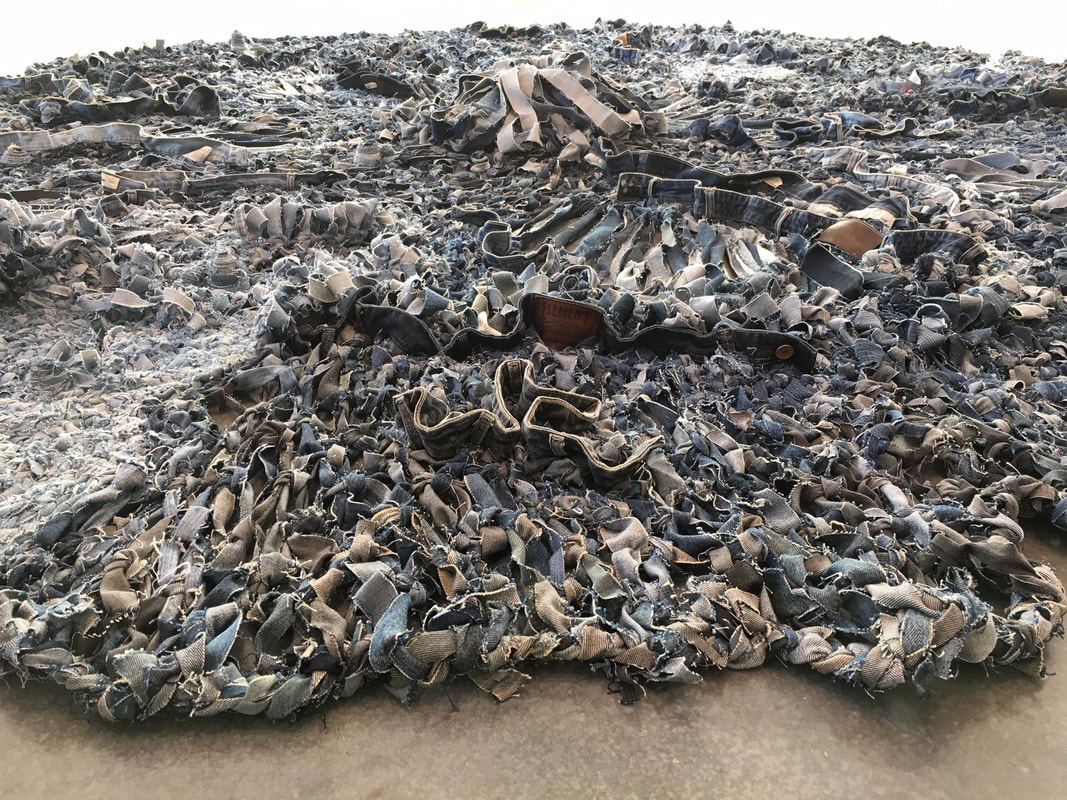
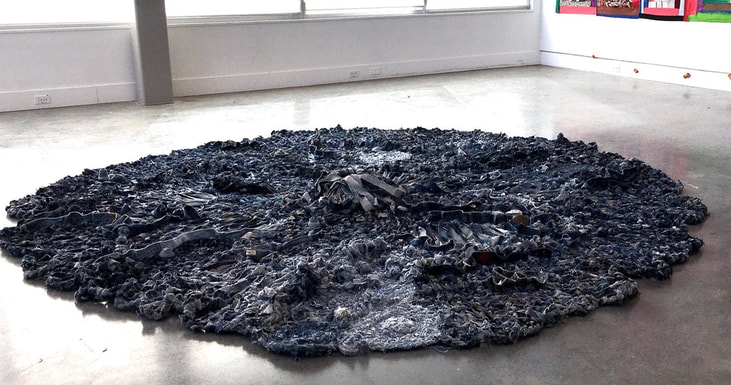
'Resurge' is inspired by the palette of the West Coast foreshore where it began.
Picture
Spanning 12 feet in diameter and grounded to the floor, 'Resurge' troubles distinctions between utility craft and visual art.

3. Hearth

Picture
'Hearth' serves as a visual archive of five months of community hand-stitching sessions at kitchen tables and art studios.
Picture
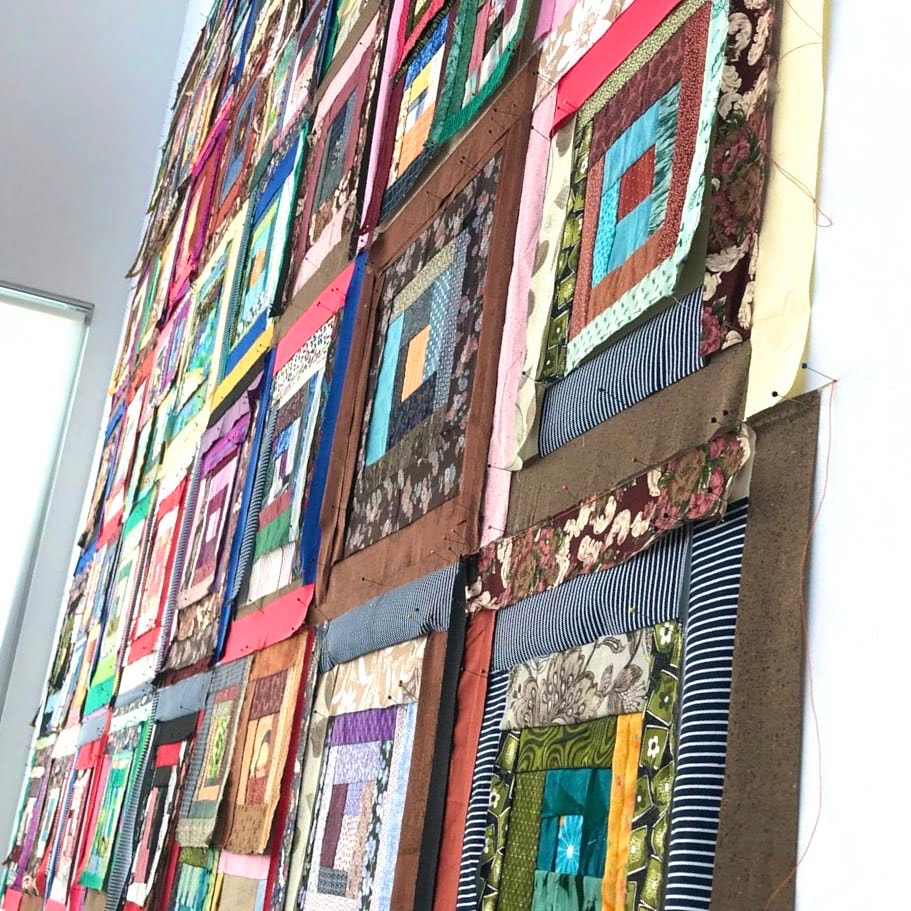
A close-up view of the wall installation reveals provisionally-composed strips of fabric and sewing pins framing the several dozen hand-stitched "log cabin"-style quilt blocks by many hands.
Picture
The simple blocks were made by artists and members of the community at large during five months of open weekly sessions.

Hoping for heat in this log cabin 

11/5/2019

Comments

 
I have this idea for building healthy community in this pretty/cold city through hand-making. It’s a process of making peace with ourselves and connecting with others, transforming individualized desires (thanks, capitalism) into shared desires for a sustainable life and world.
PictureVancouver artist Jenn Skillen — collaborator No. 1 — beta-tests a freeform, no-measure hand-stitched log cabin block method. (Carlyn Yandle photo)
That's the idea. 'How' is the big question.
​
I start with a few rules of thumb. (I love that phrase for its controversial origin that is a deep-dive into human history and etymology, but also for the visual of the hand-as-tool.)  First, the activity must be low-barrier enough to open it up to as much collaboration as possible — no need for special skills or equipment or fees or even shared verbal language. Second, the project must use only found material: freely available, with no better use (because there's already too much stuff in the world). Third, the project must spark interest, otherwise, why would people bother?

A decade ago, these rules of thumb resulted in The Network, an ever-growing public fibre-art piece engaging a wide variety of folks around Vancouver, co-created by Debbie Westergaard Tuepah. That knotty piece continues to weave through my work, mummifying a perfectly good painting practice, winding around ideas of alternative space-making, shelter, and safety nets. Now it's needling into my current project: the Safe Supply collaborative quilt. 

'Safe supply' were the two words on the lips of the crowd at a  CBC Town Hall gathering two months ago. Providing a safe supply of opioids would go a long way to addressing all the problems and fears raised by everyone from student activists to local businesses, from concerned politicians and developers to Indigenous elders: the toxic-drug death epidemic, violence, homelessness, sexual exploitation, theft, vandalism, mental illness. A safe supply is inherent in the view of addiction as a public health issue, not an individual, moral failing.

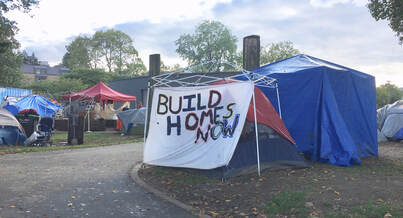
Picture'Kettling' homeless people into Oppenheimer Park has resulted in a colourful display of a national humanitarian crisis. (Carlyn Yandle photo)
Ground zero of this humanitarian crisis is the colourful, chaotic tent city crowded in Oppenheimer Park straddling Chinatown and the old Japantown. The sight of all those bright, tenuous shelters layer up with this history of racism and injustice, stolen land and lives, and soon I am binding up ideas of found colourful material and that call for Safe supply!, embedding it all in a design, with designs for this as a group project destined for exhibit in more privileged spaces. It is planned as a comforting activity in this often ruthless, discomforting city: a dis-comforter.

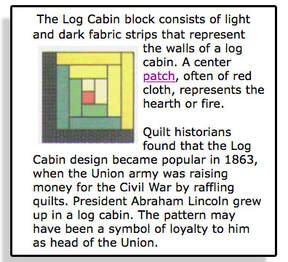
PictureHistorical clipping from the llinois State Museum website reveals the log cabin quilt has ties to ending slavery.
I begin this overarching theme one block at a time, and that block is, fittingly, the traditional 'log cabin.'

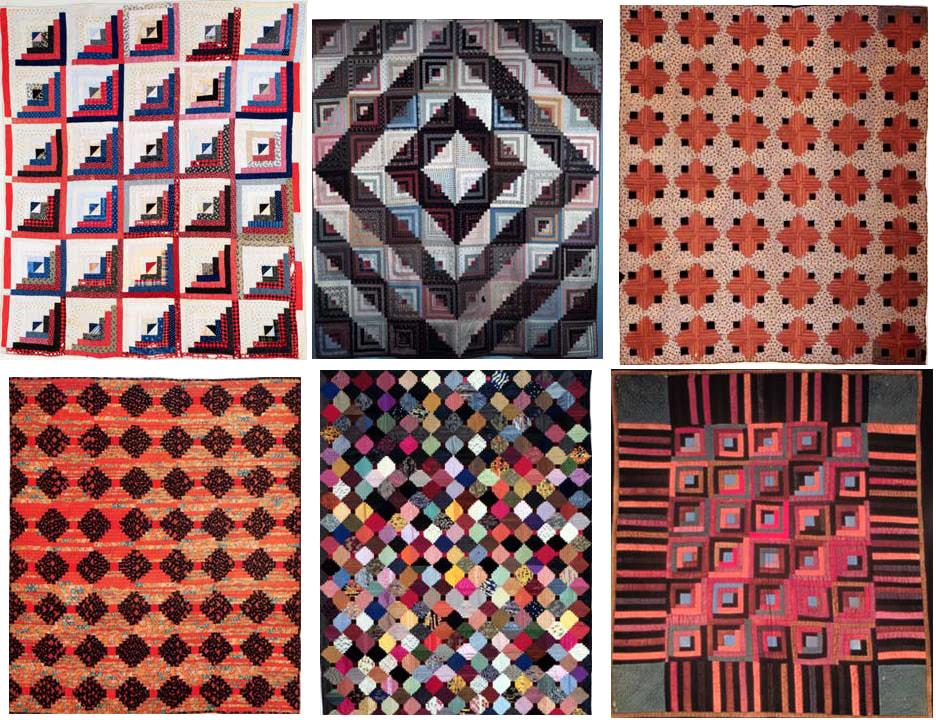
There's a long history of the log cabin block, ingenious for its simple construction that makes use of even the smallest, thinnest available scraps as well as its history as a vehicle for social justice.

I am attracted to the name that stands as aspiration for home and all that that entails, beginning with the hearth, the centre of the block. From the hearth, the block is built in a spiral of connected scraps to form a foundation for countless quilt designs (traditional examples below).

The work has not yet begun but like all collaborations it begins with faith in people and trust in my practice. Something will emerge. We will engage. We will generate some heat in this log-cabin community.

Some useful how-tos and overall pattern examples:

Picture
Traditional quilts made from colour variations of the log cabin block (clockwise from left): Straight Set, Barn Raising, Light & Dark, Courthouse Steps, Courthouse Steps Variation, Amish Crib Quilt. (From http://www.museum.state.il.us)
Comments
    Cross-posted at
    carlynyandle.substack.com

    browse by topic:

    All
    Abject
    Abstract
    Abstract Embroidery
    Abstraction
    Abstract Painting
    Abundance
    Accumulations
    Acrylic
    Activism
    Additive
    Aesthetics
    Agency
    AgentC Gallery
    Aging
    Alison Woodward
    Aluminum
    Amanda Wood
    Anxiety
    Appropriation
    Arcade Fire
    Architecture
    Arleigh Wood
    Art
    Art Activism
    Art Blog
    Art Business
    Art Discourse
    Art History
    Artifact
    Artist
    Artist Residency
    Artist Statement
    Artist Talk
    Art Marketing
    Art Quilt
    Arts And Crafts
    Art School
    Art Show
    Art Spiegelman
    Assemblage
    Author
    Banksy
    Bauhaus
    Beauty
    Betsy Greer
    Big Data
    Billy Patko
    Binding
    Blogs
    Blog Tour
    Bob Krieger
    Body Of Work
    Books
    Boro
    Braided Rug
    Braiding
    Bruce MacKinnon
    Bruce Mau
    Building
    Bull Kelp
    Burlap
    Business
    Buttons
    Canadian Artist
    Carlyn Yandle
    Caroline Eriksson
    Cartoon
    Ceca Georgieva
    Challenge
    Charley Yandle
    Children
    Christmas
    Cindy Sherman
    Circular Thinking
    Cirque Du Soleil
    City As Site
    City Planning
    Cityspace Gallery
    Clay Yandle
    Climate Change
    Cluster
    Cob
    Cob Oven
    Collaboration
    Collage
    Collection
    Colonialism
    Color
    Colour
    Commission
    Community
    Community Building
    Composition
    Conceptual Art
    Conceptual Craft
    Connection
    Connie Sabo
    Construction
    Coronavirus
    Cosplay
    Costume
    Counter Culture
    Counter-culture
    Cover
    Cover-19
    Covid
    Craft
    Craft Blogs
    Craft Camp
    Craftivism
    Crafts
    Craftsmanship
    Creative Process
    Critique
    Crochet
    Cross-stitch
    Cultural Hub
    Cultural Studies
    Culture
    Culture Jamming
    Culturejammingc9d75664fd
    Current Conditions
    Cycling
    Dafen Village
    Dallas-duobaitis
    Dance
    Data-graphic
    Data-graphic
    David Weir
    Dear Human
    Decorations
    Deep Craft
    Denim
    Denyse Thomasos
    Design
    Digital Art
    Discomforter
    Display
    Dissent
    Distraction
    Distracts
    DIY
    Doilies
    Doily
    Domestic
    Domestic Interventions
    Douglas-coupland
    Draw Down
    Drawing
    Dressed
    Drip By Drip
    DSquared2
    Dude-chilling-park
    Dyeing
    Dystopia
    Eastend
    Eastside Culture Crawl
    ECUAD
    ECUAD MFA
    Editorial
    Edward Burtynsky
    Eggbeater Creative
    Embellishment
    Embroidery
    Emily Blincoe
    Emily Carr Cozy
    Emily Carr University
    Entanglements
    Environment
    Environmental Art
    Exhibit
    Exhibition
    Expanded Painting
    Experimentation
    Exploration
    Expression
    Fabric
    Fabricating
    Fabrication
    Facebook
    Failure
    Fashion
    Fashion Revolution
    Fast Fashion
    Feminisim
    Feminist
    Feminist Art
    Festival
    Fiber
    Fiber Artist
    Fiber Arts
    Fibre
    Fibre Arts
    Film
    First Saturday Open Studios
    Flo
    Flow
    Forage
    Foraging
    Form
    Form And Function
    Foundlings
    Found Materials
    Found Objects
    Fractal
    Fracture
    Free Store
    Fuckwit
    Fuzzy Logic
    Gallery
    Gallery-row
    Garden
    Gardening
    Garment
    Gathering
    Gentrification
    Geometric Art
    Gill Benzion
    Gingerbread
    Globalization
    Glue
    Goblin Core
    Grad 2020
    Graffiti
    Grannycore
    Granny Square
    Granville-island
    Green Space
    Grid
    Grief
    Guanajuato
    Guerrilla Art
    Guerrilla Girls
    Halloween
    Handmade
    Handmaking
    Hand Stitching
    Hand-stitching
    Handwork
    Hashtags
    Haywood Bandstand
    Healing
    Health
    Hearth
    Heirloom
    Hideki-kuwajima
    Hoarding
    Homelessness
    Homemade
    Hot Art Wet City
    Housing
    Hybrid Thinking
    Ian Reid
    Ian Wallace
    Ideas
    Identity
    Images
    Imagination
    Immersive Art
    Improvisation
    Incomplete Manifesto For Growth
    Industrial Design
    Industry
    Innovation
    Inspiration
    Instagram
    Installation
    Installation Art
    Intervention
    Intrusive Thoughts
    Invention
    Irena Werning
    Ironing
    Janet Wang
    Jeans
    Jeff Wilson
    Joel Bakan
    Joseph Beuys
    Joseph-wu
    Journalism
    Joyful Making In Perilous Times
    Joyfulmakinginperiloustimes
    Judith Scott
    Kamala Harris
    Kids Art
    Kim Piper Werker
    Kimsooja
    Kintsugi
    Knitting
    Knots
    Knotting
    Kyoto
    Labor
    Labour
    LA Fires
    Landon Mackenzie
    Landscape
    Leanne Prain
    Lecture
    Lighthouse
    Linen
    Liz Magor
    Log Cabin
    Logo Sweater
    LOoW
    Lost Painting
    Lumiere Festival
    Lynda Barry
    Macrame
    Maker
    Making
    Making Is Connecting
    MakingIsConnecting
    Malcolm Gladwell
    Male Gaze
    Mapping
    Maquette
    Marie Kondo
    Marine Palette
    Marketing
    Mark Lewis
    Martha Rosler
    Martha Stewart
    Masks
    Material Exploration
    Mathematics
    Maya
    Media
    Meditation
    Meditative
    Mending
    Mend In Public Day
    Mental Health
    Metalworker
    MFA
    Mister Rogers
    Mixed Media
    Mobile Art Practice
    Monique Motut-Firth
    Monster
    Monte Clark
    Mosaic
    Motivation
    Mt. Pleasant Community Centre
    Mud Girls
    Mural
    Mushroom
    Mycelium
    Narrative
    Natalie Jeremijenko
    Nature
    Needlework
    Neon
    Net
    Network
    Networking
    Neuroplasticity
    New Forms Festival
    Newspapers
    Nick Cave
    Noah Goodis
    Nodes
    North Vancouver
    Obtrusive Thoughts
    Omer Arbel
    Online Talk
    Openings
    Organization
    Origami
    Overabundance
    #overthinking
    Paint
    Painting
    Pandemic
    Paper
    Paper Sculpture
    Papier Mache
    Parkade Quilt
    Patchwork
    Patriarchy
    Pattern
    Pecha Kucha
    Pechakucha
    Perception
    Perfectionism
    Performance
    Performance Art
    Personalispolitical
    Photography
    Playing
    Political Art
    Political Satire
    Polly-apfelbaum
    Pompidou
    Poodle
    Pop-Up
    PopUp
    Port Coquitlam
    Portrait
    Practice
    Process
    Production
    Profession
    Project
    Protest
    Protest Art
    Psychedelic
    Public Art
    Pussy Hat
    Pussy-hat
    Qr Code
    Quilt
    Quilt Block
    Quilting
    Quilt Painting
    Rachael Ashe
    Rachel Lafo
    Ravages
    Raw Materials
    Rebar
    Recycle
    Recycling
    Reflection
    Reflektor
    Reimagine
    Renewal
    Repairing Is Caring
    RepairingIsCaring
    Repetition
    Research
    Residency
    Resistance
    Resurge
    Retreat
    Re-use
    Rhonda Weppler
    Richard-tetrault
    Richmond Art Gallery
    Right Brain
    Rondle-west
    Roses Against Violence
    Rote Activity
    Rug
    Ryan-mcelhinney
    Safe Supply
    Safety
    Sampler
    Sarah-gee-miller
    Sashiko
    Saskatchewan
    Scaffolds
    Scaffolds I
    Scale
    Scraps
    Sculpture
    Seasonal Decor
    Seattle Art Museum
    Seaweed
    Seismic Rug
    Semiotics
    Sewing
    Seymour Art Gallery
    SharingIsCaring
    Sharon Kallis
    Shawn Hunt
    Shigeru Ban
    Sketchup
    Slow Craft
    Smocking
    Social Art
    Socialart
    Social Distancing
    Social Distancing Hat
    Social Engagement
    Social-engagement
    Social History
    Social Justice
    Social Media
    Soft Sculpture
    South-granville
    Space Craft
    Spore
    Stitching
    Storage
    Street Art
    Studio
    Styrophobe
    Substack
    Subversive Stitch
    Surrealism
    Surrey
    Tactical Frivolity
    Tactility
    Tagging
    Talking Art
    Tapestry
    Tatjana Mirkov-Popovicki
    Tattoo
    Teamlab
    Technology
    Terry Fox Theatre
    Text
    Textile
    Textile Art
    Textiles
    Thrifting
    Thrift Stores
    @tinypricksproject
    Tiny Pricks Project
    TJ Watt
    TO DO
    Tools
    Toronto Design Offsite
    Toybits
    Trash
    Trash Art
    Travel Art
    Trevor Mahovsky
    Trump
    Typography
    Tyvek
    Unbridled
    Unfixtures
    Unravel
    Upcycle
    Upcycling
    Urban Design
    Use Object
    Use Objects
    Utility
    Value Village
    Vancouver
    Vancouver Art Gallery
    Vancouver International Airport
    Video
    Video Tour
    Visual Artist
    Visual Field
    Visual-field
    Visual Language
    Wabi-sabi
    Wallace Stegner House
    Wall Hanging
    Waterwork
    Wearable Art
    Weaving
    William Morris
    Women's March
    Wood
    Wool
    Work Wraps
    Wrap I
    Wrap II
    Writing
    Xenobia Bailey
    Yarn Bombing
    YVR
    Zaha Hadid
    Zendoodle
    Zero Waste Art
    Zero-waste Art

    Archives

    January 2026
    December 2025
    November 2025
    September 2025
    May 2025
    April 2025
    March 2025
    January 2025
    December 2024
    November 2024
    October 2024
    September 2024
    August 2024
    July 2024
    June 2024
    October 2022
    August 2022
    June 2022
    November 2021
    April 2021
    September 2020
    April 2020
    December 2019
    November 2019
    September 2019
    August 2019
    July 2019
    June 2019
    April 2019
    November 2018
    July 2018
    May 2018
    November 2017
    September 2017
    June 2017
    April 2017
    March 2017
    February 2017
    December 2016
    November 2016
    September 2016
    July 2016
    March 2016
    February 2016
    January 2016
    December 2015
    November 2015
    October 2015
    September 2015
    June 2015
    May 2015
    April 2015
    March 2015
    February 2015
    January 2015
    December 2014
    November 2014
    October 2014
    September 2014
    August 2014
    July 2014
    June 2014
    May 2014
    April 2014
    March 2014
    February 2014
    January 2014
    December 2013
    November 2013
    October 2013
    September 2013
    August 2013
    July 2013
    June 2013
    May 2013
    April 2013
    March 2013
    February 2013
    January 2013
    December 2012
    November 2012
    October 2012
    September 2012
    August 2012
    July 2012
    June 2012
    May 2012
    April 2012
    March 2012
    February 2012
    January 2012
    December 2011
    November 2011
    October 2011
    September 2011
    August 2011
    June 2011
    May 2011
    April 2011
    March 2011

Powered by Create your own unique website with customizable templates.
Picture