carlyn yandle
  • about
  • the creative process
  • crafted objects
  • public art
  • painting
  • exhibitions
  • contact

Wild, brilliant colour is rocking my concrete-grey foundations

11/17/2017

Comments

 
Picture
PictureA wall of a Peruvian restaurant in Merida, Mexico is devoted to customers' reviews written on ribbons. Carlyn Yandle photo
Modern science calls it bunk but I am fully on board with chromotherapy, an alternative medicine branded by the labcoats as a pseudo-science. The preferred term is photobiology now, an acknowledged science that includes the indisputable benefits of light therapy. I prefer the more mystical "chromotherapy" because it's less about rational explanations and more about feeling. And, for the synaesthesiasts (more specifically, those of us who experience chromesthesia), the beautiful music.

Consider these accompanying images from southern Mexico. Bask in the warmth of these visual fields of wild, intense, unrestrained, unleashed colour jumping out of our monochromatic devices.

PictureA sewing notions store display of zippers in Merida, Mexico. Carlyn Yandle photo
Still in my first couple of weeks here in the Yucatan, I am bobbing around the crowded city streets, slack-jawed at what just may be the direct opposite palette of a Vancouver B-Line bus on any given November rush hour. My outlook has shifted from a low-level, gunmetal-grey resignation to a hot-fuchsia/blood-orange exhilarating mixto, all from looking at the zipper selection in a notions shop (of which there are plenty and another reason for exhilaration), or a glimpse into a hot-pink and aquamarine courtyard restaurant.

But it's not all feel-good. I am seduced by vibrant art and I use it to seduce in my own making: first the beauty, then the crack in the beauty. It's working when I think, "This is pretty and pretty horrifying."

PictureBright, hand-stitched floral motifs on everyday clothing say more for the Mayans than "pretty." Carlyn Yandle photo
If colour didn't entice then Walt Disney could have saved himself the price of acres of paint and Disneyland would be just metal and asphalt. The superstore cereal aisles would look like a newspaper periodicals library. You get the monochromatic picture.

Colour is a social statement in the bright, face-framing embroidered embellishments around a huipil (blouse) worn by mainly older women, or the brilliant woven blanket hanging from a balcony of a colonial facade. There is some needling in all that needlework, but without the dazzling hues we might not clue into the significance.


All this visual heat here in the southern part of North America is creating my own little inner unrest, clashing with my northern hometown palette of bruisey skies infinitely mirrored through the city's colourless glass towers. My concrete-grey foundations are being rocked. And I like it.
Picture
A dazzling woven blanket appears to appropriate the space of colonialist architecture, in Merida, Mexico. Carlyn Yandle photo
Picture
Courtyard restaurants in Merida's downtown entice diners with fiesta-hued interiors. Carlyn Yandle photo
Comments

A beautiful craftivism in a flowery part of the world

11/8/2017

Comments

 
Picture
MORE THAN DECORATION: Flower images carry deep cultural significance for the Maya. Left: A figure dating from 600-900bc nestled in a lily. Centre: Needlepoint detail from a huipil (top), part of a traditional everyday dress. Right: Jesus emerging from a lily in an oil painting of the Immaculate Conception. Carlyn Yandle photos
I've made it my mission to shake things up by injecting the handmade domestic — doilies, quilts, sweaters and rugs — into austere, authoritative spaces and places, from pristine galleries to sketchy undersides of my city, pushing back on everyday misogynistic descriptors like 'girly' or 'old-lady' or the slightly derogatory 'frou-frou' and 'flowery.'

Then I landed in Merida, Mexico, last week where there is no fight against things flowery and archetypical feminine. Here in the capital of the Yucatan state and the ancient Maya culture (not dead but flourishing against all odds, by the way, like Canada's indigenous people) the streets are a flowery visual field of richly needleworked garments and handmade decorative traditions woven throughout the city, from tiled floors to architectural details and murals.
Above and far right: Carpet-like ceramic tile floor artworks are more than decorative. At left, a four-petal flower signifies universal realms; Centre: Merida's impressive El Gran Museo Del Mundo Maya pays tribute to the importance of the handmade floral motif in one of its exhibit salons. Carlyn Yandle photos


Flowers are so sacred and symbolic in the highly complex Maya culture that the Franciscan missionaries, in service of the Catholic Church, appropriated specific flower designs in their battle for their souls, in a cultural war of the roses (and lilies and other healing, spiritually-weighty blooms).
Picture
Left: This rare depiction in oil of Fray Francisco de Santa Ana appeals to the Mayan sense of the sacred. At right, typical religious imagry is embellished with rich floral motifs in a visual appropriation of Mayan culture. Carlyn Yandle photos
Coming from the land of yoga pants, I'm fascinated by this idea that an acceptable form of everyday dress is one's own hand-stitched art piece in the form of brightly-coloured cultural patterns of flowers on white cotton or linen tops and tunics, over an underskirt edged in a thick band of white lace.


No made-in-China. No apologies, no fading away.
Picture
Comments

Am I blue? Yes, and grey and silver too

3/29/2017

Comments

 
“Your hair seems blue,” a friend noted over dinner.
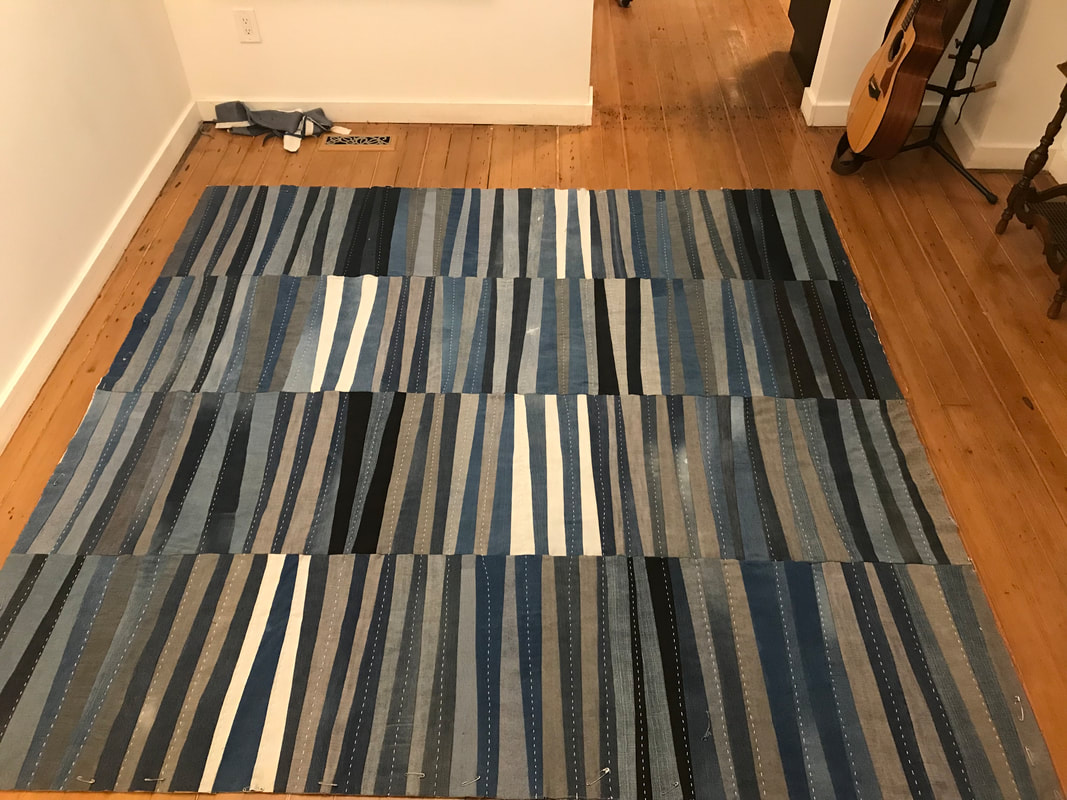
It really is. I’ve joined the blue-rinse gang — emphasis on the blue. Denim blue is an unnatural hair hue that seems only natural now that I'm surrounded by heaps of old jeans and altering all those tones of denim. As usual, I’m not questioning why, but how: how to add some pleasing form to a traditional working fabric; how to infuse some lacy aspect into that utilitarian cloth.
Picture
What I do see is that after four months exposed to the bright colours of urban Mexico and the glare of the garish new Trump era, I am thirsty for cool, serene tones and patterns of rain-soaked skies and coastal stones rolled smooth by the sea. I returned to discover that I am, in fact, attached to the world of hot-water bottles, mugs of tea and toasty quilts, the coziness against the cold.
 
Blue is my touchstone: something real and eternal to cling to in these uncertain, unfathomable times. I may be seduced by sun-baked yellow, spicy red, lethal lime green and sunset pink but my deep, serene dreams are all denim blue.

(For a sample of my 
blue-jean fabrications, check out my other site, Workwraps.weebly.com)

Below: Recent experiments with denim include dousing doilies in bleach and imprinting them on on jeans before cutting for quilts.
Picture
Impression of two overlapping doilies on a pair of jeans.
Picture
Detail of the lacy traces through the bleaching process.
Picture
Samples of experiments with different dilutions of bleach, duration and fabrics.
Picture
A roll of quilt binding made from three denim shirts.
Comments

Big painting shift at little house on the prairie

9/19/2016

Comments

 
PictureDay 12 painting: Embroidered details in a scene of a newly "thrashed" hay field.
I've just returned from a month in the big country of southwest Saskatchewan: big skies, big farming operations, big empty days that were all too much at the start of my artist residency at the Wallace Stegner House.

Suddenly agoraphobic, I pulled down all the blinds and paced around that lovely century-old house, wondering what on earth possessed me to throw myself into this imposing patchwork landscape. I am not a landscape painter; that's my dad's bag.

Plus I came by plane and an eight-hour car ride, so even if I did want to paint, I didn't have my usual large stretched canvases and totes of paints. I did bring a few of my usual travel essentials: embroidery hoops, needles and floss — and an old bed sheet. I knew there was just a couple of stores in town, and none would be selling art supplies so I packed a tiny travel set of liquid acrylics, a few brushes and a pad of mixed-media cardstock.

My sketchy plan involved, well, sketching with my father, who has spent some of every summer in this tiny town of Eastend ever since he filled the Stegner House with his landscape paintings 15 years ago.

We were quite a pair: me, not at all comfortable with the whole plein-air tradition, and him, increasingly unfamiliar with his life's work of painting that involved biking into the country to sketch then returning to his basement to paint in the heat of the day. (Actually we were mostly a trio, his wife acting as facilitator for whatever this was, supplying us with water bottles, sunhats, sketch pads and willow charcoal, and generally getting us on the road.)

We circled around this vague idea of mine as we circled around this dead-quiet, struggling little town every morning. But the awkwardness turned to anguish back at my studio as I undertook the tedious pursuit of finding some interest — or even the point — in painting puffy clouds and dun-coloured hills.

A week later and out of sheer frustration at my lack of landscape-painting prowess, I resorted to dropping diluted paint on a taut scrap of bedsheet in an embroidery hoop just to watch it bleed. I threw the first painted scrap away and did another, with a little more intention, then threw that away too. Within a couple of hours I figured out the right water-to-paint ratio to create a slightly controlled bloom with each stroke. A lot of other distracted behaviour (baking apple crisps, walking by the river, venting via text to my artist friends) meant that each additional stroke was added to a dried layer and by the end of the afternoon, a landscape was emerging on a miniature stretched canvas. That one I didn't throw out. But it was still a little hazy. That's when I thought about using my stash of embroidery floss for final line work. 

I sat in the cool of the front screened porch that evening and embroidered some more information onto the painting. It was a clumsy first effort but soon I was enjoying the daily practice of biking in the morning with my father, painting something inspired by the ride in the afternoon, then embroidering some details in the evening, inviting others to join me for stitching sessions on the front porch.

I did this every day until I had 12 little paintings, each a progression from the last. I saw them as blocks for a future quilt, which led to a well-attended culminating exhibit, "Scenes from a Quilted Landscape."

But now I'm viewing them as something beyond a quilt and beyond the horizon. I'm calling them Points of Interest: something to build on and build with.


As with all creative pursuits, forcing solutions is futile. My original idea of coaxing my father back into his painting studio by getting him to share some of his process with me was a non-starter. These days he finds everyday joy in the moment, whether that is spotting a hawk while biking the backroads, playing a languid rendition of The Girl from Ipanema on piano in the hot afternoons, or watching the town's many cats on the prowl from the front porch of the Stegner House while his wife and I embroidered the summer evenings away.

I'm not sure if he knew it but he passed on to me the most valuable lesson for painting a scene: You have to actually see it.


Picture
My first effort: a clunky rendition of the Wallace Stegner House
Picture
Day 2: Black bridge behind the Stegner House, in black stitches
Picture
Day 3: Fun with architectural detail and embroidered lettering
Picture
Day 4: Sky and hills and embroidered sunflowers facing the morning sun
Picture
Day 5: Our hangout: coffee shop and pottery studio, surrounded by gardens
Picture
Day 6: The silty back roads, llike biking on velvet. (Wheel-seizing "gumbo" when wet)
Picture
Day 7: Embroidery showing the flight path of a hostile hawk
Picture
Day 8: Big skies and tiny grain elevator
Picture
Day 9: Old Beaver Lumber building in the nearby almost-ghost town
Picture
Day 10: The observatory, in some of the darkest skies in Canada
Picture
Day 11: "The Town of Eastend" rock formation in the hills, in embroidery

Slide-showing the process:

Comments

From disaster to 'Discomforter': 5 lessons learned

5/15/2015

Comments

 
Picture
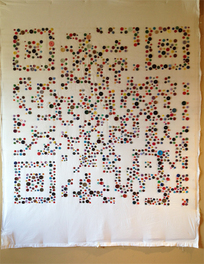
There is really no way to know whether a blanket covered in brightly coloured buttons will read until the very end of all the work so I wanted to build in the likelihood of failure. That's how I came to decide on "The devil is in the details" as the line of text that would appear on a QR code reader. If it didn't read successfully at least it would prove the rule.

But it wasn't as simple as that. The details that bedevilled me began with my big idea to use masking tape to indicate the grid instead of tailor's chalk (too dusty), disappearing-ink marker (fades too quickly) or basting (tedious).

That tape plan might have worked if I had removed it in a timely manner, like within a few days or even weeks. But when you pull masking tape off of fine white cotton sheeting after 13 months you are left with a hard, yellowed embedded adhesive residue. You scrape it, scrub it, attack it with solvents and still it does not un-adhere. In desperation, you ball up the entire quilt and chuck it into the washing machine, despite the raw edges and exposed batting. When it comes out in a tight mass of threads and shrunken batting you curse your hare-brained impulsiveness. You let out a little scream when you realize that the colours from many of those buttons have inexplicably run, bleeding all over the white cotton.  (Lesson 2: Research your materials.) At this point you roll yourself up into a little ball and go fetal in a corner somewhere until you're ready to rejoin humanity.

I knew going into my second QR Quilt project that there was a very good chance that after sewing more than 1,000 buttons into three layers of fabric the pattern may not be recognized by the QR code reader. But I also knew that I had a fighting chance after the surprising success of the readable QR Quilt: After Douglas Coupland. My quilt version of his painting, I Wait and I Wait and I Wait for God to Appear proved that a quilt composed of scraps of coloured business shirts and scattered buttons could contain a message as easily as the typical black and white grid. After several weeks of piecing over 1,000 squares together into one queen-sized square I stood back, aimed my phone at the quilt, and prayed. The sentence appeared, like a message from god.

I wanted that euphoria again. I needed it. (Lesson 1: Avoid great expectations.)
Picture
You eventually decide that the title has suddenly gained poignancy (Lesson 3: Embrace unexpected results) so you pick away at the binding selvedge threads from the quilt-ball until you can hang the wet, lead-apron-heavy slab of fiber and plastic to dry for several days. You start to notice that the sheeting is puckering from the shrinking and is sagging from the weight of all that hard plastic in this queen-sized quilt of the damned. Turns out some of those buttons were of some early plastic vintage that were painted after they were fabricated. (Who knew?)

You attempt to find salvation from a bottle of stain-remover -- Out, damned spot! Out, I say!  -- but it looks worse. The next time you have the nerve to look at this fabricated failure you notice that -- praise the lord -- the bleaching agent has worked -- sort of. You stipple-quilt out the sags and bags and the rest of the discolouration disappears -- also sort of. You trim it square and bind it in black with a devil-may-care attitude. After it's finished you realize that the stippling was essential for creating enough rigidity to prevent the buttons from sagging when it hangs. You like the resulting topography. (Lesson 4: Innovate solutions.)

Then you air the whole sordid story on your blog, knowing that sharing the anguish is part of the process, though you regret you don't have any images that would give the full impact of the horror story. (Lesson 5: Photodocument the process, even failure.)

The title of this work is Discomforter (The Devil is in the Details). It's a cumbersome title befitting this project that took me to the edge of my sanity, or at least close enough to see that there is in fact an edge and I know I can't go there again.

Picture
Comments

Nothing new on halloween, and that's a good thing

10/31/2014

Comments

 
What do you do when one of your closest friends is in the hospital with complications and the weather outside is the perfect visual for seasonal depression? You make!

And so I devote this column to the silly business of making and make-believe in trying times. 

First, let me say that Halloween is my kind of holiday. It is an intoxicating cocktail of glue guns and spontaneity, material-hacking and thrift-store-hopping, laced with peanut-butter cups and just a smidge of anti-consumerism.

It all sounds a bit contradictory but after a lifetime of costume-making I've pretty much found the place I need to find a little meaning in this sugar-cranked occasion.

It starts in late September, that one time of year when the little people in my life are willing to share their full-throttle imaginations (before their emerging Inner Critic begins to outshout them).

Then I strike out for my usual haunts (thrift shops, ReStore) with an opportunistic eye. My rules for costume-making have been distilled down to one:  'nothing new.' Except for tools and fasteners (glue, thread, pins etc.) all the fabrics and bits must have already finished their first use. There is more than enough stuff already in existence without creating a new market; it's just a matter of moving goods from their past use (clothing, construction scraps, bolt-ends) to my costume purposes. 

Finally, there is the fabrication stage, which may or may not involve the tykes in question, depending on age. I encourage them to at least draw something about the costume they envision, or be 'in the manner of' to help me conceive it. I will make a portion of the costume early on for them to play with (business types would call this a progress meeting) and revise as I/we go.

For the price of some semi-toxic treat from their loot bag, I will ensure the costume will be durable and comfy enough for dancing and leaping around during their sugary highs.

To wit, we have three-year-old Mimi's costume this year. She showed me that she needed to be a lock-kneed, arms-extended robot so I scoured the second-hand aisles in search for a way to create the all-important illusion of stiffness. A small bundle of metalic-polyfiber pipe insulation found at the VGH Thrift Store on Broadway and Main fit the bill, coupled with a metallic girls' sweater and silver shoes from the nearby SallyAnn. I found the other bits around the apartment: a couple of unlistenable CDs, metal washers, jar lids, orange wire nuts and silver buttons she selected from my button jars. (Not shown: the extendable treat can made from accordion air duct tubing.)
Picture
PictureDem bones get another daylighting, on another nephew. (Yandle family photos)
I invest some effort in my costumes so that they are durable enough to be passed on to some other kid and have even spotted my handiwork worn, often in new ways, by neighbourhood kids I've never met.

Not a Halloween goes by when someone (always a woman) will say to me, "You have too much free time." It's one of those jokey putdowns but now that I've embraced making full time, I see that throwaway comment for what it is. Mister Rogers sang it to me when I was a kid and I sing it when I'm making with kids: I like to take my time.


My costumes have nothing to do with perfection or approval but are a maker's way of engaging with kids to play in a whole new way before they are fully seduced by the marketing complex.

Like the Mister says, you can think about things and make-believe; all you have to do is think and they'll grow.

Comments

QR button blanket: Epic fail or a larger reading?

3/21/2014

Comments

 
Picture
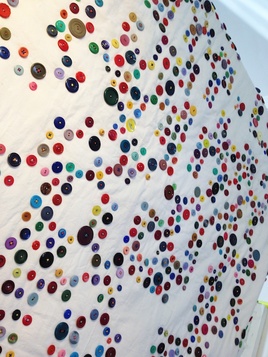
After three months of sewing one donated button after another into a giant QR code, the big moment arrived this week: time to stand back and scan that baby with a reader app, translating this quilt-thing to read, "The devil is in the details."

Except it didn't read. Don't panic!, I thought, then spent the entire next day working with a photo image of the QR Button Blanket, Photoshopping in more buttons and darker buttons and bigger buttons, trying to add the minimum amount of density for the software program to register the pattern and work its magic to produce the punchline. No luck; even a sliver of white in one button cluster puts a wrench in the wholecloth works. I filed this one under the category of Epic Fail, not worth finishing it as intended, framing it in black bias binding. I do not want to create something that is 'still' good; I want the thing to be good, full stop.
Picture
Failure demands confronting the why. Why conceive such a laborious, risky project in the first place?  Why endure the painstaking process when half-way through it was becoming abundantly clear that this was not going to 'read'?

But there is another power here, and that's tied to the process beyond the product. The achievement may lie in the endurance (in an increasingly A.D.D. world) that is not necessarily attached to the product after all. It may be in seeing it through, without the promise of a sure result. The power may lie in the humble, everyday materials and the community of women who contributed all those bits of plastic saved from the waste stream. (There should really be a global ban on production of billions of plastic buttons. Plant-based plastic, bone, wood, and leather- or fabric-wrapped tin buttons eventually return to the earth.)

But what's really starting to click in for me is the cultural reference of this button-grid design. A decade ago, it might have been viewed as an oddly arranged colour field or an abstracted grid but we're so acclimatized to codes that the pattern begs to be 'read.' The fact that this is irresolvable might be annoying. And that's interesting. 
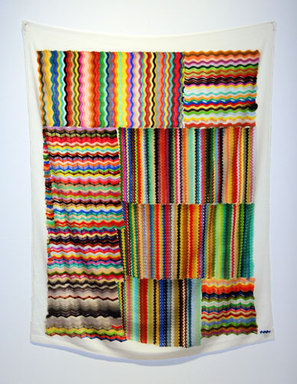
PictureWavy Gravy, marker on synthetic velvet, 58" x 43"
The possible multiple references could be more engaging than the one answer provided by a QR reader app. There's something to be learned in the discomfort of the open-endedness.

Moments like these, I seek out the artists who have embraced what New York artist Polly Apfelbaum calls the 'tough beauty' of visually exciting works that incorporate everyday materials in surprising ways. Apfelbaum, who calls herself a bad crafter, articulates the process of hard work in this video. 

"I work all the time," she says, without a schedule and in a highly experimental way. "You make the work and then you hope for the best." 

 "It's very important to get your fuck-you back."

I'm going with that.
Comments

Designs on the halter dress-tool belt combo

1/30/2014

Comments

 
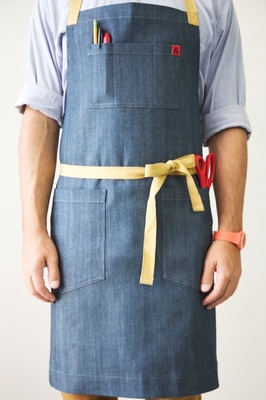
PictureThe denim Dakota, from hedleyandbennett.com
Most people will admit that their everyday clothes are a sort of uniform.  We need to keep it pretty simple because we're likely dressing in the dim of the still-dark morning when we'd rather spend those extra minutes sleeping.

My own uniform is basically a T-shirt, tights and boots under what I view as a Western-secular abaya — a wrap sweater, long hoodie or whatever else is lying around — and a raincoat. Just this side of 'not crazy' and pretty functional for weekdays at the studio.

It's taken some trial and error to figure out how to adapt this bike-friendly getup to a day of painting or carving or casting or sewing, climbing up and down ladders or working on the floor. I need a combo toolbelt and day dress, something I can switch out with the sweater-abaya thingy.

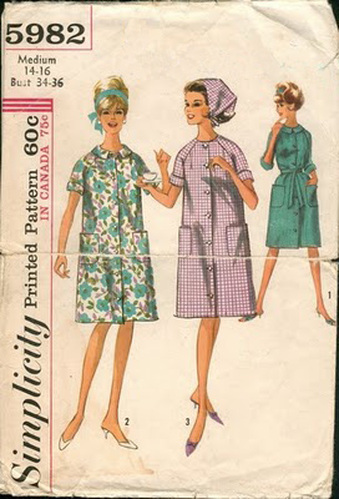
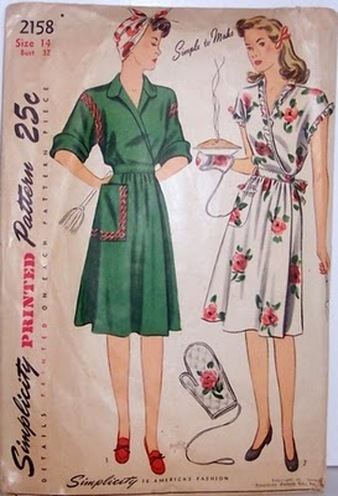
These designs take time. You need to walk a mile in a maker's apron to figure out how it needs to function. That's what former culinary school grad Ellen Bennett did. As a cook she saw the need that led to her own L.A.-based online business, Hedley and Bennett. I'm inspired, and denim is definitely the way to go. The tool pockets are essential but the backless style doesn't work over tights. I need me a work dress.

Back in the day, women had housework dresses, but they were a little too light duty. Sewing one up in denim would basically create a lab coat, and I hate to be encumbered by sleeves. I'm thinking more halter dress than coat.

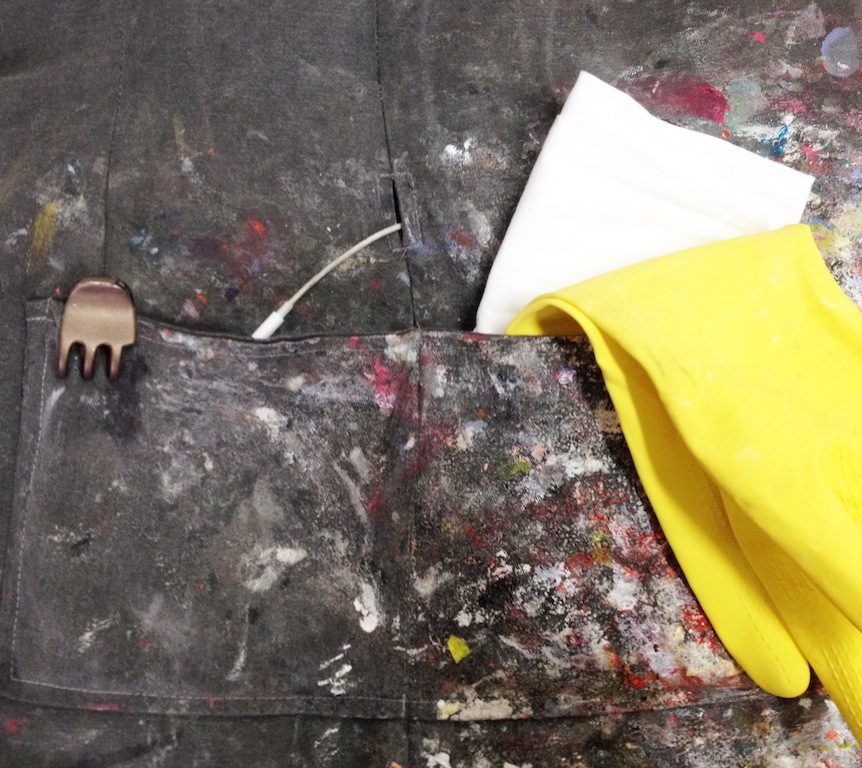
Back to the drawing board. I need big front and side pocket-compartments for the brushes, Xacto knife, painting rags, latex gloves, hair clip, micro computer/stereo system and some sort of accommodation for earbuds to enable hands-free operation of said iPhone.  I was following my instincts, obeying my gut, but this was all starting to sound a little familiar. I was conjuring up the maximum-convenience garment version of The Homer.

Picture
 

Picture
 

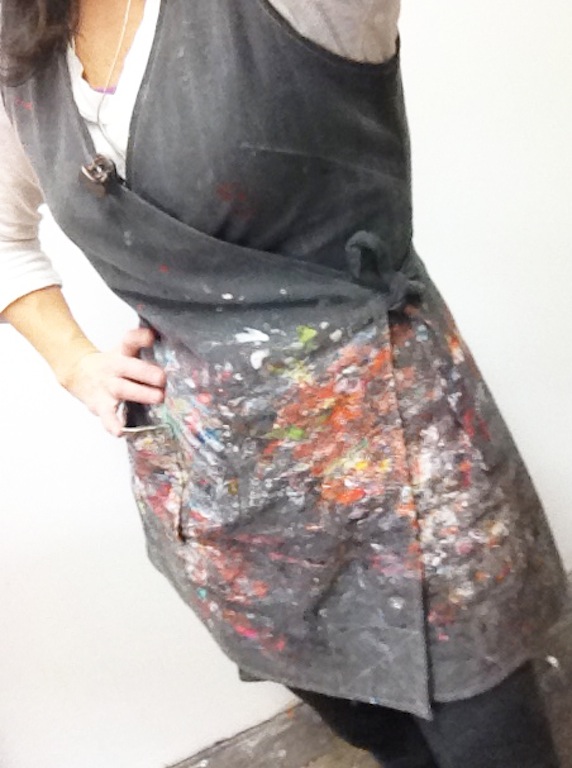
Like all enduring design, function trumps form, and it takes a lot of mulling to simplify that form. I separated the 'must haves' from the 'nice to haves' and finally settled on sewing up a durable grey denim wrap dress, for ease of movement, with right-side tool/communication pockets.

My beta version is now encrusted with more than a year's worth of paint and gesso so it's a good time to roll out Work Dress 2.0. I still like the wrap design but I can see the top section should pull over the head apron-style so I can use that upper front real-estate for slim pockets for the pointy tools that don't sit pretty in side pockets when I'm sitting. Oh yes, and it needs to be made out of old jeans, pockets and all.

I may be taking orders for the Work Dress by next year, or not taking any orders on what is appropriate daywear.
Picture
The beta version of the workers' wrap dress.
Picture
Earbuds buttonhole above the side back pocket: check.
Comments

Just a bad craft? Time and techonology will tell

11/29/2013

Comments

 
Picture
I'm posting this picture because if I don't do it now I might cram this doomed project into a green garbage bag and stuff it where the sun don't shine: in deep storage.

 I've seen through some fraught, laborious projects in my time but I may have met my match. After months of hoarding buttons and hounding others to surrender their button jars "for art's sake" I'm thisclose to admitting this thing is a colossal waste of time.

The plan was to create a companion piece to my QR Quilt: After Douglas Coupland, a scrappy quilt translation of the artist's QR Code Paintings.

This new one will be a 'whole-cloth' quilt, where only the buttons would bind the layers. And of course it will be readable with a QR code reader app. Trouble is, since I designed this coded button blanket last year I'm starting to think that QR codes are a fleeting technology, like the fax machine. The geeky chatter on the interwebs also tells me so . So, in a few years when the industrial marketing complex has made the stampede over to some  other state-of-the-art attention-grabbing software schtick, the whole point of this project will be rendered obsolete. How did I not see the futility of trying to grapple with fleeting technology through a painstakingly slow craft method?

The inner negator has been bullying me throughout week one of sewing one found button after another onto my marked grid. It's not helpful realizing that in the unlikely event that I have selected the correct colours to read black, and have sewn in enough button-density to create a readable pattern, I'm still left with an unwashable, lead-apron-heavy quilt. I can't even dedicate it as a shroud in my final wish for a sustainable green burial, as my corpse would be cocooned in all that non-biodegradable plastic poundage.

This is normally the time when I call for reinforcements in the form of artist friends, who will invoke the usual mantra: 'Trust the process, trust the process.'

I get it and I'm going with it. See it through. One button at a time, one day at a time. The week-one picture is posted. There's no pretending it's all still just a concept. This matter of time, technology and endurance matters.


Comments

A potent show of Fabric unfolds at the Vancouver Art Gallery

10/11/2013

Comments

 
PictureKimsooja with curator Daina Augaitis
Internationally renowned artist Kimsooja was verklempt at the opening reception for her show, Unfolding, at the Vancouver Art Gallery Thursday. 

Her audience would soon feel that emotion unfolding as the soft-spoken artist led a tour of the new exhibit that runs to Jan. 26.

Revisiting some 30 years of her deeply personal works, with her son and other close family and friends in attendance, was clearly overwhelming for the Korean-born New York artist , who recently wrapped up another wrapping at the Venice Biennale. 

'Overwhelming' is a good descriptor for the show, too. 

Bright, satiny boulder-like mounds presented in the Bottari tradition of wrapping gifts in colourful fabrics contain material scraps the artist retrieved from the Tsunami-struck region of Japan. 

Picture
Visitors feel the unfolding of a singular vulnerability in a cavernous room as simultaneous video screenings reveal the artist standing still in a crowded street in various urban corners of the Earth. 


PictureThe mix of rusty, worn mechanical objects and brilliant satin fabrics is a visual feast.
Another room featuring truck overloaded with a heap of colours evokes displacement or an unwieldy migration.

This retrospective is a reminder of the potency of found fabric, a culturally embedded material that can be a medium for painting or sculpture, often at the same time, as Kimsooja does so powerfully.

The artist raises those stakes by making material a metaphor for the wrapping and unwrapping, the enfolding, the unfolding, the concealing and exposing that resonates long after leaving the gallery.

A performance of Kimsooja's A Beggar Woman (see video clip, below) is set for Nov. 29 as part of Fuse.

Comments
<<Previous
Forward>>
    Cross-posted at
    carlynyandle.substack.com

    browse by topic:

    All
    Abject
    Abstract
    Abstract Embroidery
    Abstraction
    Abstract Painting
    Acrylic
    Activism
    Additive
    Aesthetics
    Agency
    AgentC Gallery
    Aging
    Alison Woodward
    Aluminum
    Anxiety
    Appropriation
    Arcade Fire
    Architecture
    Arleigh Wood
    Art
    Art Activism
    Art Blog
    Art Business
    Art Discourse
    Art History
    Artifact
    Artist
    Artist Residency
    Artist Statement
    Artist Talk
    Art Marketing
    Art Quilt
    Arts And Crafts
    Art School
    Art Show
    Art Spiegelman
    Assemblage
    Author
    Banksy
    Bauhaus
    Beauty
    Betsy Greer
    Big Data
    Billy Patko
    Binding
    Blogs
    Blog Tour
    Bob Krieger
    Body Of Work
    Books
    Boro
    Braided Rug
    Braiding
    Bruce MacKinnon
    Bruce Mau
    Building
    Bull Kelp
    Burlap
    Business
    Buttons
    Canadian Artist
    Carlyn Yandle
    Caroline Eriksson
    Cartoon
    Ceca Georgieva
    Challenge
    Charley Yandle
    Children
    Christmas
    Cindy Sherman
    Circular Thinking
    Cirque Du Soleil
    City As Site
    City Planning
    Cityspace Gallery
    Clay Yandle
    Climate Change
    Cluster
    Cob
    Cob Oven
    Collaboration
    Collage
    Colonialism
    Color
    Colour
    Commission
    Community
    Community Building
    Composition
    Conceptual Art
    Conceptual Craft
    Connection
    Connie Sabo
    Construction
    Coronavirus
    Cosplay
    Costume
    Counter Culture
    Counter-culture
    Cover
    Cover-19
    Covid
    Craft
    Craft Blogs
    Craft Camp
    Craftivism
    Crafts
    Craftsmanship
    Creative Process
    Critique
    Crochet
    Cross-stitch
    Cultural Hub
    Cultural Studies
    Culture
    Culture Jamming
    Culturejammingc9d75664fd
    Current Conditions
    Cycling
    Dafen Village
    Dallas-duobaitis
    Dance
    Data-graphic
    Data-graphic
    David Weir
    Dear Human
    Decorations
    Deep Craft
    Denim
    Denyse Thomasos
    Design
    Digital Art
    Discomforter
    Display
    Dissent
    Distraction
    Distracts
    DIY
    Doilies
    Doily
    Domestic
    Domestic Interventions
    Douglas-coupland
    Draw Down
    Drawing
    Dressed
    DSquared2
    Dude-chilling-park
    Dyeing
    Dystopia
    Eastend
    Eastside Culture Crawl
    ECUAD
    ECUAD MFA
    Editorial
    Edward Burtynsky
    Eggbeater Creative
    Embellishment
    Embroidery
    Emily Blincoe
    Emily Carr Cozy
    Emily Carr University
    Entanglements
    Environment
    Environmental Art
    Exhibit
    Exhibition
    Expanded Painting
    Experimentation
    Exploration
    Expression
    Fabric
    Fabricating
    Fabrication
    Facebook
    Failure
    Fashion
    Fashion Revolution
    Fast Fashion
    Feminisim
    Feminist
    Feminist Art
    Festival
    Fiber
    Fiber Artist
    Fiber Arts
    Fibre
    Fibre Arts
    Film
    First Saturday Open Studios
    Flo
    Flow
    Forage
    Foraging
    Form
    Form And Function
    Foundlings
    Found Materials
    Found Objects
    Fractal
    Free Store
    Fuckwit
    Fuzzy Logic
    Gallery
    Gallery-row
    Garden
    Gardening
    Garment
    Gathering
    Gentrification
    Geometric Art
    Gill Benzion
    Gingerbread
    Globalization
    Glue
    Goblin Core
    Grad 2020
    Graffiti
    Grannycore
    Granny Square
    Granville-island
    Green Space
    Grid
    Grief
    Guanajuato
    Guerrilla Art
    Guerrilla Girls
    Halloween
    Handmade
    Handmaking
    Hand Stitching
    Hand-stitching
    Handwork
    Hashtags
    Haywood Bandstand
    Healing
    Health
    Hearth
    Heirloom
    Hideki-kuwajima
    Homelessness
    Homemade
    Hot Art Wet City
    Housing
    Hybrid Thinking
    Ian Reid
    Ian Wallace
    Ideas
    Identity
    Images
    Imagination
    Immersive Art
    Improvisation
    Incomplete Manifesto For Growth
    Industrial Design
    Industry
    Innovation
    Inspiration
    Instagram
    Installation
    Installation Art
    Intervention
    Intrusive Thoughts
    Invention
    Irena Werning
    Ironing
    Janet Wang
    Jeans
    Jeff Wilson
    Joel Bakan
    Joseph Beuys
    Joseph-wu
    Journalism
    Joyful Making In Perilous Times
    Joyfulmakinginperiloustimes
    Judith Scott
    Kamala Harris
    Kids Art
    Kim Piper Werker
    Kimsooja
    Kintsugi
    Knitting
    Knots
    Knotting
    Kyoto
    Labor
    Labour
    LA Fires
    Landon Mackenzie
    Landscape
    Leanne Prain
    Lecture
    Lighthouse
    Linen
    Liz Magor
    Log Cabin
    Logo Sweater
    LOoW
    Lost Painting
    Lumiere Festival
    Lynda Barry
    Macrame
    Maker
    Making
    MakingIsConnecting
    Malcolm Gladwell
    Male Gaze
    Mapping
    Maquette
    Marie Kondo
    Marketing
    Mark Lewis
    Martha Rosler
    Martha Stewart
    Masks
    Material Exploration
    Mathematics
    Maya
    Media
    Meditation
    Meditative
    Mending
    Mend In Public Day
    Mental Health
    Metalworker
    MFA
    Mister Rogers
    Mixed Media
    Mobile Art Practice
    Monique Motut-Firth
    Monster
    Monte Clark
    Mosaic
    Motivation
    Mt. Pleasant Community Centre
    Mud Girls
    Mural
    Mushroom
    Mycelium
    Narrative
    Natalie Jeremijenko
    Nature
    Needlework
    Neon
    Net
    Network
    Networking
    Neuroplasticity
    New Forms Festival
    Newspapers
    Nick Cave
    Noah Goodis
    North Vancouver
    Obtrusive Thoughts
    Omer Arbel
    Online Talk
    Openings
    Organization
    Origami
    #overthinking
    Paint
    Painting
    Pandemic
    Paper
    Paper Sculpture
    Papier Mache
    Parkade Quilt
    Patchwork
    Patriarchy
    Pattern
    Pecha Kucha
    Pechakucha
    Perception
    Perfectionism
    Performance
    Performance Art
    Personalispolitical
    Photography
    Playing
    Political Art
    Political Satire
    Polly-apfelbaum
    Pompidou
    Poodle
    Port Coquitlam
    Portrait
    Practice
    Process
    Production
    Profession
    Project
    Protest
    Protest Art
    Psychedelic
    Public Art
    Pussy Hat
    Pussy-hat
    Qr Code
    Quilt
    Quilt Block
    Quilting
    Quilt Painting
    Rachael Ashe
    Rachel Lafo
    Ravages
    Raw Materials
    Rebar
    Recycle
    Recycling
    Reflection
    Reflektor
    Reimagine
    Renewal
    Repairing Is Caring
    RepairingIsCaring
    Research
    Residency
    Resistance
    Resurge
    Retreat
    Re-use
    Rhonda Weppler
    Richard-tetrault
    Richmond Art Gallery
    Right Brain
    Rondle-west
    Roses Against Violence
    Rote Activity
    Rug
    Ryan-mcelhinney
    Safe Supply
    Safety
    Sampler
    Sarah-gee-miller
    Sashiko
    Saskatchewan
    Scaffolds
    Scaffolds I
    Scale
    Scraps
    Sculpture
    Seasonal Decor
    Seattle Art Museum
    Seaweed
    Seismic Rug
    Semiotics
    Sewing
    SharingIsCaring
    Sharon Kallis
    Shawn Hunt
    Shigeru Ban
    Sketchup
    Slow Craft
    Smocking
    Social Art
    Socialart
    Social Distancing
    Social Distancing Hat
    Social Engagement
    Social-engagement
    Social History
    Social Justice
    Social Media
    Soft Sculpture
    South-granville
    Space Craft
    Spore
    Stitching
    Storage
    Street Art
    Studio
    Styrophobe
    Subversive Stitch
    Surrealism
    Surrey
    Tactical Frivolity
    Tactility
    Tagging
    Talking Art
    Tapestry
    Tattoo
    Teamlab
    Technology
    Terry Fox Theatre
    Text
    Textile
    Textile Art
    Textiles
    Thrifting
    Thrift Stores
    @tinypricksproject
    Tiny Pricks Project
    TJ Watt
    TO DO
    Tools
    Toronto Design Offsite
    Toybits
    Trash
    Trash Art
    Travel Art
    Trevor Mahovsky
    Trump
    Typography
    Tyvek
    Unbridled
    Unfixtures
    Upcycle
    Upcycling
    Urban Design
    Use Object
    Use Objects
    Utility
    Value Village
    Vancouver
    Vancouver Art Gallery
    Vancouver International Airport
    Video
    Video Tour
    Visual Field
    Visual-field
    Visual Language
    Wabi-sabi
    Wallace Stegner House
    Wall Hanging
    Waterwork
    Wearable Art
    Weaving
    William Morris
    Women's March
    Wood
    Wool
    Work Wraps
    Wrap I
    Wrap II
    Writing
    Xenobia Bailey
    Yarn Bombing
    YVR
    Zaha Hadid
    Zendoodle
    Zero Waste Art
    Zero-waste Art

    Archives

    September 2025
    May 2025
    April 2025
    March 2025
    January 2025
    December 2024
    November 2024
    October 2024
    September 2024
    August 2024
    July 2024
    June 2024
    October 2022
    August 2022
    June 2022
    November 2021
    April 2021
    September 2020
    April 2020
    December 2019
    November 2019
    September 2019
    August 2019
    July 2019
    June 2019
    April 2019
    November 2018
    July 2018
    May 2018
    November 2017
    September 2017
    June 2017
    April 2017
    March 2017
    February 2017
    December 2016
    November 2016
    September 2016
    July 2016
    March 2016
    February 2016
    January 2016
    December 2015
    November 2015
    October 2015
    September 2015
    June 2015
    May 2015
    April 2015
    March 2015
    February 2015
    January 2015
    December 2014
    November 2014
    October 2014
    September 2014
    August 2014
    July 2014
    June 2014
    May 2014
    April 2014
    March 2014
    February 2014
    January 2014
    December 2013
    November 2013
    October 2013
    September 2013
    August 2013
    July 2013
    June 2013
    May 2013
    April 2013
    March 2013
    February 2013
    January 2013
    December 2012
    November 2012
    October 2012
    September 2012
    August 2012
    July 2012
    June 2012
    May 2012
    April 2012
    March 2012
    February 2012
    January 2012
    December 2011
    November 2011
    October 2011
    September 2011
    August 2011
    June 2011
    May 2011
    April 2011
    March 2011

Powered by Create your own unique website with customizable templates.
Picture